
Why is the Russian missile campaign targeting Ukraine's steel industry?
Russia's systematic targeting of metallurgical plants aims to dismantle the economic foundation of the Ukrainian state. By striking these industrial hubs, the campaign seeks to cut off foreign export revenue, prevent the payment of taxes and wages, and destabilize the social fabric of major industrial cities. Oleksandr Myronenko, chief operating officer of Metinvest, stated that the objective is to stop Ukraine from securing the funds necessary to maintain its economy and ensure its citizens have jobs.
Beyond the economic motive, there is a strategic military dimension to these strikes. Russia has justified its actions by alleging that plants in Zaporizhzhia and Kryvyi Rih are used to manufacture military hardware. This creates a cycle of destruction where the very materials needed for Ukraine's defense and future reconstruction—steel for military equipment, shelters, and infrastructure repair—are being systematically eliminated.
How has the destruction of Zaporizhstal affected the local community?
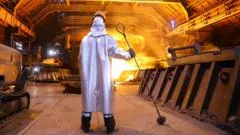
The indefinite shutdown of the Zaporizhstal steelworks has left a massive void in the city of Zaporizhzhia. As the primary employer for 8,500 people, the factory is often described by residents as the "heart of the city." The recent waves of attacks, including two in August and two in September, have caused catastrophic physical damage.
According to Oleksandr Myronenko of Metinvest, Russia fired a total of 17 missiles at the facility. The impact on the infrastructure has been devastating:
- Blast furnaces have been almost completely ruined.
- Equipment has been nearly entirely destroyed.
- Buildings have suffered significant structural damage, including holes in roofs and missing windows.
The human cost is equally severe. The strikes resulted in eight deaths and 31 injuries among the workforce. For workers like Denys Maksyshko, who has worked at the plant for generations, the factory's silence represents a profound loss of identity and livelihood for the entire region.
The struggle to maintain operations during active hostilities
Attempts to maintain even minimal operations have proven nearly impossible due to the persistent threat of air strikes. Oleksandr Vodoviz of Metinvest shared an instance where the company attempted to relaunch Zaporizhstal by restarting a furnace, only for the operation to be interrupted by another strike after just 10 hours. This volatility makes it difficult for companies to justify the massive capital expenditure required for recovery when the survival of the plant remains so uncertain.
What is the broader impact on the Ukrainian economy and GDP?
The metallurgical and mining sectors were historically the backbone of the Ukrainian economy. Before the full-scale invasion in 2022, these industries accounted for approximately 10% of the national GDP and contributed one-third of all exports. The industry was a massive engine for growth, with Stanislav Zinchenko, head of GMK Center, noting that it typically invested between $2 billion and $3 billion annually into the economy.
The decline of this sector has been a gradual process of attrition. Ukraine possessed 12 major metallurgical plants prior to the 2014 conflict. By 2018, that number had dropped to nine, and by 2025, only six remained operational following the loss of key sites like Azovstal and Illich in Mariupol. The recent strikes have now brought the remaining capacity to a near-standstill. Metinvest reports that its own steelworks are currently out of action, and the industry's overall contribution to the GDP has likely plummeted toward zero.
How do these strikes threaten the survival of Ukrainian cities?
The collapse of the steel industry poses a direct threat to the fiscal stability of local governments. In many industrial hubs, the tax revenue generated by metallurgical companies provides the primary funding for essential public services. Stanislav Zinchenko of GMK Center highlights that these companies often fund between 30% and 70% of local government spending.
Without this tax base, municipalities face a catastrophic loss of ability to function. Oleksandr Vilkul, head of the Local Defence Council, emphasized that the loss of these funds impacts:
- The maintenance of critical city infrastructure and heating plants.
- The operation of social services and nursery schools.
- The general municipal budget required for community survival.
This economic vacuum creates a secondary crisis: a potential humanitarian catastrophe. Zinchenko warns that if steelmaking cannot be restored, the resulting mass unemployment could trigger waves of migration that extend far beyond Ukraine's borders.
What obstacles remain for the recovery of the steel sector?
Even if the immediate threat of missile strikes were mitigated, the logistics of steel production remain compromised. The industry faces a multi-front challenge involving transportation, export security, and international trade regulations.
Logistical and trade barriers to production
The physical movement of goods is currently a high-risk endeavor. Russian strikes on railway networks have made domestic transport dangerous and unreliable. Furthermore, the maritime routes used for exports have become a "lethal lottery." Oleksandr Myronenko noted that because ports are under constant threat, the chance of a ship successfully completing an export journey is estimated at only 50%.
Additionally, new economic pressures are emerging from the European Union. The introduction of EU steel import quotas on July 1 may further complicate the ability of Ukrainian producers to access vital markets. This combination of physical destruction, logistical insecurity, and shifting trade barriers suggests that a return to pre-war production levels will be a long and arduous process.
Frequently asked questions
How many people are employed by Zaporizhstal?
Zaporizhstal employs approximately 8,500 people. The indefinite shutdown of the plant due to Russian missile strikes has placed the livelihoods of these workers and their families at significant risk, contributing to broader economic instability in the Zaporizhzhia region.
What was the historical importance of metallurgy to Ukraine?
Before the full-scale invasion, the mining and metallurgical sectors accounted for about 10% of Ukraine's GDP and one-third of its total exports. The industry also provided employment for over half a million people, making it a cornerstone of the national economy.
Why are Russian forces targeting steel plants?
Russia targets these facilities to undermine the Ukrainian economy by cutting off tax revenue and export income. Additionally, Russia alleges that these plants are used to produce military hardware, providing a strategic justification for the strikes.
How does the steel industry affect local city budgets?
Metallurgical companies are major taxpayers. In many host cities, these companies provide between 30% and 70% of the local government's budget, which is used to fund infrastructure, schools, social services, and heating plants.
Can Ukraine restart its steel production easily?
No, restarting production is extremely difficult. Companies face ongoing missile threats, damaged infrastructure like ruined blast furnaces, destroyed railway networks, and the high risk of ship attacks at ports, alongside new EU import quotas.
Key takeaways
- The Ukraine steel industry's contribution to GDP has fallen from 10% to near zero.
- Major plants like Zaporizhstal and ArcelorMittal Kryvyi Rih are currently shut down.
- Metallurgical taxes fund up to 70% of some local municipal budgets.
- Russian strikes have killed at least 13 workers across major steelworks recently.
- Logistical risks include a 50% chance of ship attacks at export ports.
Conclusion
The systematic destruction of Ukraine's steel industry represents more than just industrial loss; it is a targeted strike against the nation's economic and social continuity. By crippling the metallurgical sector, the campaign threatens to bankrupt local municipalities, trigger mass migration, and starve the state of essential export revenue. While workers continue to attempt repairs amidst the rubble, the combination of physical destruction, logistical perils at sea and on rail, and shifting international trade policies creates a daunting path toward recovery. The ability of Ukraine to rebuild its infrastructure and sustain its defense will depend heavily on whether this vital industrial heart can ever be restored.