How does the Oblik system reduce rotational forces?
For decades, helmet safety was judged primarily on direct, linear impacts—how hard a head hits the ground. However, modern research emphasizes that the true danger often lies in rotational movement, which can cause the brain to twist and stretch inside the skull, leading to concussions and severe injuries. While the US Consumer Product Safety Commission (CPSC) still focuses on linear impacts, the industry has moved toward managing rotation.
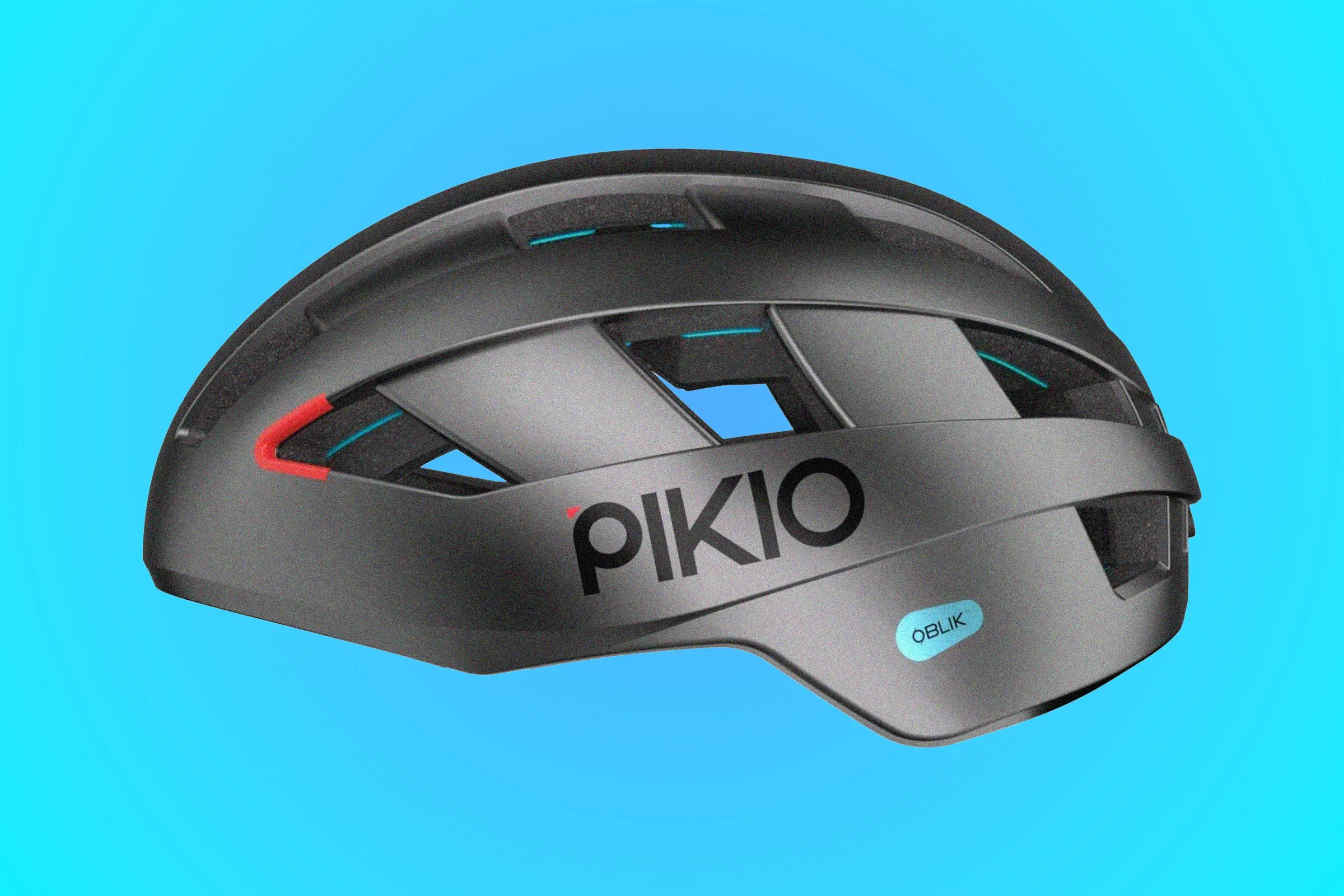
The Oblik design addresses this by fundamentally changing the structure of the helmet's core. Most helmets use a single, continuous block of expanded polystyrene (EPS) foam. Oblik breaks this familiar structure into independently mounted sections rather than one solid piece. Each of these segments attaches to the base EPS layer via flexible connection points, allowing them to move separately or even detach entirely if the helmet sustains a serious impact. When combined with dual-density foam that absorbs direct linear energy, these moving sections work to minimize the twisting forces transmitted to the head. As founder Daniel Abram explains, the system is designed to "deform, deflect, and detach depending on the impact's intensity, location, and direction," providing a multi-layered defense against both linear and rotational energy.
Why did Pikio outperform established helmet technologies?
The cycling industry has seen a massive shift in safety standards, largely driven by Virginia Tech's helmet STAR (Summation of Tests for the Analysis of Risk) ratings. Launched in 2018, these ratings measure both linear and rotational impacts, pushing manufacturers to go beyond the legal minimum. The competition has been fierce; while only four of the first 30 helmets earned five stars, by 2025, 167 of 272 helmets had achieved that mark, forcing Virginia Tech to tighten its grading criteria. This tightening has turned safety into a competitive business advantage.
In this high-stakes environment, the Pikio Si Oblik has emerged as a significant outlier. It holds a 4.61 STAR score, where a score of 10.1 or lower earns a five-star rating. To put this in perspective, Pikio's score is 2.21 points lower than the previous leader, the Canyon Deflectr, which scored 6.82. This 32 percent improvement is massive in a field where many top-tier helmets hover between 7 and 10 points.
Pikio's success comes by taking a different mechanical path than its rivals. The industry standard, MIPS, uses a low-friction layer that allows 10 to 15 millimeters of movement during the first few milliseconds of an impact. Other systems like 6D’s Omni-Directional Suspension (ODS) use nested liners, while WaveCel employs an engineered cellular structure that flexes and glides. Even the Canyon Deflectr’s Release Layer System (RLS) uses external shell panels on polycarbonate ball bearings. While these technologies tackle rotation from the outside or through sliding layers, Oblik manages it through internal segmentation of the foam itself.
What role did founder background play in the design?
The technical leap achieved by Pikio Labs is not a matter of luck, but the result of nearly two decades of specialized research. Founder Daniel Abram brings 18 years of experience in impact protection and helmet design to the startup. After studying mechanical engineering, Abram moved into the academic sphere at Simon Fraser University, where he contributed to the development of BrainShield, a system specifically designed to reduce rotational forces during impacts.
His career has been a continuous progression in helmet intellectual property. He previously founded the technology company BiaGuard, and in 2022, MIPS acquired the patents and intellectual property from that venture for approximately $1 million. This deep expertise in the mechanics of brain protection allowed Abram to approach the Oblik design with a sophisticated understanding of how to manage energy. The biological inspiration for the design is also highly specific: the woodpecker. Woodpeckers are famous for their ability to withstand repeated, high-speed head impacts without suffering concussions, a biological marvel that informed the way Oblik handles impact intensity and direction.
What are the practical trade-offs of the Pikio Si Oblik?
Innovation of this scale comes with a significant price tag. At $379, the Pikio Si is a premium product, costing $219 more than the second-best STAR-tested model, the Canyon Deflectr RLS. This cost is driven by the sheer complexity of the build. While a standard cycling helmet typically consists of eight to 10 individual parts, the Pikio Si is composed of approximately 80 components. The combination of separate foam sections, dual-density construction, and the intricately engineered flexible connection points makes the manufacturing process far more demanding than conventional methods.
From a user perspective, the helmet is a balance of high-tech protection and practical daily use. In a medium size, it weighs 279 grams. While this is respectable, it is not class-leading in terms of lightness. The design is somewhat bulky for a dedicated road helmet, but it offers high comfort with 17 air vents to maintain cooling and a dial-to-fit cradle that provides a secure, pinch-free hold. One notable omission is the lack of a magnetic Fidlock fastening under the chin, a feature many riders prefer. However, Abram noted that this was a deliberate choice to manage weight; a standard buckle weighs only four grams, whereas a Fidlock system adds roughly 13 grams.
To support the product's lifecycle, Pikio also offers a safety-focused replacement program. Because EPS foam is designed to crush upon impact, the helmet must be replaced after a serious accident. To mitigate the cost for riders, Pikio offers a 30 percent discount on a replacement helmet if the customer returns the damaged unit to the company for analysis.
How has real-world performance been reported so far?
While laboratory testing provides the baseline for the STAR ratings, real-world application is the ultimate test of any safety technology. So far, Pikio has seen four helmets returned under their replacement program following serious impacts. According to Abram, each of these instances has proven the technology's efficacy, with the helmets having successfully performed their job of keeping the riders safe.
While these four cases provide encouraging early evidence, the product is still relatively new, and broader long-term field data is still being gathered. The company is looking to expand its footprint quickly, with a second helmet design scheduled for release in early 2027. Whether the company remains a niche premium brand or scales into a major industry player will depend on how this technology is received by the wider cycling community.
FAQ: Pikio Si Oblik helmet
What is the Virginia Tech STAR score of the Pikio Si Oblik?
The helmet records a 4.61 score. In the Virginia Tech rating system, lower scores indicate better performance, making this one of the highest-rated helmets currently available.
How much does the Pikio Si Oblik cost?
The retail price is $379. This represents a significant premium over other high-performing helmets, such as the Canyon Deflectr RLS, which is $219 cheaper.
Does the Oblik system replace MIPS?
It is a different approach rather than a direct replacement. While MIPS uses a low-friction layer to allow movement, Oblik uses segmented internal foam sections to manage rotational and linear energy.
Is the helmet suitable for daily commuting?
Yes. It features 17 vents for airflow and a comfortable dial-to-fit cradle. While it is slightly bulkier than some ultra-light road helmets, it is designed for reliable, comfortable protection.
What happens after a serious impact?
The helmet must be replaced. Pikio offers a 30 percent discount on a new helmet if you return the damaged one to them for evaluation.
Key takeaways
- Pikio Si Oblik achieves a 4.61 STAR score, significantly outperforming the previous best of 6.82.
- The Oblik system uses segmented EPS foam sections to manage rotational forces.
- Founder Daniel Abram has extensive experience, including work on BrainShield and a patent sale to MIPS.
- The helmet's complexity—80 components compared to the standard 8-10—contributes to its $379 price.
- Pikio offers a 30 percent replacement discount for damaged helmets returned for analysis.
- Virginia Tech has tightened safety grading as more helmets achieve five-star ratings.
Conclusion
The Pikio Si Oblik demonstrates that a small, specialized team can disrupt a massive industry by rethinking fundamental design principles. By moving away from the single-block foam model and embracing a segmented, multi-component approach, Pikio has set a new benchmark for what rotational protection can look like. While the premium price and specialized manufacturing present hurdles for mass adoption, the technology has given the cycling industry a new, much higher number to chase.