What does the new Gemini North image reveal about the Pa 30 supernova remnant?
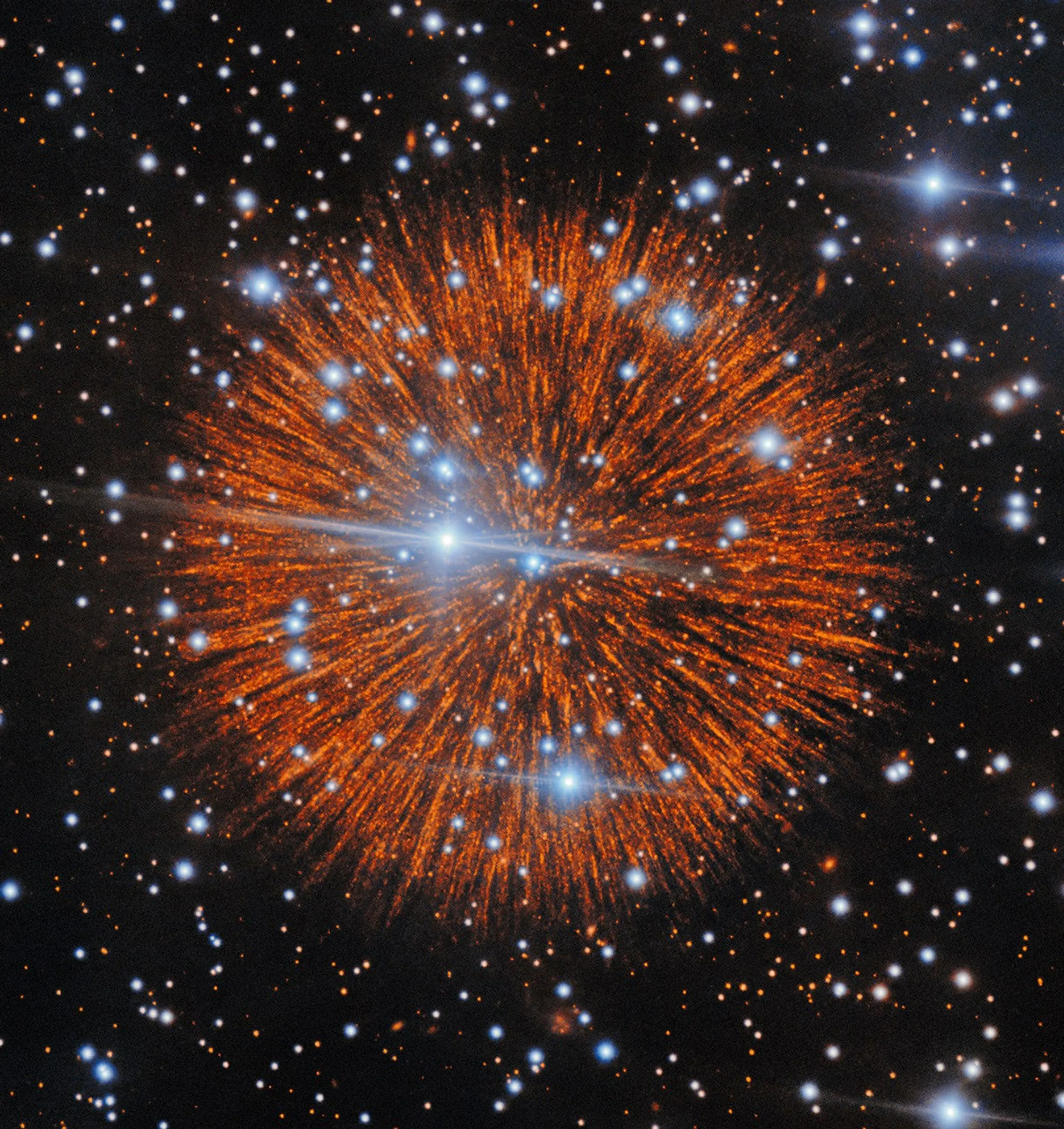
The latest observations of the Pa 30 nebula were obtained with the Gemini Multi-Object Spectrograph on the Gemini North telescope in Hawaii. These new images represent a significant leap in resolution, revealing a spherical arrangement of filaments that previous, lower-resolution images had depicted as smooth, continuous strands. While earlier glimpses of the explosion's remnants captured a sphere of long, filament-like strands resembling fireworks or a dandelion, the new data provides a much more granular view.
The improved resolution has fundamentally changed our understanding of the nebula's architecture. Instead of seeing continuous lines of matter, researchers now see that these filaments are actually composed of discrete segments. They resemble beads on a string, made up of pearl-like knots of gas that are relatively uniform in size. This level of detail is transformative; the new observations revealed approximately ten times more individual structures than any previous glimpses of the supernova remnant. This increased density of visible features allows astronomers to see the true complexity of the ejecta, providing a clearer picture of how material was distributed during the original explosion nearly 800 years ago.
How do the filament structures differ from earlier expectations?
The structural composition of the Pa 30 filaments presents a puzzle for astronomers. In the aftermath of a supernova, the standard scientific expectation is to find much more irregular and chaotic accumulations of material. Typically, the violent ejection of a star's outer layers results in oddly shaped clumps and unpredictable distributions of debris.
The Pa 30 filaments, however, display a striking departure from this expected chaos. They feature a repeating pattern of knots that are remarkably similar in size and appear to be aligned precisely along the filaments. This peculiar order is a new feature that challenges existing models of stellar death. The regularity of these structures suggests an organized ejection process that is not yet fully understood. Researchers are now tasked with determining why the material settled into such a disciplined, bead-like arrangement rather than the turbulent, irregular mass usually associated with such massive cosmic events.
What size comparison helps describe the knots?
The individual components of these filaments, which researchers have described as "cosmic pearls," are truly enormous. According to the study published in The Astrophysical Journal, each bead-like knot measures approximately four light-days in diameter. To put this staggering scale into perspective, the sheer volume of these gas knots is difficult to visualize without a familiar reference point.
Ilaria Caiazzo, a coauthor of the study, provided a comparison to help contextualize the size of these structures. She noted that the entire planetary region of our solar system could fit inside a single one of these knots about ten times, and there would still be room to spare. Despite their massive scale, the knots maintain a striking uniformity across the nebula. This consistency in dimension is a key area of interest for scientists, who are now eager to attempt to model how such massive, uniform concentrations of material could form and persist in the wake of a supernova.
Why is the central star of Pa 30 described as a zombie star?
The Pa 30 nebula is considered particularly unusual because of the nature of its central object. In most cases involving a thermonuclear supernova, the event is a violent, terminal explosion that completely destroys the original star. The star is effectively obliterated, leaving nothing behind but the expanding cloud of debris.
However, Pa 30 defies this rule. Instead of being entirely consumed, the central star appears to have survived the catastrophe, leading scientists to classify it as a "zombie star." This phenomenon—where part of a star may survive its own supernova—is rare, and the underlying reasons for how or why this happens are not yet fully understood. The unusual, organized structures found in the surrounding ejecta may provide the missing pieces of the puzzle. By studying the patterns of the pearls and filaments, astronomers hope to reconstruct more precisely how these specific types of detonations occur and how a star can continue to exist in a compact form after such a massive explosion.
How does the Pa 30 nebula connect to observations recorded in 1181?
Beyond its physical peculiarities, the Pa 30 nebula holds a unique place in human history due to its direct connection to ancient eyewitness accounts. The nebula matches the historical records left by Chinese and Japanese astronomers in the year 1181. These observers documented the sudden appearance of a "new star" in the sky that remained visible for several months.
At the time of the sighting, these astronomers could not have known they were witnessing the light from a massive stellar explosion. It was only centuries later that scientists were able to link that specific historical event to the supernova that gave rise to the Pa 30 remnant we see today. This connection provides a rare bridge between modern high-definition astrophysics and medieval human observation. It allows researchers to study a single cosmic event across nearly a millennium, using historical descriptions to help ground the physical reality of the nebula's origin.
Frequently asked questions
What telescope produced the highest-resolution image of Pa 30?
The Gemini North telescope in Hawaii captured the data using the Gemini Multi-Object Spectrograph, revealing roughly ten times more filament structures than prior observations.
How large are the knots within the Pa 30 filaments?
Each knot measures approximately four light-days in diameter, a scale that could contain the solar system planetary region about ten times over.
Why is the central object called a zombie star?
The core survived the supernova explosion that normally destroys the entire star, leaving a compact remnant whose formation process remains under investigation.
Which historical records match the Pa 30 event?
Chinese and Japanese astronomers in 1181 noted a new star visible for several months; its position aligns with the location of the Pa 30 nebula.
Are the knots expected to be uniform in other supernova remnants?
Standard models predict irregular shapes, so the regular size and alignment seen in Pa 30 represent an unusual feature that may refine understanding of ejection dynamics.
Key takeaways
- The Gemini North telescope produced an image showing about ten times more structures in the Pa 30 remnant than earlier views.
- Filaments consist of uniform knots roughly four light-days across rather than continuous strands.
- The central star survived the explosion and is classified as a zombie star.
- The remnant corresponds to a supernova recorded by Chinese and Japanese observers in 1181.
- The regular knot pattern may help model how material was ejected during the event.
Conclusion
The high-resolution view of Pa 30 supplies vital new structural data on a supernova remnant whose formation was witnessed in the Middle Ages. The discovery of bead-like "cosmic pearls" and the presence of a surviving "zombie star" present measurable, highly unusual features that can be compared against theoretical astrophysical models. As researchers work to model these strikingly uniform knots and investigate the survival of the central core, they move closer to understanding the complex mechanics of stellar death and the rare instances where a star survives its own destruction.