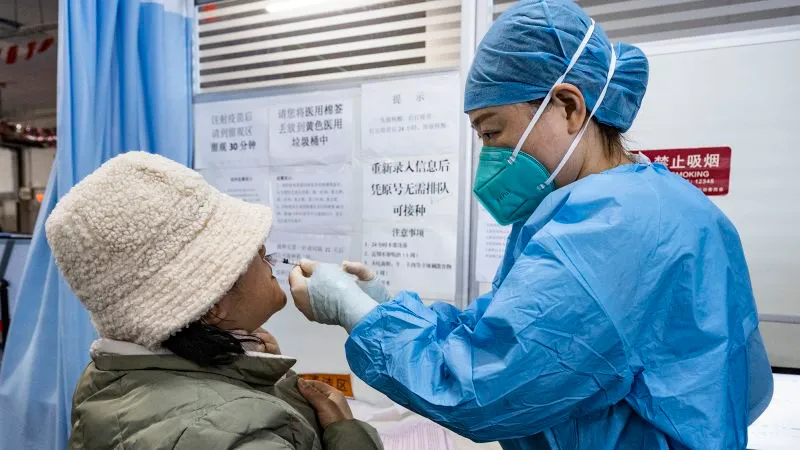
How does a nasal Covid-19 vaccine provide sterilizing immunity?
The nasal vaccine works by inducing sterilizing immunity, a state where the virus is prevented from replicating in the upper respiratory tract. In recent experiments published in Nature Microbiology, researchers found that two doses of a live but weakened coronavirus vaccine blocked the virus from copying itself in the airways of hamsters. This differs significantly from current injectable vaccines, which primarily generate immunity in the bloodstream.
By targeting the mucosal linings of the nose and throat, the vaccine acts as a first line of defense. Emanuel Wyler, a scientist at the Max Delbrück Center for Molecular Medicine in the Helmholtz Association in Berlin, compares this to stationing firefighters directly under a smoke alarm rather than having them stationed miles away. While injected vaccines must travel through the blood to mount a response, mucosal vaccines are already "on site" to eliminate the threat immediately. "If they are already on site, they can immediately eliminate the fire, but if they’re like 2 miles away, they first need to drive there, and by that time, one-third of the house is already in full flames," Wyler said.
The role of IgA antibodies in mucosal defense
A critical component of this localized defense is the production of IgA antibodies. Traditional vaccines typically prime the body to produce IgG antibodies, which are Y-shaped and possess two arms for binding to pathogens. In contrast, IgA antibodies feature four arms, allowing them to grab onto invaders more effectively. Scientists suggest that IgA may also be less specific in its targeting, which could make it more resilient against emerging viral variants compared to the more rigid IgG response.
What is the technology behind the weakened virus approach?
The vaccine utilizes a technique known as codon pair deoptimization to create a live but attenuated version of the virus. This method involves manipulating the genetic material of the coronavirus to make it difficult for cells to translate its instructions. According to Emanuel Wyler, this process makes the viral "text" much harder for the body's cells to read, effectively hobbling the virus without making the host sick. "You could imagine reading a text … and every letter is a different font, or every letter is a different size, then the text is much harder to read. And this is basically what we do in codon pair deoptimization," Wyler explained.
This approach is a modern evolution of a strategy used since the 1870s for vaccines against anthrax and rabies. By using a weakened version of the actual virus rather than just focusing on the spike protein, the immune system is exposed to the entire coronavirus structure. This allows the body to develop a broader array of immune weapons, potentially offering better protection against a wider range of viral components than current mRNA or adenovirus-based injections. In the hamster studies, this live weakened vaccine created a much stronger immune response than either two doses of an mRNA-based vaccine or one that uses an adenovirus to ferry instructions.
Why did the vaccine perform differently against the Omicron variant?
While the vaccine showed high efficacy against the original strain used in the 2021 study, its performance shifted when challenged with the Omicron variant. In hamster models, the vaccine still outperformed other delivery methods, but its ability to neutralize the virus was noticeably diminished. This indicates that while the mucosal approach is robust, the vaccine composition will likely require updates to remain effective against rapidly evolving lineages.
The discrepancy highlights the ongoing challenge of viral evolution. Dr. Greg Poland from the Mayo Clinic notes that the world remains vulnerable to significant shifts in the virus. He argues that the goal should be the development of "pan-coronavirus" vaccines that induce long-lived mucosal immunity, ensuring that a new variant does not return the global response to square one. "All it would take is another Omicron-level shift in the evolution of the virus, and we could be back at square one, with no effective tools against the coronavirus," Poland warned.
What is the current status of nasal vaccine clinical trials?
Several nasal vaccines are currently navigating the complex path toward widespread use, though progress has been described as "slow and halting." According to the World Health Organization’s vaccine tracker, at least four nasal vaccines have reached late-stage testing in humans. While China and India have already rolled out nasal vaccines, the published data regarding their real-world effectiveness remains limited.
Different companies are pursuing various technological paths to achieve mucosal protection:
- Adenovirus-based: Currently used in China and India, these rely on harmless viruses to deliver instructions to cells, though effectiveness data for these has yet to be published.
- Recombinant vaccines: One candidate, being studied at Mount Sinai in New York, can be produced in chicken eggs, similar to influenza vaccines.
- Live attenuated: The German research team is working with the Swiss company RocketVax to begin Phase I clinical trials. Another firm, Codagenix, is also developing a live attenuated version that has seen testing in Africa and South America. The German team is watching the Codagenix data closely to see if this approach is promising.
Challenges in commercialization and safety
The development of these next-generation tools faces significant economic and biological hurdles. High costs associated with bringing new vaccines to market are a barrier, especially as public perception often suggests the vaccine race has already concluded. Furthermore, safety concerns remain regarding live attenuated vaccines. Because they contain a real, albeit heavily weakened, virus, they may not be suitable for everyone. People with very compromised immunity are often cautioned against using live vaccines because even these weakened viruses may be risky. "Although it’s strongly attenuated, it’s still a real virus," Wyler noted.
Key takeaways
- Nasal vaccines aim to provide sterilizing immunity by blocking viral replication in the upper respiratory tract.
- The technology uses codon pair deoptimization to weaken the virus, making it harder for cells to read.
- Mucosal vaccines trigger IgA antibodies, which offer a more robust, four-armed defense than IgG antibodies.
- Current research shows the vaccine is effective in hamsters but requires updates to combat Omicron variants.
- Clinical trials are ongoing for several candidates, including recombinant and live attenuated versions.
Frequently asked questions
How is a nasal vaccine different from an injection?
Nasal vaccines target mucosal immunity in the nose and throat, whereas injections primarily build immunity in the blood. This allows nasal vaccines to act as a localized first line of defense, potentially stopping a virus before it can establish a foothold in the body.
What does "sterilizing immunity" mean?
Sterilizing immunity refers to the ability of a vaccine to prevent a pathogen from replicating at all within the host. In the studied hamster models, this meant the virus could not multiply in the upper airways, effectively halting the infection at the entry point.
Why is codon pair deoptimization used?
Codon pair deoptimization is a genetic technique that makes the virus's genetic code harder for cells to translate. This weakens the virus so it can train the immune system without causing actual disease in the recipient, making it a safe live-attenuated approach.
Are nasal vaccines effective against new variants?
While mucosal vaccines show promise, their effectiveness can vary with new variants. In studies, the vaccine performed well against Omicron but showed diminished neutralization capabilities, suggesting that the vaccine formula must be updated to match evolving viral strains.
Can everyone take a live attenuated nasal vaccine?
No, live attenuated vaccines may not be suitable for everyone, particularly those with severely compromised immune systems. Because these vaccines contain a real, albeit heavily weakened, virus, doctors must exercise caution when prescribing them to vulnerable populations.
Conclusion
The development of nasal Covid-19 vaccines represents a significant shift toward preventing infection at the source rather than merely managing systemic disease. By leveraging mucosal immunity and advanced techniques like codon pair deoptimization, researchers are working to create a more proactive defense against respiratory viruses. While the transition from animal models to human clinical trials remains a complex and costly process, the potential for achieving sterilizing immunity offers a vital pathway to mitigating the impact of future viral mutations and protecting the most vulnerable members of society.