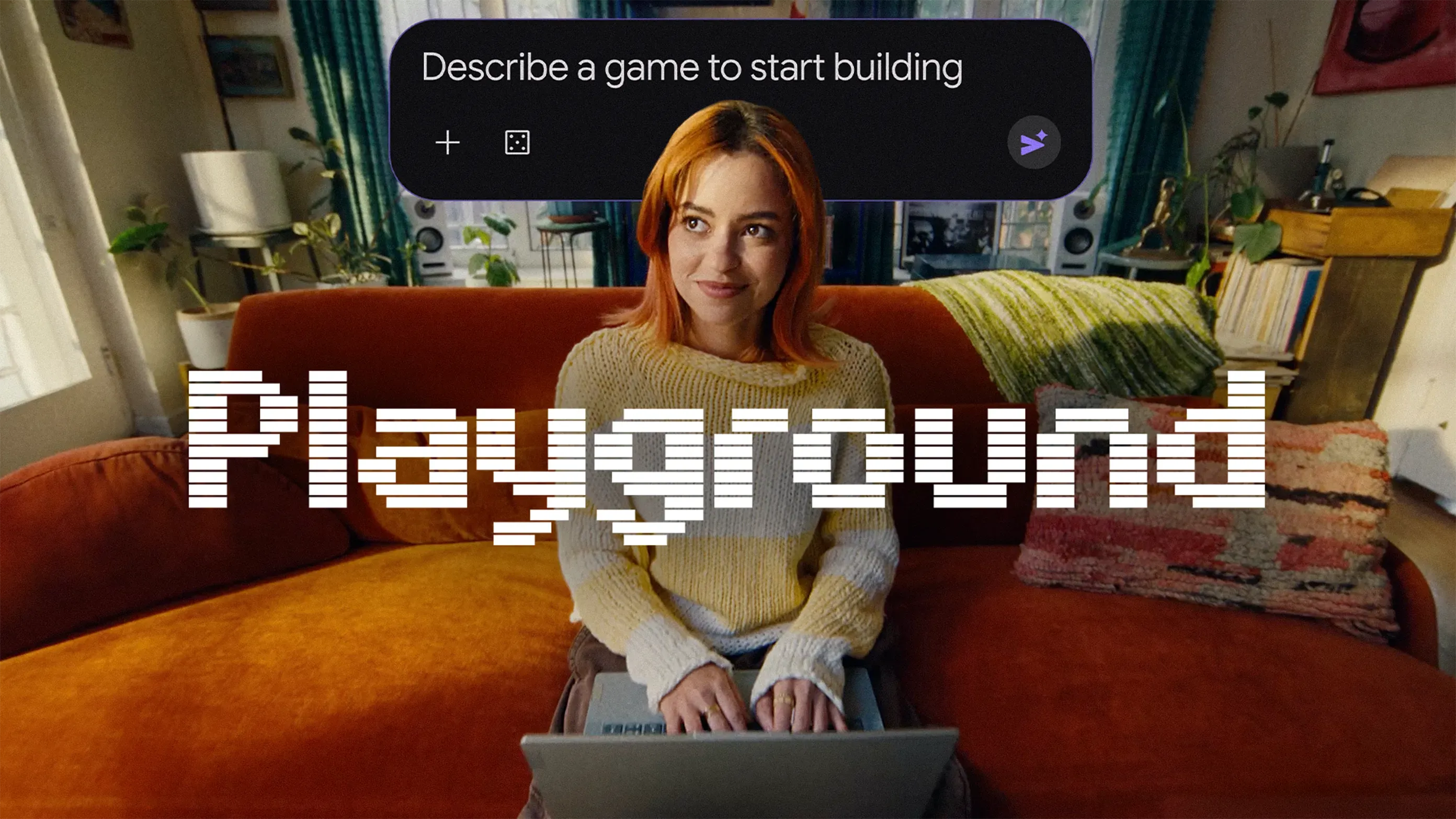
What exactly does Google AI Playground do?
Google AI Playground, launched as part of the Google Labs experimental suite, converts text descriptions into playable in-browser games. It operates on a principle often referred to as "vibe coding," where users describe the desired genre, theme, and mechanics in a chatbot-like interface rather than writing lines of code. The system then handles the heavy lifting, generating visuals, controls, and basic game logic. This approach is similar to Meta's Horizon Create service, which was announced in September.
The process is designed to be conversational and highly responsive, making it accessible to individuals with little to no video game development experience or coding skills. Beyond simple text prompts, the platform allows users to upload reference assets—such as photos, videos, or 3D models—to guide the AI's aesthetic and design choices. If no references are provided, the visuals and designs are entirely AI-generated. While the initial build provides a working foundation, users can continue to iterate on the design by providing further instructions to the AI to tweak specific elements of the game.
How long does it take to produce a working game?
A basic, playable game can appear within minutes of entering a first prompt. During testing, a farm-themed version of Tetris was generated almost immediately from a simple request. The AI "chugged" through the processing and spit out a version featuring little pig faces on every block. This demonstrates the speed at which the tool can move from a concept to a functional prototype.
The speed of generation allows for rapid iteration. For instance, when the initial pig-themed blocks weren't quite right, further instructions were given to make the blocks themselves shaped like distorted pigs. This process of "prompting and refining" allows a user to move from a generic concept to a more specific vision in a very short timeframe. However, while the initial generation is fast, the depth of the resulting game depends heavily on how much the user is willing to engage in the conversational loop to refine mechanics and aesthetics.
Game examples produced in one session
The testing session yielded three distinct, playable, and stable titles, each representing a different genre and level of complexity.
Pork Drop: The first creation was a result of the prompt "Tetris but with cute pigs instead of blocks." After an initial build, the user iterated on the design, instructing the AI to make the blocks look like "contorted," "squished but still cute" pigs. The result was a clean, playable version of the classic puzzle game, though some blocks occasionally appeared in awkward, "T-posed" configurations. While the AI suggested the title "Piggy Stacker," the user opted for "Pork Drop."
Dinner Darling: Prompted by a colleague's request for a "Gay dinner party," this game emerged as a 2D, flash-style experience. The art style resembled Bitmojis, placing the player in the role of Julian, a stressed-out host. The gameplay involved managing a fancy dinner party by preparing artisanal bruschettas and espresso martinis for fussy guests. Despite the simple premise, the game proved difficult; failing to manage the timers or meet specific guest needs (such as Sasha's demand for multiple espresso cocktails) resulted in a "PARTY CATASTROPHE" game-over screen.
Neon Don: This was the most complex project, evolving from a "cyberpunk-style rhythm game" into a top-down, arcade-style shooter reminiscent of Hotline Miami. The player controls a grizzled, "very divorced" ex-cop battling waves of rogue agents and corrupt politicians. The game features pulsing synthwave music and a text-based snark system where the character delivers witty quips about his ex-wife's lawyer during combat. Through iterative prompting, the user added features like level scaling, boss generation, and improved enemy variety, including enemies with "bulky, wide builds" and "custom tough-guy swagger animations."
What limits appear during extended use?
While the tool is powerful, it is strictly governed by usage limits. Google throttles usage of the Playground service, meaning every new game generated and every iteration performed consumes a portion of a user's allowance. Once this allowance is exhausted, users are blocked from making further changes or starting new projects until their credits refresh.
These limitations can be frustrating when trying to polish a game. For example, an attempt to add a "Backflip" button to Neon Don resulted in the AI naming the move "Doge flip," a change that could not be corrected until the next usage refresh. Beyond the credit system, there is also a qualitative limitation: a sense of "unmistakable sameness." As users scroll through the library of generated games, they may notice that different genres often share nearly identical menus, music, and combat styles. This suggests that while the AI can mimic many styles, it often falls back on a set of predictable patterns, leading to a feeling of "AI slop" when viewed in bulk.
Does the tool lower barriers for non-developers?
Undoubtedly, Playground lowers the barrier to entry for game creation. It allows anyone with a Google account to move from an idea to a tangible, playable result in a single afternoon. The intuitive, conversational nature of the interface removes the traditional hurdles of syntax, logic, and engine management.
However, this ease of use comes with a trade-off in control and quality. A professional developer would have much finer control over the specific wording of character dialogue or the exact physics of a movement mechanic. In Playground, the user is often negotiating with the AI—asking for a change and receiving something slightly different than intended. While it is an excellent tool for "vibe-based" prototyping and casual fun, the current limitations in customization and the tendency toward repetitive assets mean it is not yet a replacement for professional development workflows.
Frequently asked questions
Can anyone access Google AI Playground?
Yes, anyone can sign in with a Google account to play user-generated games or attempt to create their own. However, the service is part of Google Labs, meaning it is an experimental platform subject to usage limits and throttling.
Are the generated games permanent?
User-generated games are hosted on the platform and can be played by others, but they are subject to the platform's experimental nature and the creator's usage allowance for updates.
Can users upload their own art or models?
Yes, the interface allows users to upload photos, videos, or models to serve as visual or design references for the AI during the generation process.
Does the system support multiplayer?
The current testing showed only single-player experiences. There is no mention of built-in multiplayer functionality in the current experimental version.
What happens when usage credits run out?
When your allowance is used up, you cannot create new games or iterate on existing ones. You must wait for your usage credits to refresh (for example, on a specific date like October 14) to continue developing.
Key takeaways
- Google AI Playground uses "vibe coding" to turn text prompts into playable browser games.
- The tool is highly accessible to non-developers, allowing for rapid prototyping.
- Usage is limited by a credit system that throttles iterations and new builds.
- A noticeable uniformity exists across the platform, with many games sharing similar menus and music.
- While fun for experimentation, the tool lacks the precision required for professional game development.
Conclusion
Google AI Playground demonstrates the potential of generative AI to democratize game creation, turning abstract ideas into playable realities in minutes. From the pig-themed puzzles of Pork Drop to the synthwave grit of Neon Don, the tool proves that a conversational interface can produce stable, engaging prototypes. Yet, the experience also highlights the current boundaries of the technology. The constraints of usage credits, the tendency toward repetitive "AI slop," and the difficulty in fine-tuning specific mechanics suggest that while the barrier to entry has been lowered, the ceiling for true creative mastery remains firmly in the hands of traditional developers.