What happened during the Coquelles bus collision?
A minibus collided with a departing freight train at the Eurotunnel loading platform in Coquelles, near Calais, on Thursday evening. The accident took place at 19:27 local time, involving a vehicle that was transporting a group of workers intended to board the Le Shuttle rail service. The passengers on board were identified as men of various nationalities, though it has not been confirmed if any British nationals were among the injured.
The collision occurred in a high-activity zone where two trains were positioned on either side of the platform. According to local sub-prefect Agathe Cury, one train was in the process of being loaded with heavy goods vehicles (HGVs) for a cross-Channel journey, while the other, which had already been loaded, was in the process of departing. The minibus struck the departing train, causing significant impact despite the vehicle remaining upright.
The mechanics of the impact
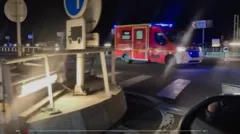
While the minibus did not overturn during the collision, the force of the impact was sufficient to cause injuries to 19 individuals. Local authorities noted that the shock of the collision was a primary factor in the injuries sustained by those inside the vehicle. Images from the scene showed the minibus with visible damage to its front and side sections, positioned alongside the train amidst a heavy presence of emergency responders.
How many people were injured and what is their condition?
Nineteen people were injured in the collision, including the bus driver and 18 passengers. The severity of the injuries varied among the group, with two individuals requiring urgent medical intervention. Specifically, the driver and one passenger were classified as severely injured and had to be evacuated from the site via helicopter to receive specialized medical care.
Despite the severity of the initial medical response, local officials have provided reassurance regarding the long-term prognosis of the victims. Agathe Cury stated that none of the injuries sustained in the accident were considered life-threatening. This assessment suggests that while the physical and psychological shock to the workers was significant, the immediate medical emergency has been stabilized.
What is the impact on Eurotunnel and Eurostar services?
Eurostar and freight traffic through the Channel Tunnel experienced minimal disruption following a short pause to facilitate emergency evacuations. Although the collision occurred at a critical junction of the tunnel's logistics, the primary passenger services remained operational. Eurostar issued a formal update clarifying that the incident took place several kilometers away from the main tunnel infrastructure and did not involve or impact their specific London-to-Europe routes.
Observations from the scene supported the report of continued operations. BBC journalist Evan Davis, who was traveling through the tunnel at the time, noted that while emergency vehicles were concentrated on one of the platforms, car queues at check-in were moving. He observed that vehicles were being processed through check-in despite the ongoing emergency response, suggesting that the Le Shuttle service managed to maintain a level of throughput.
Service breakdown at the Channel Tunnel
To understand the scope of the disruption, it is necessary to distinguish between the three primary rail services that operate through the undersea link:
- Eurostar: High-speed passenger service connecting London to various European destinations.
- Le Shuttle: A service designed to transport vehicles and their passengers via rail.
- Freight Services: Dedicated trains for the transport of heavy goods and HGVs.
The collision specifically involved the Le Shuttle logistics chain, as the minibus was transporting workers meant to facilitate the movement of vehicles. Because the incident was localized to the loading platform in Coquelles, the high-speed passenger lines were able to bypass the affected area with only a brief delay.
Why is this incident considered significant for tunnel safety?
The collision is being treated as a highly unusual event by French authorities, as it represents a rare breach of safety protocols on the loading platforms. Sub-prefect Agathe Cury noted that this was the first time an incident of this specific nature had occurred on an Eurotunnel loading platform. The uniqueness of the event has prompted an immediate and thorough investigation to determine the cause.
An investigation has been launched to uncover the exact reason why the minibus entered the path of the departing train. Currently, the motive or mechanical failure that led to the collision remains unknown. Investigators will likely focus on whether the incident was caused by driver error, a failure in platform signaling, or a breakdown in the coordination between the minibus transit and the train's departure schedule.
Frequently asked questions
How many people were injured in the Coquelles accident?
A total of 19 people were injured during the collision. This includes the minibus driver and 18 passengers. While two individuals required helicopter evacuation due to the severity of their injuries, local officials confirmed that no life-threatening injuries were reported following the incident.
Was the Channel Tunnel closed after the collision?
No, the Channel Tunnel was not closed. While there was a brief stoppage to allow emergency services to evacuate the injured, both Eurostar passenger services and freight traffic continued to operate. Observations at the scene confirmed that vehicles were still being processed through check-in.
What kind of vehicles were involved in the collision?
The collision involved a minibus and a freight train. The minibus was transporting a group of male workers, specifically lorry drivers, who were preparing to board the Le Shuttle service. The train involved was a departing freight train that had already been loaded with goods.
Did the accident affect Eurostar trains?
The accident did not affect Eurostar services. Eurostar confirmed that the incident occurred several kilometers away from the main tunnel infrastructure and did not involve their trains. All Eurostar services running to and from London continued to operate as expected.
What is being done to investigate the crash?
An official investigation has been launched by French authorities to determine the cause of the collision. Because this is the first incident of its kind on an Eurotunnel loading platform, investigators are working to understand why the minibus collided with the departing train.
Key takeaways
- Nineteen people were injured in a minibus collision with a freight train in Coquelles.
- Two individuals were seriously injured and required emergency helicopter evacuation.
- Eurostar and freight services experienced only brief delays and remained operational.
- The incident is the first of its type recorded on an Eurotunnel loading platform.
- An investigation is currently underway to identify the cause of the collision.
Conclusion
The collision in Coquelles highlights a rare operational incident within the complex logistics of the Channel Tunnel. While the injury to 19 workers, including two severe cases, underscores the potential risks present at high-traffic loading platforms, the rapid response of emergency services and the resilience of the rail network prevented a wider systemic disruption. As investigators work to determine why the minibus struck the departing freight train, the focus remains on whether this was an isolated error or a signal for reviewing platform safety protocols. For now, the primary transport links between the UK and France remain functional.