How was the age of the shipwreck established without surviving wood?
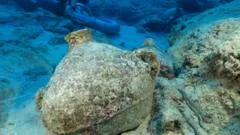
Archaeologists could not apply radiocarbon dating because no wooden structure remained. They instead examined the form and decoration of the ceramic amphorae recovered from the site. Pottery styles changed across centuries, allowing specialists to link specific shapes to known periods. The Kekova amphorae display two handles, a central ridge and a flat base. These features match vessels previously excavated in Egypt and the Middle East and already assigned to the Early Bronze Age. Professor Hakan Öniz stated that comparison of decoration techniques confirms the date with certainty. The method relies on established typologies rather than direct measurement of organic material from the wreck itself.
What cargo did the vessel carry and what do residues reveal?
More than thirty amphorae lay scattered across the underwater slope. Several remained intact after thousands of years. Dr Karin Sowada of Macquarie University inspected the jars after recovery and observed substantial viscous glossy residue inside some examples. The material was not limited to small traces. Laboratory work continues to identify the original contents. Possible substances include olive oil, wine or tree resins. Reuse of the large jars after their initial voyage remains another possibility. The size of the containers suggests they were emptied at destination and then employed repeatedly over many years before the final voyage.
Where did the ship originate and where was it bound?
The vessel measured approximately ten metres in length and functioned as a trading ship. Archaeologists place its departure point along the eastern Mediterranean coast. The intended destination was either the ancient city of Troy in north-western Turkey or Minoan settlements on Crete. Strong currents and winds around Kekova Island have caused many losses over centuries. The Mediterranean Archaeology Association maintains ongoing surveys of the numerous wrecks in the region. The present discovery supplies direct evidence of maritime exchange networks operating during the Early Bronze Age.
What will happen to the recovered artefacts?
The Turkish Ministry of Culture owns the shipwreck and its contents. Recovered amphorae are undergoing conservation treatment. Minister Mehmet Nuri Ersoy announced that the items will be exhibited in the new Mediterranean Underwater Archaeology Museum in Antalya once the facility opens. The museum will provide public access to the collection within the coming months. Conservation protocols aim to stabilise the ceramics after prolonged submersion. The display will allow visitors to view objects handled for the first time in roughly five thousand years.
How does the find alter understanding of ancient Mediterranean trade?
The wreck supplies a sealed snapshot of cargo movement at a specific moment in the Early Bronze Age. Three large stone anchors confirm the vessel's maritime function. The presence of residue inside amphorae indicates that perishable goods formed part of regular exchange. Earlier records placed the oldest known wreck near Dokos at about 4200 years old. The Kekova site now occupies the top position on that list. The intact residue offers rare material for chemical analysis that may refine knowledge of traded commodities. The find also highlights the risks faced by crews navigating the same waters used today.
FAQ: World's oldest shipwreck
When was the shipwreck discovered?
The discovery was announced in October 2026 following dives conducted by the Mediterranean Archaeology Association. The site lies close to Kekova Island in Antalya province, Turkey.
How deep is the wreck site?
The artefacts rest on an underwater slope thirty metres beneath the surface. Divers recovered the amphorae and anchors from this depth without difficulty.
Why could radiocarbon dating not be used?
No wooden remains survived on the seabed. Radiocarbon analysis requires organic material, so researchers relied on ceramic typology instead.
What is the previous record holder for oldest shipwreck?
A wreck located off Dokos island in southern Greece had been dated to approximately 4200 years ago. The Kekova find now exceeds that age range.
Where will the artefacts be displayed?
The Turkish Ministry of Culture plans to exhibit the amphorae and anchors in the new Mediterranean Underwater Archaeology Museum in Antalya.
Key takeaways
The wreck dates to the Early Bronze Age between 4400 and 4700 years ago based on amphorae typology.
More than thirty ceramic storage jars and three stone anchors were recovered from thirty metres depth.
Visible residue inside several amphorae may represent olive oil, wine or resins from the original cargo.
The vessel measured about ten metres and carried trade goods across the eastern Mediterranean.
Artefacts will enter the collection of the new Mediterranean Underwater Archaeology Museum in Antalya.
The find replaces the Dokos wreck as the oldest known shipwreck recorded to date.
Conclusion
The Kekova discovery extends the known timeline of organised maritime trade by several centuries. Ceramic analysis supplied a reliable date where wood preservation failed. Residue samples now offer direct evidence of the goods exchanged. Conservation and museum display will make the collection available for further study and public viewing. The site demonstrates both the reach and the hazards of Early Bronze Age seafaring in the Mediterranean. Ongoing surveys by the same team are expected to locate additional wrecks that may add further detail to this picture.