
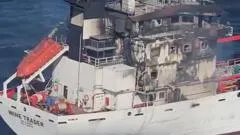
What happened during the drone attack on the Wine Trader?
The Wine Trader, a chemical tanker flying the San Marino flag, reported multiple explosions on board at approximately 07:00 local time (05:00 GMT) on Thursday morning. At the time of the incident, the vessel was sailing empty of cargo from Tunisia toward Romania. Romanian naval authorities positioned the ship 13 nautical miles (24km) east of the mouth of the River Danube at Sulina when the blasts and subsequent fire were reported.
While official investigations are ongoing, Romanian media cited crews on nearby ships who observed the vessel being struck by two drones. The impact left the tanker ablaze, necessitating an immediate emergency response. The situation is complicated by environmental factors; Romanian authorities have reported very high waves in the area, which pose a significant risk to both the survivors and the rescue teams attempting to reach them. Currently, the priority for responders is to reach the four crew members who have been confirmed to be alive, while the fate of the remaining seven crew members remains unknown.
Which other vessels were affected in the same area?
The attack on the Wine Trader is part of a recent surge in drone activity targeting maritime vessels along the western Black Sea coast. Just one day prior, on Wednesday, the Comoros-flagged chemical tanker Yara J was also struck by a drone. Unlike the Wine Trader, the crew of the Yara J was able to successfully douse the resulting flames themselves, and all members of that crew are reported to be safe.
The volatility of the region was further highlighted by incidents further south along the Bulgarian coast. On Tuesday, two merchant ships were struck by drones, one of which sank, leaving 11 crew members missing. Bulgaria has expressed suspicion that Russia was behind that specific attack, leading the country to summon the Russian envoy. These successive strikes—on the Yara J, the Wine Trader, and the vessels off Bulgaria—demonstrate an intensifying pattern of drone warfare affecting commercial shipping in the Black Sea corridor.
Regional security consultations under consideration
The escalation of attacks has brought Romania and Bulgaria to the brink of formal diplomatic and military consultations. The leaders of both nations are scheduled to discuss whether to invoke Article 4 of the NATO treaty. This specific provision allows any member of the military alliance to request consultations with its allies if it believes its territorial integrity or security is being threatened.
Romanian President Nicușor Dan has signaled a firm stance, stating, "We want to have all the information about what happened, but there will be a response from the Romanian state." To facilitate this, Dan is set to meet NATO Secretary General Mark Rutte in Brussels, alongside Bulgarian Prime Minister Rumen Radev. These high-level discussions are expected to focus on urgent operational requirements, specifically the need for additional equipment to protect shipping lanes in the Black Sea. The involvement of NATO leadership underscores the gravity with which the alliance views these threats to maritime security and regional stability.
How have Russia and Ukraine responded to the incidents?
The incidents have triggered a sharp exchange of blame between Moscow and Kyiv, as well as European leadership. Moscow has claimed that the vessels targeted were actually cargo ships carrying military supplies destined for Ukraine's Odesa port, though the Kremlin did not name the specific vessels involved. This aligns with Moscow's stated objective of targeting ships delivering weapons and dual-use cargo to Ukrainian ports.
Conversely, Ukraine and its European allies have directly blamed Russia for the attacks on civilian vessels. Kyiv maintains that these strikes target merchant ships carrying essential civilian goods, such as grain, which are vital for the regional economy. European Commission President Ursula von der Leyen has characterized the situation as a dangerous escalation, stating that the Black Sea is becoming "another front of escalation of the Russian war in Ukraine" and calling the current state of affairs "unacceptable." This maritime conflict is part of the broader war initiated by Russian President Vladimir Putin in 2022, during which Moscow has maintained control over approximately 20% of Ukrainian territory. While Turkey has called on both Russia and Ukraine to halt attacks in the Black Sea to protect trade, Russia has repeatedly rejected calls from the US and Europe for a naval ceasefire, instead blaming Ukraine for attacks on Russian merchant ships.
What is the current status of search and rescue operations?
A large-scale search and rescue operation is currently active off the Romanian coast to locate the missing crew members of the Wine Trader. The Romanian interior ministry has deployed significant assets to the scene, including two Black Hawk helicopters and two rescue boats. The difficulty of the operation is compounded by the heavy sea state and the ongoing fire on the vessel.
The Romanian interior ministry has released video footage showing one of the Black Hawk helicopters hovering over the stricken tanker to assist in the operation. While the focus remains on the seven missing individuals, the presence of four confirmed survivors provides a critical window for rescue efforts. However, the combination of high waves and the volatile nature of a chemical tanker makes the mission exceptionally hazardous for the deployed rescue teams.
Frequently asked questions
What caused the fire on the Wine Trader?
The fire was caused by multiple explosions reported on board at approximately 07:00 local time. Romanian media and local reports suggest the vessel was struck by two drones, leading to the blaze.
Have any crew members been rescued so far?
As of the latest reports, four crew members from the Wine Trader have been confirmed alive. Search and rescue operations continue for the seven crew members who remain missing.
Did the Yara J sustain lasting damage?
The Yara J was struck by a drone on Wednesday, causing a fire. However, the crew managed to extinguish the flames themselves, and all crew members are reported safe.
Is NATO involvement expected?
Romania and Bulgaria are discussing the potential invocation of NATO Article 4, which allows for consultations among allies regarding threats to security or territorial integrity. Meetings with NATO Secretary General Mark Rutte are planned.
Why is the western Black Sea seeing increased incidents?
The western Black Sea is a vital route for Ukrainian exports and imports. The area has seen an intensification of strikes by both Russia and Ukraine, with Moscow targeting alleged military cargo and Kyiv and Europe reporting attacks on civilian merchant vessels.
Key takeaways
Seven crew members remain missing after the Wine Trader was struck by drones off Romania. The Yara J suffered a separate drone strike the previous day with no casualties reported. Romanian and Bulgarian leaders are evaluating NATO Article 4 consultations. Moscow claims the targets carried military cargo destined for Ukraine. Rescue operations continue with two helicopters and two boats deployed. Attacks have also occurred recently off Bulgaria, heightening regional shipping concerns.
Conclusion
The recent strikes on the Wine Trader and other vessels underscore the rapidly increasing risks to commercial shipping in the western Black Sea. As the region becomes a contested zone for drone warfare, the safety of civilian crews and the security of international trade routes are under direct threat. The outcome of the ongoing search and rescue operations, combined with the diplomatic discussions between Romania, Bulgaria, and NATO, will be critical in determining the international response to these maritime escalations.




