What makes the overall winning photograph stand out?
Federico Veronesi received the top award for an image showing a female elephant transporting a dead calf. The photograph was captured in Namibia after Veronesi noticed unusual tracks in a dry riverbed. He followed the trail and recorded the scene of the calf’s leg positioned between the elephant’s tusk and trunk. Subsequent consultation with local researchers indicated the elephant had lost her own calf years earlier and had collected remains of other calves. Veronesi described the encounter as the most emotionally intense of his twenty-year career and expressed hope that the image would prompt viewers to recognise individual animal relationships and memories.
How did young photographers achieve their awards?
Oscar Whitfield, aged between 11 and 14, won the Young Grand Title for a ground-level view of a dung beetle pushing its load uphill in Zimbabwe’s Zambezi National Park. The composition required lying in the dust to convey the physical effort involved. Amelie Davis, in the 10 Years and Under category, used a smartphone in a Surrey garden to freeze a single wingbeat of a bumblebee approaching a flower. Konrad Gräeter, in the 15-17 Years category, photographed a blackbird singing at dawn from a vineyard vantage point in Germany, capturing the bird’s most elaborate spring song.
What technical choices supported these youth entries?
Whitfield tested multiple angles before selecting the eye-level perspective that emphasised scale and exertion. Davis relied on the close-focusing capability of a standard smartphone camera under natural garden light. Gräeter positioned himself before sunrise to record the peak complexity of the blackbird’s vocal performance against the vineyard backdrop.
Which images highlight animal behaviour in specific environments?
James Lewin produced an infrared black-and-white photograph of a young bull elephant spraying water toward zebras at a Kenyan waterhole. Aaron Sanders recorded a common octopus eye peering from kelp off the Cornish coast, noting increased sightings linked to rising sea temperatures. Isak Pretorius documented two shoebill storks gathering nest material in a Ugandan swamp, one of fewer than 5,300 mature individuals estimated to remain. Tony Wu captured the courtship display of Abbott’s moray eels in Japanese waters using red light and a custom fisheye lens to limit disturbance.
What stories do the photojournalism and urban entries tell?
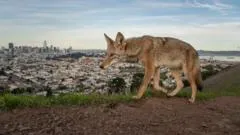
Loren Elliott recorded coyotes living among residents in San Francisco, where the population is estimated at around 100 animals that both prey on pets and control rodents. Francisco Negroni documented a puma displayed as a hunting trophy along a Patagonian road. Seth Forestson photographed a water monitor lizard against the Bangkok skyline after lowering the camera into mud at Lumphini Park. Alex Visbal showed the colour change in a Utah wetland after an engineered barrier separated it from fresh water, allowing salt-tolerant microbes to dominate.
Frequently asked questions
When does the exhibition open to the public?
The annual exhibition of winning images opens at the Natural History Museum in London on Friday 16 October 2026.
Where was the overall winning photograph taken?
The image was recorded in Namibia’s Huab River Valley after the photographer followed drag marks across a dry riverbed.
How many mature shoebill storks remain in the wild?
Researchers estimate fewer than 5,300 mature shoebill storks survive in the wild according to the competition information.
Which category featured an octopus portrait?
The Animal Portraits category included the octopus image taken at Porthkerris Beach in Cornwall, United Kingdom.
Did any winners use smartphone cameras?
Yes, the 10 Years and Under winner captured the bumblebee image on a smartphone in a domestic garden in Surrey.
Key takeaways
The overall winner documented an elephant carrying a calf that was not her own in Namibia.
Youth category winners used ground-level and smartphone techniques to record insects and birds.
Shoebill stork numbers are estimated below 5,300 mature individuals worldwide.
Common octopuses have been sighted more frequently in south-west England due to warmer seas.
Urban entries showed wildlife adapting to city parks in Bangkok and San Francisco.
The exhibition of all awarded photographs opens on 16 October 2026 at the Natural History Museum.