
How did Wicknell Chivayo rise from poverty to extreme wealth?
Wicknell Chivayo’s journey began in significant hardship, marked by early academic interruption and an entry into the informal economy. After his father died when he was 10, Chivayo was forced to drop out of high school at age 15 because his family could no longer afford the fees. His professional life started in a humble capacity as a wages clerk for a bus company, but he soon transitioned into the high-stakes world of independent hustling.
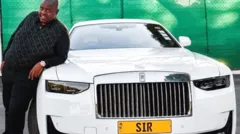
He built his initial fortune by dealing in mobile phones and foreign currency, often operating within the black market during the height of Zimbabwe’s hyperinflation crisis. This early exposure to volatile, informal financial markets provided the foundation for his later business activities. By the time he reached prominence, he had cultivated a persona of immense affluence, which he was relentless in self-documenting. Through social media, he showcased a lifestyle defined by piles of cash, a vast collection of designer shoes, high-end watches, and a fleet of expensive cars—primarily Rolls-Royces—often featuring vanity plates.
To his admirers, he was a fabulously wealthy man sharing his good fortune. To his detractors, these ostentatious displays were a stark illustration of inequality in a country where, according to the World Bank, nearly half the population lives below the international poverty line. Chivayo, however, remained largely tone-deaf to such criticism, becoming ever more unapologetic about flaunting his wealth as his fortunes rose.
The transition to 'tenderpreneurship'
Following a period of incarceration, Chivayo moved into the energy sector, a move that solidified his status as a 'tenderpreneur'—a term used to describe individuals who amass wealth by securing government contracts. His firm, Intratrek Zimbabwe, became a central player in this arena, particularly through partnerships with international entities like the Chinese electrical giant CHiNT Electric. This era of his life was characterized by the intersection of private business and state-driven economic policies, such as indigenisation, which required companies in the country to cede economic control to black Zimbabweans.
Chivayo's path was not without legal turbulence. In 2005, he was sentenced to five years in prison for money laundering involving 837,000 South African rand (then worth approximately $137,500). He served three years at Chikurubi Maximum Prison after two years of the sentence were suspended. While the details of his career immediately following his release remain somewhat murky, his pivot into government-linked contracting marked his ascent into the upper echelons of Zimbabwean business power.
Why was his business career marked by intense controversy?
The most significant controversy of Chivayo's career involved a massive solar power project in the southern town of Gwanda. In 2014, his company, Intratrek, was selected to build a 100MW solar power station. A contract worth more than $170 million was signed the following year, becoming one of the most contentious deals of his career.
Despite receiving an advance of more than $5 million, the project remained unbuilt to this day. The Zimbabwe Power Company, the state-owned utility that awarded the contract, sought to terminate the agreement when Intratrek failed to deliver. However, the courts ultimately ruled that the agreement remained valid. A parliamentary inquiry later scrutinized the deal, labeling Intratrek a 'briefcase company' being used as a front to attract investment. Chivayo defended the firm by stating it lacked the expertise for solar construction and served as the local partner while CHiNT provided the technical muscle.
In a strange turn of events, just weeks before his death, Intratrek received a government notice to proceed with the Gwanda project, granting them 24 months to complete it. Despite the heavy accusations, Chivayo often met the maelstrom with a smile, managing to navigate the controversy and eventually transform a once-tense relationship with the presidency into a close personal association.
What was the impact of his relationship with political leaders?
Chivayo’s political influence was most visible through his proximity to President Emmerson Mnangagwa and the ruling Zanu-PF party. The relationship was once fraught; in 2018, Mnangagwa had cited the Gwanda solar project as a lesson in the dangers of doing business with 'fly-by-night briefcase businessmen,' adding the ominous warning that 'Chikurubi is not full.' The state-run Herald newspaper reported this warning was directed specifically at Chivayo.
Yet within a few years, that tension transformed into what observers described as a 'bromance.' Photographs captured the remarkable informality between the two, showing Chivayo lounging on a sofa beside the President, appearing entirely at ease. His political involvement was not merely social; he was an active and vocal supporter of Zanu-PF. In April 2024, he offered $10,000 to each of Zimbabwe's 360 legislators, an act that drew accusations of attempting to influence a vote on a constitutional amendment to extend the President's term. Although he withdrew the offer following a public backlash and denied any intent to influence the vote, his loyalty was frequently broadcast via social media, including videos of him celebrating the extension of the President's term.
His reach was not limited to Zimbabwe. He maintained high-profile connections with various African leaders, including:
How did his philanthropy divide public opinion?
Chivayo’s philanthropic style was characterized by massive, highly visible displays of wealth that often targeted influential figures. This 'gifting spree,' which began in earnest around 2023, involved donating luxury cars and large sums of cash to musicians, religious leaders, and politicians. For example, the musician Jah Prayzah received three luxury cars and approximately $400,000 over three years, while Bishop Nehemiah Mutendi, head of the Zion Christian Church, received millions in cash and four luxury vehicles.
He also targeted influential religious sects, such as the Johane Masowe weChishanu African apostolic church, providing cars, buses, and cash to push the influential group closer to the ruling party. This strategy led many to dismiss his generosity as grandstanding—an attempt to ensure the support of key politicians and church leaders.
This approach created a deep rift in Zimbabwean society. To his supporters and recipients, he was a benefactor. To his detractors, his actions were a blatant attempt to buy support for the ruling party. Critics, such as Pedzisai Ruhanya of the Zimbabwe Democracy Institute, noted that he gave to 'those few on an island of wealth in a sea of poverty.' Many citizens pointed out the irony of such ostentatious displays occurring while the nation's public health system faced collapse, questioning whether wealth derived from state contracts should be used to bolster political allies rather than the broader public.
Varied responses to his largesse
Not all prominent figures accepted his gifts. Veteran musician and government critic Thomas Mapfumo famously rejected a luxury car and a house, describing the money as 'dirty.' Similarly, the widow of Archbishop Ezekiel Guti, Eunor Guti, declined a luxury vehicle and $250,000. However, the reception of his money was not entirely uniform; Mapfumo later accepted $1 million to perform at a wedding and a birthday party, a move that led some to accuse him of compromising his principles.
Conversely, some close to Chivayo argued his philanthropy was not always a performance for social media. Prominent lawyer Wilson Manase described him as 'pure hearted' and deeply religious, noting that Chivayo had flown to visit him when the lawyer was ill in Dubai. Others pointed to his more traditional charitable acts, such as donating 20 ambulances to the public health system and providing buses and assistance to schools, as evidence of a broader philanthropic intent.
Frequently asked questions
Who was Wicknell Chivayo?
Wicknell Chivayo, known as 'Sir Wicknell,' was a prominent Zimbabwean businessman and 'tenderpreneur.' He gained fame and notoriety for his immense wealth, luxury lifestyle, and his close ties to the ruling Zanu-PF party and various African heads of state.
What caused the controversy surrounding the Gwanda solar project?
The controversy stemmed from a $170 million contract awarded to Chivayo's firm, Intratrek, to build a solar plant. Despite receiving a $5 million advance, the project was not completed, leading to allegations that the firm was a 'briefcase company' used to secure state funds.
How did Chivayo interact with the Zimbabwean government?
Chivayo was a vocal supporter of President Emmerson Mnangagwa and the Zanu-PF party. He used his wealth to support political figures and religious leaders, and he was often seen in highly informal, close proximity to the President and other high-ranking officials.
Was Chivayo's philanthropy viewed positively by everyone?
No. While some recipients and supporters saw him as a generous benefactor, many critics viewed his gifts as a method of buying political influence. Others highlighted the disparity between his displays of wealth and the struggling public services in Zimbabwe.
What was the cause of his death?
Wicknell Chivayo died in a helicopter crash alongside his wife, Lucy Muteke. The accident occurred as he was traveling, marking a sudden end to a life that had been defined by constant public visibility and controversy.
Key takeaways
- Wicknell Chivayo built his wealth through currency dealing and government contracts.
- His business career was marred by the unfulfilled $170 million Gwanda solar project.
- He maintained high-level diplomatic and political connections across several African nations.
- His massive gifting of luxury cars and cash polarized Zimbabwean society.
The legacy of a polarizing figure
The death of Wicknell Chivayo leaves behind a complicated legacy that continues to spark debate across the African continent. To some, he remains a symbol of individual success and a man who used his resources to support influential pillars of society. To others, he represents the systemic inequalities and political patronage that characterize much of the region's economic landscape. As Zimbabwe reflects on his passing, the conversation remains centered on the origins of his fortune and the true nature of his impact on the nation.




