
Why has the US imposed sweeping sanctions on the ICC?
The United States has transitioned from targeting individual officials to sanctioning the International Criminal Court (ICC) as a whole institution. This shift aims to restrict the court's ability to function financially by prohibiting US entities from engaging in transactions with the body. According to US Secretary of State Marco Rubio, these measures are intended to defend American sovereignty against a court that the administration accuses of attempting to prosecute US citizens.
The Trump administration has characterized the ICC as a "rogue" institution managed by "globalists" who pose a direct threat to the autonomy of the United States. This hostility is rooted in several specific legal frictions, most notably the court's past investigation into the conduct of American soldiers in Afghanistan—an investigation that has since been closed—and the issuance of arrest warrants for high-ranking Israeli officials, including Prime Minister Benjamin Netanyahu.
The shift from individual to institutional sanctions
Previously, the US approach focused on specific personnel, having already sanctioned 17 ICC judges and officials. However, the current measures represent a significant escalation in diplomatic and economic pressure. By targeting the institution's financial architecture, Washington is attempting to undermine the structural viability of the court itself. While the administration has provided a six-month grace period for certain sanctions to allow for negotiations, the underlying objective remains the dismantling of the court's perceived overreach into sovereign domestic affairs.
How did Navi Pillay's Nobel Peace Prize trigger this escalation?
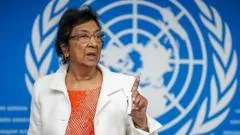
The announcement of South African jurist Navi Pillay as the 2026 Nobel Peace Prize winner served as a catalyst for immediate diplomatic friction. Pillay, an 85-year-old former ICC judge and UN rights chief, was honored by the Nobel committee for her contributions to international law and the promotion of a comprehensive global legal order. Her career has been defined by high-profile human rights work in regions such as Rwanda, Myanmar, and Gaza, as well as her early defense of anti-apartheid activists in South Africa.
President Donald Trump reacted to the selection by describing the choice of Pillay as "disgraceful and embarrassing," further labeling the decision an "indelible stain on the country of Norway." This reaction followed a period of tension regarding the prize, as the President has long expressed his belief that he should have been the recipient. The timing of the sanctions, unveiled only hours after the Nobel announcement, highlights the direct correlation between the recognition of international legal figures and the US administration's opposition to those legal frameworks.
What is the impact of these sanctions on international law?
The International Criminal Court has described the US measures as a direct assault on the rule of law and the foundations of the international legal order. The primary concern among legal experts and international bodies is that sanctioning a judicial body for the orders it issues sets a dangerous precedent. Navi Pillay, speaking via video link from the Nobel Peace Center in Oslo, noted that the practice of sanctioning judges specifically for their judicial decisions is "unheard of" and "unacceptable."
The institutional impact is multifaceted:
- Financial Constraints: By cutting off US-based financial pathways, the ICC faces increased difficulty in managing the funds provided by member states for its operational costs.
- Precedent Setting: The move creates a blueprint for other nations to use economic leverage to bypass or influence international judicial proceedings.
- Diplomatic Fragmentation: The sanctions have created a visible rift between the United States and its traditional allies, who maintain support for the court's mission.
UN Secretary General Antonio Guterres has warned that this decision represents a "serious blow" to the collective pursuit of international criminal justice, emphasizing that the ICC remains a vital pillar of global accountability.
How has the international community responded to the US decision?
The response from global leaders has been largely critical, with several key allies expressing regret over the US stance. While the United States argues it is protecting its sovereignty, many of its partners view the move as a retreat from the multilateralism that underpins global stability. The UK, along with Canada, Denmark, Germany, France, Italy, Japan, and the Netherlands, issued a joint statement expressing that they "regret and strongly disagree with" the sanctions.
This coalition of nations represents a significant portion of the ICC's support base. The disagreement highlights a fundamental tension in modern geopolitics: the conflict between the principle of absolute national sovereignty and the necessity of international institutions to adjudicate human rights violations and war crimes. Although the new US sanctions do not explicitly demand the withdrawal of existing arrest warrants—such as those for Israeli officials—the economic pressure is widely viewed as a method to achieve such outcomes indirectly.
Frequently asked questions
What is the primary goal of the US sanctions against the ICC?
The primary goal is to defend US sovereignty and prevent the ICC from attempting to prosecute American citizens. By sanctioning the institution itself, the US aims to inhibit the court's financial ability to operate and dismantle what it perceives as a rogue, globalist-led organization.
Who is Navi Pillay and why did she win the Nobel Peace Prize?
Navi Pillay is a South African jurist and former ICC judge who was awarded the 2026 Nobel Peace Prize. The Nobel committee recognized her for her extensive efforts to promote international law and peace, which they state has helped facilitate a more comprehensive global legal order.
Does the US require the ICC to withdraw arrest warrants to lift sanctions?
No, the current US sanctions do not explicitly state that arrest warrants, such as those issued for Israeli officials, must be withdrawn before the measures can be lifted. However, the administration's actions are widely interpreted as an attempt to pressure the court regarding these specific legal actions.
Which countries have expressed disagreement with the US sanctions?
Several nations have formally expressed regret and disagreement, including the United Kingdom, Canada, Denmark, Germany, France, Italy, Japan, and the Netherlands. These countries have signaled their continued support for the international legal order despite the US policy shift.
How long do the new sanctions take to implement?
The US administration has provided a six-month grace period before some of the latest sanctions become fully effective. This window is intended to allow member states time to negotiate a solution to the concerns raised by Washington regarding the ICC's operations.
Key takeaways
- The US has expanded sanctions from individual ICC officials to the entire institution to limit its financial capacity.
- Navi Pillay's 2026 Nobel Peace Prize win preceded the rapid unveiling of these sweeping US sanctions.
- US Secretary of State Marco Rubio stated the sanctions are necessary to defend American sovereignty.
- Major allies, including the UK, France, and Germany, have formally disagreed with the US decision.
- The ICC views the sanctions as a direct assault on the global rule of law.
Conclusion
The imposition of US sanctions on the International Criminal Court marks a significant turning point in the relationship between the world's leading superpower and international judicial institutions. By targeting the ICC's financial infrastructure, the Trump administration has moved beyond mere criticism of specific cases to an active attempt to undermine the court's operational viability. While the US frames this as a defense of sovereignty, the reaction from the UN and a broad coalition of allies suggests a deep concern for the future of international criminal justice. The six-month grace period offers a narrow window for diplomacy, but the fundamental ideological divide between US sovereignty and international legal accountability remains unresolved.




