
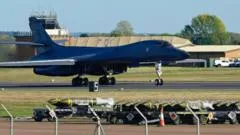
Why did the US Air Force withdraw bombers from RAF Fairford?
The United States military has removed its fleet of B-1 bombers from RAF Fairford in response to emerging security threats and a recent suspicious activity incident. While the Pentagon did not provide an explicit reason for the movement, the withdrawal occurred shortly after police were alerted to three suspicious vehicles near the Gloucestershire base on 27 September. Tracking data confirmed B-1 bombers departing the airfield on Sunday, often flying out while aerial refueling aircraft were still being scrambled to support the transit to American soil.
According to reports from the New York Times, US commanders acted upon new intelligence regarding an Iran-backed plot specifically targeting the RAF Fairford facility. Although these warnings were linked to broader threat intelligence received three weeks prior, officials reportedly accelerated the withdrawal after specific, actionable details surfaced within the last 24 hours. The decision appears to have been made at an operational level by the US military rather than as a political maneuver, with the movement communicated directly to British counterparts.
Operational vs Political Decision-Making
Evidence suggests the relocation was a tactical response to immediate risks rather than a shift in diplomatic relations. Whitehall sources have not disputed that the withdrawal was a direct consequence of the security incident at the airbase. By moving the aircraft to the continental United States, the US Air Force mitigates the risk of localized attacks on high-value assets stationed on foreign soil, even as it maintains the ability to project power globally.
What was the nature of the security incident near the base?
The security incident involved the detection of suspicious vehicles and led to several arrests by counter-terror police. In the early hours of the morning following the initial alert, five men—all UK nationals from London aged between 23 and 25—were detained. These individuals were initially held on suspicion of explosives offences before the investigation shifted to the suspicion of preparing a terrorist act. A sixth man, a 25-year-old UK-Iranian national, was subsequently arrested in London on suspicion of preparing terrorist acts.
All six suspects have since been released on bail. The police described the decision to release the men as an "investigative decision" based on established strategy and experience. Despite the release of the suspects, the gravity of the situation was underscored by high-level political commentary. US Secretary of State Marco Rubio noted that the incident "clearly involve[d] the hands of a foreign actor," while Prime Minister Andy Burnham stated there were "strong indications" of Iranian involvement, though specific details remained undisclosed.
How does the withdrawal impact US strategic capabilities?
The removal of B-1 bombers from RAF Fairford reduces the US military's immediate forward presence in Europe, though it does not eliminate its strike capacity. RAF Fairford has served as a vital forward operating location for the US Air Force for decades, providing a platform for long-range missions. The B-1 bombers stationed there were frequently used for missions in the Middle East, carrying precision-guided "bunker busting" bombs and air-to-surface missiles designed to penetrate hardened targets.
While the US can technically conduct precision strikes from the continental United States—as demonstrated during Operation Midnight Hammer last year—the loss of the UK base removes a critical foothold outside of Europe. Missions launched from the UK typically required 12 to 15 hours of total flight time, including necessary air-to-air refueling. The loss of this staging ground necessitates longer flight durations and increased reliance on aerial refueling assets for any potential operations involving Iranian capabilities.
The Role of Precision-Guided Munitions
The B-1 bombers withdrawn from the UK were significant assets due to their payload. Many were equipped with specialized munitions capable of striking deeply buried weapons stores. These missions are complex, requiring precise coordination between strike aircraft and refueling tankers. The withdrawal effectively shifts the burden of these long-duration sorties back to US-based airfields, increasing the logistical footprint required for Middle Eastern contingencies.
What is the geopolitical context involving Iran?
The security concerns at RAF Fairford are deeply intertwined with escalating tensions between the US, its allies, and Iran. Since the US and Israel launched wide-ranging strikes on Iran on 28 February, the Middle East has remained in a state of heightened conflict. Iran has explicitly stated that any military base used to facilitate aggression against its territory is a legitimate target for its forces. This stance was articulated as recently as July, adding significant pressure to US assets stationed in the UK.
The US military is currently navigating a complex landscape, attempting to recover from damage previously inflicted on its aircraft by Iranian precision strikes. The decision to move assets from a UK base to the US mainland serves as a defensive measure against the threat of Iranian-backed sabotage or kinetic strikes. While Tehran has strongly denied any involvement in the recent suspicious activity near RAF Fairford, the intelligence assessments provided to US commanders suggest a high level of concern regarding state-sponsored interference.
How has the UK government responded to the situation?
The UK government has maintained a cautious stance regarding the operational withdrawal of US assets. While the Ministry of Defence has declined to comment on the specific movement of the bombers, the political leadership has addressed the implications of the security breach. Prime Minister Andy Burnham's comments regarding Iranian involvement suggest that the UK government is aligned with US intelligence assessments, even if formal diplomatic accusations have not been leveled.
The cooperation between the UK and the US remains a central theme in the official rhetoric. US President Donald Trump noted that the UK has worked "very closely" with the United States on these matters. However, the release of the suspects on bail has drawn criticism from some US officials, including President Trump, who expressed surprise at the decision. This highlights a potential friction point in how the two nations manage counter-terrorism investigations involving foreign nationals and suspected state-sponsored actors.
FAQ: US bombers RAF Fairford withdrawal
Why were the B-1 bombers moved from the UK?
The bombers were moved following a security incident involving suspicious vehicles and intelligence regarding a potential Iran-backed plot. The US military decided to relocate the aircraft to their home stations in the United States as an operational measure to ensure the safety of the assets.
Who was arrested in connection with the RAF Fairford incident?
Six men were arrested: five UK nationals from London, aged 23 to 25, and one 25-year-old UK-Iranian national. All individuals were held on suspicion of terrorism-related offences and have since been released on bail following investigative decisions by the police.
Can the US still strike targets without using RAF Fairford?
Yes, the US can conduct precision strikes directly from the continental United States, as seen in Operation Midnight Hammer. However, using RAF Fairford as a forward base provides a significant strategic advantage by reducing flight times and increasing operational flexibility in the Middle East.
What is Iran's position on US bases in the UK?
Iran has declared that any military base used for aggression against Iranian territory is a legitimate target. This policy has increased the security risks for US assets stationed at facilities like RAF Fairford, particularly during periods of heightened tension with the US and Israel.
What kind of weapons were the B-1 bombers carrying?
The B-1 bombers were frequently armed with precision-guided "bunker busting" bombs designed to penetrate hardened or underground targets. They also carried air-to-surface missiles intended for use against heavily defended targets, making them high-priority assets for the US Air Force.
Key takeaways
- The US has withdrawn approximately twelve B-1 bombers from RAF Fairford to US home stations.
- The withdrawal follows a security incident involving suspicious vehicles and potential Iran-backed threats.
- Six men were arrested on suspicion of terrorism-related offences but have been released on bail.
- The move is an operational military decision intended to mitigate risks to high-value aircraft.
- The US retains the ability to conduct strikes from the continental United States if necessary.
Conclusion
The withdrawal of US bombers from RAF Fairford marks a significant shift in the operational posture of the US Air Force within the United Kingdom. While the US maintains its global strike capability, the move highlights the increasing vulnerability of forward-deployed assets to state-sponsored threats and localized security breaches. The incident, involving both suspicious activity and intelligence regarding Iranian interests, underscores the complex security environment facing NATO allies. As the US and UK continue to coordinate on counter-terrorism, the strategic reliance on UK-based staging grounds remains subject to the evolving landscape of international conflict and regional stability.
