
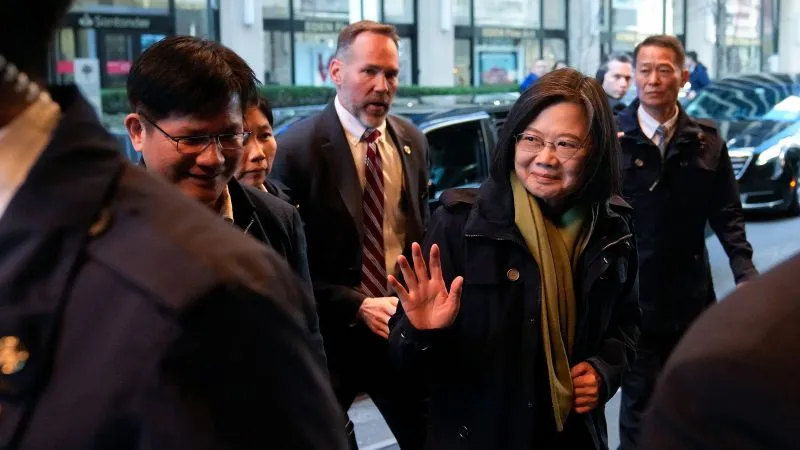
Why is the Tsai Ing-wen McCarthy meeting considered a high-stakes diplomatic event?
The meeting between President Tsai Ing-wen and House Speaker Kevin McCarthy represents a significant symbolic moment for the unofficial ties maintained between the United States and Taiwan. Although the US does not officially recognize Taiwan's sovereignty under its "One China" policy, the presence of the second-highest-ranking official in the US House of Representatives highlights the deepening security and political cooperation between Washington and Taipei.
For President Tsai, who is currently in the final year of her second term, this meeting serves as a capstone to her presidency. According to political scientist Wen-Ti Sung of the Australian National University, Tsai has cultivated an image of a leader who has elevated US-Taiwan relations to new heights and provided the island with unprecedented international visibility. The meeting underscores Taiwan's refusal to be isolated by external pressures, a sentiment Tsai herself expressed during her recent travels to Central America.
The symbolic weight of US-Taiwan cooperation
The optics of the meeting are heavily influenced by the participants' roles. As the leader of the Republican majority in the House, McCarthy’s engagement with Tsai signals bipartisan support in Washington for Taiwan's defense and international standing. This is particularly notable given the historical context of high-level US visits to the island, which have frequently triggered intense reactions from Beijing.
How might Beijing respond to the meeting in California?
Beijing has already signaled its intention to respond to the meeting, with officials warning that they will "resolutely fight back" against perceived provocations. However, analysts suggest that the location of the meeting—taking place in the United States rather than in Taiwan—may prevent a repeat of the massive military escalation seen during former Speaker Nancy Pelosi's visit to Taipei in 2022.
During the Pelosi visit, China launched unprecedented military drills, including firing missiles into the waters surrounding Taiwan and deploying warplanes across the Taiwan Strait's median line. This time, the strategic calculus for Beijing may be different. Yun Sun, director of the China Program at the Stimson Center, notes that Beijing faces a significant burden: any excessive overreaction could further alienate China from the international community. This "burden of restraint" is complicated by the opacity of China's decision-making processes and the potential for competing interests within its vast bureaucracy.
Comparing the Pelosi and McCarthy precedents
The distinction between a visit to Taipei and a meeting on US soil is a critical factor in predicting the scale of Chinese military coercion. While Pelosi's visit triggered a fever pitch of nationalist rhetoric and direct military encirclement, the current meeting in California is viewed as a less provocative move. Nevertheless, Beijing continues to maintain a high level of pressure, including regular military incursions over the informal border in the Taiwan Strait.
What are the broader implications for US-China relations?
The meeting occurs at a precarious juncture for Washington and Beijing, as both nations struggle to stabilize communication. Tensions are already high due to disputes over semiconductor supply chains and the fallout from a suspected Chinese surveillance balloon. A heavy-handed response from China to the Tsai-McCarthy meeting could further damage the fragile efforts to manage competition between the two superpowers.
China is also navigating a complex global landscape. Following the invasion of Ukraine, Beijing has attempted to position itself as a diplomatic mediator to repair relations with Europe. Analysts suggest that China is acutely aware of the global spotlight on its actions toward Taiwan, as the rhetoric used by President Vladimir Putin regarding Ukraine finds parallels in the language used by Chinese leadership regarding the island. Consequently, Beijing must balance its domestic nationalist demands with its desire to maintain international standing.
How does the meeting affect Taiwan's domestic political landscape?
The timing of the meeting is closely linked to Taiwan's upcoming presidential election, which could fundamentally shift the island's relationship with mainland China. A fierce military response from Beijing could have unintended political consequences within Taiwan, potentially driving voters toward the opposition Kuomintang (KMT), which is generally perceived as being more conciliatory toward Beijing.
This political dynamic is further complicated by the recent visit of former Taiwanese President Ma Ying-jeou to mainland China. Ma’s tour is being described by political scientists as a rare opportunity to send conciliatory messages between the two sides. A significant escalation in military tension following the McCarthy meeting could jeopardize the potential for dialogue that Ma's visit aims to foster, creating a volatile environment for voters as they prepare to choose their next leader.
The tension between visibility and stability
President Tsai’s strategy has focused on increasing Taiwan's international visibility to deter unilateral actions by Beijing. However, this visibility comes at the cost of heightened military tension. The challenge for the Taiwanese electorate will be weighing the benefits of strengthened US ties against the risks of increased military coercion from the mainland.
Frequently asked questions
What is the significance of the meeting location in California?
The meeting taking place on US soil is considered less provocative than a high-level US official visiting Taipei directly. This distinction may influence Beijing's response, potentially leading to a more measured reaction than the massive military drills seen during Nancy Pelosi's 2022 visit to Taiwan.
How does China view the Tsai-McCarthy meeting?
Beijing views such high-level meetings as violations of its sovereignty and part of a strategy to diplomatically isolate Taiwan. Consequently, the Chinese government has threatened to "resolutely fight back" against what it considers provocations regarding its claims over the island.
What role does the US "One China" policy play here?
Under the "One China" policy, the US acknowledges China's position that Taiwan is part of China but does not officially recognize Beijing's claim. This allows the US to maintain unofficial ties and provide Taiwan with the means to defend itself without formally breaking diplomatic relations with Beijing.
Could the meeting impact Taiwan's upcoming election?
Yes, the meeting and any subsequent Chinese retaliation could influence voters. A heavy-handed response from Beijing might push Taiwanese voters toward the Kuomintang (KMT), a party often seen as more friendly toward Beijing, compared to the current administration's more assertive stance.
Why is the current moment more sensitive for China?
China is under intense global scrutiny due to its relationship with Russia and the ongoing war in Ukraine. Beijing is attempting to repair ties with Europe and position itself as a peace agent, meaning an overreaction to Taiwan could damage its broader diplomatic objectives.
Key takeaways
- Beijing has threatened a resolute response to the Tsai-McCarthy meeting in California.
- The meeting serves as a capstone for President Tsai Ing-wen's presidency and increased international visibility.
- Analysts suggest Beijing may exercise more restraint than in 2022 to avoid international isolation.
- The outcome of the meeting could influence Taiwan's upcoming presidential election and domestic political stability.
Conclusion
The meeting between President Tsai Ing-wen and Speaker Kevin McCarthy represents a delicate balancing act in the ongoing struggle for influence in the Taiwan Strait. While it reinforces the symbolic and practical ties between the US and Taiwan, it simultaneously tests the limits of China's patience. Beijing finds itself caught between the need to project strength to its domestic audience and the necessity of avoiding a massive escalation that could further alienate the global community. As Taiwan approaches a pivotal election, the geopolitical consequences of this encounter will likely resonate far beyond the immediate diplomatic interaction.




