What was the context of the Trump Iran comment?
The controversy stems from remarks made by Donald Trump during a campaign rally in Nebraska on Monday, where he addressed the ongoing conflict with Iran. Trump suggested that the ability of Iran to target major American metropolitan areas was a risk that justified previous military escalations. Specifically, he stated, "They can take out a city. Let them take out Los Angeles, let them take out San Diego," while arguing that such risks are a "small price to pay" for global and national security.
According to reports, portions of the audience responded to these comments with cheers. The remarks have since become a focal point for political tension, as critics argue the language minimizes the threat to American lives, while supporters view it as a blunt assessment of the necessity of preemptive military measures to maintain stability in the Middle East.
How did the White House respond to the backlash?
The White House has issued a strong rebuttal, characterizing the criticism as a "media freakout" that lacks a basis in reality. White House Communications Director Stephen Cheung defended the President, asserting that the remarks were intended to illustrate that American cities would face much greater threats had the administration not intervened to stop Iran's nuclear ambitions.
The administration's defense rests on several key claims regarding Iran's current military capabilities and the impact of US policy:
- Nuclear Deterrence: The White House maintains that US actions have successfully prevented Iran from acquiring the nuclear capability required to strike US soil.
- Military Limitations: Stephen Cheung stated that under the current administration's influence, "Iran has no nuclear, no navy, no air force, and no money."
- Preventative Logic: Official White House rapid response communications argued that the President was highlighting the exact catastrophe—a nuclear strike on LA or San Diego—that his policies are designed to avoid.
The administration's stance on national security
The administration continues to advocate for the necessity of disrupting Iran's nuclear programme. Officials argue that the strategic friction resulting from these operations is a necessary component of safeguarding US national security. By framing the potential destruction of US cities as a hypothetical consequence of an unchecked Iran, the White House seeks to pivot the conversation from the rhetoric of the rally to the strategic outcomes of their foreign policy.
Why are Los Angeles and San Diego considered high-risk targets?
Both Los Angeles and San Diego are home to critical US military installations that make them strategic priorities in any conflict involving foreign actors. The presence of high-value assets in these regions means that any escalation in tensions with a state like Iran carries direct implications for the safety of these civilian populations.
Military infrastructure in San Diego
San Diego serves as a massive hub for US naval and marine operations. Its strategic importance is underscored by several key installations:
- Naval Base San Diego: This facility serves as the home port for the US Navy's Pacific Fleet.
- Naval Amphibious Base Coronado: This is the primary training center for Navy SEALs on the West Coast.
- Marine Corps Base Camp Pendleton: A major installation where approximately 70,000 service members and civilians are stationed.
Military infrastructure in Los Angeles
Located approximately 120 miles north of San Diego, Los Angeles holds significant aerospace and space-related military assets. These include the Los Angeles Air Force Base and the headquarters of the US Space Force's Space Systems Command. The concentration of these assets in densely populated areas creates a complex security landscape where military targets and civilian centers are inextricably linked.
What is the reaction from California state leadership?
California leaders have reacted with sharp condemnation, viewing the remarks as a direct threat to the state's security and stability. Governor Gavin Newsom described the comments as "deranged and dangerous," even suggesting they could be interpreted as "treasonous" depending on how foreign adversaries perceive the rhetoric.
In response to the potential for foreign actors to interpret the comments as an invitation for aggression, Governor Newsom has taken the following steps:
- Security Monitoring: He has directed the California State Threat Assessment Center to closely monitor the situation.
- Threat Prevention: The agency, tasked with detecting and preventing security threats within the state, will focus on assessing whether the remarks have increased the risk of foreign-led attacks.
Local leadership in the mentioned cities has also voiced opposition. San Diego Mayor Todd Gloria used social media to state that his city is not "collateral damage" and called for an end to "reckless war talk." Los Angeles Mayor Karen Bass echoed these sentiments, describing the comments as threats that attempt to encourage attacks on American lives.
How does this incident fit into the Trump-Newsom rivalry?
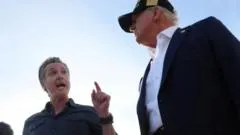
This latest clash is part of a long-standing and highly public political feud between Donald Trump and Gavin Newsom. The tension between the two leaders has escalated through various personal and political disagreements over the past year.
Previous points of contention include:
- Immigration and Protests: Trump previously criticized Newsom's handling of violent anti-immigration enforcement protests in Los Angeles, labeling him incompetent.
- Use of Military Power: Newsom accused Trump of an "abuse of power" following the deployment of military personnel to secure federal buildings during those same protests.
- Personal Attacks: The relationship has also seen personal friction, including instances where Trump mocked Newsom's dyslexia, leading to public criticism from advocacy groups.
With Newsom often viewed as a potential candidate for the 2028 presidential election, the friction between the former president's campaign rhetoric and the governor's security mandates highlights the deep partisan divide regarding national security and federal-state relations.
Frequently asked questions
Was the Trump Iran comment a direct threat to California?
The White House denies that the comment was a threat, claiming it was a rhetorical explanation of why US military action is needed to prevent Iran from becoming a nuclear power. However, California officials argue the language is dangerous because it could be perceived as an invitation for foreign attacks.
What military bases are located in San Diego?
San Diego hosts several critical installations, including Naval Base San Diego (Pacific Fleet home port), Naval Amphibious Base Coronado (Navy SEAL training), and Marine Corps Base Camp Pendleton, which supports 70,000 personnel. These make the city a strategic military hub.
What is the role of the California State Threat Assessment Center?
The State Threat Assessment Center is a California agency designed to detect, analyze, and prevent security threats within the state. Governor Newsom has directed them to monitor potential foreign responses to the President's remarks to ensure state safety.
Why does the White House defend the remarks?
The White House defends the remarks by stating they were not literal suggestions of vulnerability, but rather a way to highlight the security benefits of the administration's policies. They argue that the President's actions have prevented Iran from having the capacity to strike US cities.
Is there a history of conflict between Trump and Newsom?
Yes, the two have a history of public clashes involving immigration protests, the use of military personnel in domestic settings, and personal criticisms regarding competence and health, reflecting a broader political divide between their respective platforms.
Key takeaways
- The White House claims Trump's comments were intended to highlight the necessity of preventing a nuclear Iran.
- Governor Newsom has activated California's State Threat Assessment Center to monitor potential foreign retaliation.
- San Diego and Los Angeles house critical military assets, including Navy SEAL training and Space Force headquarters.
- The incident marks a significant escalation in the ongoing political rivalry between Trump and Newsom.
Conclusion
The dispute over the Trump Iran comment highlights a fundamental disagreement regarding the intersection of political rhetoric and national security. While the White House maintains that the President's words were a strategic defense of American interests, California's leadership views them as a catalyst for potential instability. As the State Threat Assessment Center monitors the fallout, the incident underscores the vulnerability of major metropolitan areas that serve as dual civilian and military hubs. This confrontation not only impacts local security perceptions but also intensifies the broader political friction between federal ambitions and state-level governance in the lead-up to future election cycles.