
Why did Donald Trump criticize the 2026 Nobel Peace Prize?
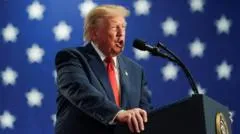
Donald Trump expressed intense dissatisfaction with the Nobel committee's decision to award the prize to Navi Pillay, a former UN human rights chief and International Criminal Court judge. Speaking at a rally in Syracuse, New York, the US President characterized the selection as a "disgraceful and embarrassing" event. He further asserted that the decision constitutes an "indelible stain on the country of Norway," adding that his administration "will not forget" the choice.
The President's critique extended beyond the individual recipient to the institution itself. He alleged that the Nobel Peace Prize has been "forever discredited by a handful of radical ideologues who are anti-democracy and really enemies of civilisation." This rhetoric suggests a fundamental disagreement with the criteria used by the Norwegian Nobel Committee to evaluate peace efforts and international legal contributions. Trump further claimed he had "never heard" of the "mystery person" being honored, highlighting his dismissal of Pillay's international standing.
Trump's claims regarding conflict resolution
During his address to supporters, Trump bolstered his criticism by making unverified claims regarding his own diplomatic record. He asserted that he had successfully settled eight wars and claimed he was on the verge of settling or winning two additional conflicts. However, the source notes that he provided no evidence to substantiate these specific figures or the progress of these purported negotiations.
These claims serve as the basis for his perceived eligibility for the prize, though they remain unsupported by documented proof in the provided accounts. By framing himself as a decisive peacemaker, Trump positions the committee's selection of a legal expert over a political leader as a failure of the institution to recognize actual conflict resolution.
Who is Navi Pillay and why did she win?
Navi Pillay, the 85-year-old South African jurist, was awarded the prize for her extensive work in promoting international law and fostering a more comprehensive global legal order. As a former judge of the International Criminal Court and the International Court of Justice, her career has been defined by the pursuit of justice in the face of extreme violence and systemic human rights abuses.
The Norwegian Nobel Committee emphasized the significance of her legal contributions. Jørgen Watne Frydnes, the chair of the Norwegian Nobel Committee, stated that Pillay's work had been "instrumental in ensuring that war crimes, crimes against humanity, and genocide are prosecuted." This recognition highlights the committee's focus on the rule of law as a foundational component of global peace, rather than the settlement of political disputes through traditional diplomacy.
Pillay reacted to the announcement from the Palace of Justice in Nuremberg. While acknowledging the gravity of her work, she maintained a sense of humor regarding the political tension surrounding her win. She joked to the applauding crowd, "If you clap a little bit more I may share this prize with Trump," a remark that underscored the polarized reception of her award and the high-profile nature of the criticism against her.
How has the Nobel Peace Prize been contested previously?
The current friction between the White House and the Nobel Committee is not an isolated incident, as Trump has a history of vocal opposition to the committee's choices. In 2025, the President expressed similar grievances when the prize was awarded to the Venezuelan opposition leader María Corina Machado. At that time, the White House officially accused the committee of prioritizing "politics over peace."
The controversy surrounding Machado's award introduced unique diplomatic complexities. In an unusual gesture of recognition for his support of Venezuelan freedom, Machado gifted her Nobel medal to Trump during a meeting at the White House. Trump described the act as a "wonderful gesture of mutual respect." This event established a precedent for the intersection of Nobel recognition and US political relations, which continues to influence the President's rhetoric toward the committee.
The non-transferable nature of the Nobel Prize
Following the transfer of the medal, the Nobel committee was forced to issue a clarification regarding the status of the award. The committee stated clearly that the prize is not a transferable asset. According to their official statement, "Once a Nobel Prize is announced, it cannot be revoked, shared, or transferred to others."
The committee reinforced the finality of their decisions, noting that the award "stands for all time," regardless of subsequent political gestures or symbolic handovers. This clarification serves to protect the integrity of the award against attempts to use the physical medal as a tool of political diplomacy or personal recognition outside the official committee process.
What is the relationship between the Norwegian government and the Nobel Committee?
A significant point of contention in Trump's criticism is the implication that the Norwegian state is responsible for the prize selection. However, there is a distinct separation between the Norwegian government and the body that selects the laureate. This distinction was previously clarified by Norwegian Prime Minister Jonas Gahr Støre in an attempt to de-escalate tensions with the US President.
Støre explained to Trump that the decision rests with an independent committee based in Norway, rather than being a direct policy decision of the Norwegian government. This independence is a core tenet of the Nobel Foundation, intended to ensure that the prize remains free from the direct influence of state diplomacy or bilateral political pressure. Despite this clarification, the President's rhetoric continues to link the committee's actions directly to the reputation of the Norwegian nation, calling the decision a "stain" on the country.
Key takeaways
- Donald Trump called the 2026 Nobel Peace Prize decision "disgraceful" and a "stain" on Norway.
- Navi Pillay received the award for her work in prosecuting war crimes and genocide.
- The President claimed credit for settling eight wars without providing supporting evidence.
- The Nobel Committee confirmed that prizes are non-transferable and cannot be shared or revoked.
- Previous tension occurred in 2025 when María Corina Machado was awarded the prize.
FAQ: Nobel Peace Prize Controversy
Why did Trump call the decision a "stain" on Norway?
Trump used this terminology to suggest that the Nobel Committee's choice of Navi Pillay reflects poorly on the nation's judgment. He implied that the committee's selection process is influenced by ideologues rather than objective standards of peace and democracy.
What did Navi Pillay do to earn the prize?
Navi Pillay was recognized for her efforts to promote international law and her role in ensuring the prosecution of genocide, war crimes, and crimes against humanity. Her work as a judge helped establish a more comprehensive global legal order.
Can a Nobel Prize be given to someone else as a gift?
No, the Nobel Committee has explicitly stated that the prize cannot be revoked, shared, or transferred. Even though María Corina Machado gifted her medal to Trump in 2025, the official award remains tied to the original recipient.
How did the Norwegian government respond to Trump's claims?
Prime Minister Jonas Gahr Støre previously clarified that the Nobel Committee is an independent body. He emphasized that the Norwegian government does not decide who receives the prize, attempting to separate state diplomacy from the committee's autonomous decisions.
What was the reaction of the 2026 laureate?
Navi Pillay reacted with humor during her announcement in Nuremberg. While accepting the recognition for her legal work, she joked that she might share the prize with Trump if the audience applauded more loudly.
Conclusion
The 2026 Nobel Peace Prize has become a flashpoint for renewed tension between the US Presidency and the Norwegian Nobel Committee. While Navi Pillay's recognition focuses on the essential role of international law in preventing atrocities, Donald Trump's reaction focuses on the perceived political bias of the awarding body. This conflict underscores the ongoing struggle to maintain the perceived neutrality of international institutions in an increasingly polarized global political landscape. As the committee maintains the finality and independence of its decisions, the friction between diplomatic recognition and political rhetoric remains a central theme of the award's legacy.




