
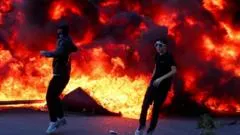
Escalation of violence against state infrastructure
Student protesters in Tirana have transitioned from peaceful demonstrations to direct attacks on several high-profile government buildings. Following an initial gathering outside the ministry of education on Tuesday, the scale of the unrest expanded significantly on Wednesday. Reports indicate that a portion of the education ministry's building was set on fire during the demonstrations.
The wave of violence was not limited to the education sector. Protesters also targeted the prime minister's office, the finance ministry, and the interior ministry. Surrounding private businesses in the capital were also caught in the unrest. In response to the escalating chaos, riot police have deployed tear gas and water cannons in an attempt to disperse the crowds and regain control of the streets.
Law enforcement and arrests
The crackdown on the demonstrations has already resulted in legal consequences for several participants. According to Albania's state-run news agency, sixteen individuals were arrested in connection with violent acts during the protests on Tuesday.
Roots of the Flamingo Revolution and corruption allegations
The current unrest is part of a broader movement known as the Flamingo Revolution, which has been gaining momentum over several months. While the immediate catalyst for the recent student-led demonstrations involved demands for improved university conditions and better job prospects, the movement's goals are much wider. The primary objective of the Flamingo Revolution is the resignation of Albanian Prime Minister Edi Rama.
Public anger is deeply rooted in allegations of systemic corruption and a perceived lack of government transparency. One specific trigger for the recent surge in tension was a luxury tourism project linked to Jared Kushner, the son-in-law of Donald Trump. This project has become a symbol for many Albanians of the alleged cronyism and opaque dealings within the Rama administration.
Demonstrators have expressed that their grievances extend beyond student-specific issues. Enida Bimi, a participant in the protests, told Reuters that the movement represents the anger of all Albanian citizens regarding the current system. Arber Leshi, another protester, characterized the current administration as the most corrupt in the country's history.
Conflicting political responses to the unrest
The Albanian government has taken a firm stance against the methods used by the demonstrators, distinguishing between the right to protest and the use of violence. Education Minister Mirela Kumbaro noted that while she respects the right to civic protest, she drew a clear line between peaceful demonstration and violence against public property.
Economy Minister Delina Ibrahimaj also condemned the destruction of state institutions. Responding to footage appearing to show protesters throwing rocks at the finance ministry, Ibrahimaj stated that setting fire to an institution is an act that endangers lives rather than constituting a peaceful protest. Deputy Prime Minister Albana Koçiu echoed calls for restraint, advising the public to maintain maturity and stating that Albania does not need to burn in order to achieve change.
Opposition support for the student movement
In contrast to the government's condemnation, the political opposition has been quick to embrace the protesters. Sali Berisha, the leader of the Democratic Party of Albania, has offered strong vocal support for the students involved in the clashes.
During an evening meeting on Wednesday, Berisha praised the courage of the demonstrators. According to Albania's state-run news agency Ata, Berisha remarked that the streets and squares of Tirana have never seen individuals as courageous as these students. This alignment between the opposition and the student-led movement suggests a deepening political divide that may further complicate the stability of the current administration.
Frequently Asked Questions
What triggered the recent student protests in Tirana?
The immediate cause for the student involvement was a demand for improved university conditions and better employment prospects for graduates. However, these specific grievances have merged with larger national protests known as the Flamingo Revolution, which target systemic corruption and the leadership of Prime Minister Edi Rama.
What is the Flamingo Revolution?
The Flamingo Revolution refers to the ongoing months-long series of anti-government protests in Albania. The movement is primarily focused on calling for the resignation of Prime Minister Edi Rama, fueled by public anger over corruption, lack of transparency, and controversial luxury tourism projects linked to foreign interests.
How has the Albanian government responded to the violence?
The government has responded through both law enforcement and political rhetoric. Riot police have used water cannons and tear gas to disperse crowds, while officials have condemned the attacks on buildings as dangerous acts. Ministers have emphasized that while protest is a right, violence against public property is unacceptable.
Final perspective on the Albanian unrest
The situation in Tirana represents a convergence of specific student grievances and a broader, more systemic national crisis. As the Flamingo Revolution intensifies, the transition from civil protest to the targeting of state infrastructure suggests a breakdown in the social contract between the citizens and the Rama administration. With the opposition providing political cover for the protesters and the government focusing on law and order, the path toward resolution remains unclear. The stability of Albania's political landscape will depend on whether the government can address the core allegations of corruption or if the cycle of violence continues to escalate.




