
What triggered the recent landmine blasts in the DMZ?
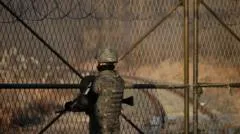
Three South Korean military personnel were wounded by landmine explosions on 21 September 2026 while operating within the Demilitarised Zone (DMZ). The incident took place on the South Korean side of the buffer zone, which serves as the primary separation between the two Koreas. According to the South Korean military, the explosions were caused by mines that are believed to have been laid by North Korean forces as part of a border fortification strategy.
The South Korean government has expressed certainty regarding the origin of these explosives. Following the incident, Seoul demanded an immediate apology from Pyongyang and called for an end to all fortification activities along the shared border. Defence Minister Kang Shin-chul characterized the blasts as a "clear" violation of the 1953 armistice agreement, which remains the legal framework governing the cessation of active combat between the two nations.
The role of the 1953 Armistice
The 1953 armistice established the 4km-wide (2.5-mile) DMZ to act as a buffer strip. It contains the Military Demarcation Line, which marks the land border. Because the armistice is designed to prevent direct military confrontation, any unauthorized fortification or explosive activity within this zone is viewed by Seoul as a direct breach of international stability mechanisms.
How has North Korea responded to the accusations?
North Korea has categorically denied any involvement in the landmine explosions, labeling the South Korean allegations as "groundless." Kim Yo Jong, the sister of North Korean leader Kim Jong Un, issued a statement through state media on Wednesday, dismissing the claims as a "farce" intended to escalate tensions on the Korean Peninsula. She accused Seoul of "cooking up" the narrative to create a political and military provocation.
Kim Yo Jong specifically rejected the suggestion that North Korean troops had crossed the border to plant the mines. She described the accusations as a "deliberate and planned strained assertion" designed to shift the blame for rising tensions onto Pyongyang. Furthermore, she issued a warning to the South, stating they should be prepared to "pay the price" for what she described as a provocation of their own making.
What is the historical context of DMZ mine incidents?
The current tension mirrors a significant incident from 2015, when two South Korean soldiers were maimed by landmines while conducting patrols in the DMZ. In that instance, South Korea also alleged that North Korean soldiers had secretly planted the mines near a South Korean guard post, a claim that was met with similar denials from Pyongyang.
Kim Yo Jong explicitly referenced the 2015 incident in her recent statement, arguing that South Korea is once again using past events as a "pretext" to justify escalating tensions. This pattern of recurring accusations and denials highlights a long-standing cycle of mistrust that has characterized the border security situation for over a decade.
Why are inter-Korean relations more volatile now than in 2015?
Inter-Korean relations have undergone a significant deterioration since the 2015 incident, reducing the safety margins that previously prevented minor accidents from turning into major crises. Experts suggest that the structural communication channels that once existed between the two sides have been severely eroded.
Christopher Green, a senior consultant with Crisis Group, noted in an interview with the BBC that North Korean authorities have been actively attempting to "harden the border" and effectively eliminate inter-Korean relations. This shift in strategy has direct implications for regional stability.
The risk of accidental escalation
The absence of reliable communication makes the peninsula more susceptible to rapid, unintended conflict. According to Christopher Green, the two Koreas no longer possess the "same low-level communication" that was available during the 2015 crisis. He warned that the distance between a localized incident and a full-scale escalation is much shorter today than it was a decade ago, stating that "accidental escalation on the Korean Peninsula is always just a few steps away, and it's fewer steps now than it was in 2015."
What role does the United Nations Command play in this dispute?
The United Nations Command (UNC) is actively involved in the investigation of the landmine blasts and the subsequent determination of armistice violations. The UNC conducted an on-site investigation alongside the South Korean military to assess the nature and origin of the explosives used in the September 21 incident.
The UNC has stated its intention to address the suspected violation of the 1953 armistice through established legal and diplomatic mechanisms. In an official capacity, the UNC emphasized its commitment to maintaining the Armistice Agreement and fulfilling its mandate to preserve stability and prevent further escalation on the Korean Peninsula. The outcome of the UNC's findings will likely dictate the next steps in the diplomatic response to the border fortification activities.
Frequently asked questions
Who was injured in the DMZ landmine blasts?
Three South Korean military personnel were injured by landmine explosions on 21 September 2026. The incident occurred while they were operating within the Demilitarised Zone (DMZ), specifically on the South Korean side of the border, leading to immediate demands for an investigation and an apology.
What is North Korea's official stance on the incident?
North Korea has denied all responsibility for the landmine blasts, calling the South Korean claims "groundless" and a "farce." Kim Yo Jong stated that the accusations are a planned provocation by Seoul intended to shift the responsibility for rising tensions onto Pyongyang.
How does this incident relate to the 1953 Armistice?
South Korea views the planting of these mines as a "clear" violation of the 1953 armistice, which established the DMZ as a buffer zone. The armistice was designed to prevent military provocations and maintain a stable boundary between the two Koreas.
Has this happened before in the DMZ?
Yes, a similar incident occurred in 2015 when two South Korean soldiers were maimed by landmines during a patrol. In that case, Seoul also accused North Korea of planting the mines, though Pyongyang denied the allegations at the time.
What is the United Nations Command doing about the blasts?
The United Nations Command conducted an on-site investigation into the blasts with the South Korean military. They have pledged to handle the suspected armistice violation through established mechanisms to maintain stability and prevent further escalation on the peninsula.
Key takeaways
- Three South Korean soldiers were wounded by landmines in the DMZ on 21 September 2026.
- South Korea asserts the mines were planted by North Korea to fortify the border.
- North Korea has dismissed the accusations as a political farce and a provocation.
- Experts warn that reduced communication makes accidental escalation more likely than in 2015.
- The United Nations Command is investigating the incident as a potential armistice violation.
Conclusion
The landmine explosions in the DMZ represent more than a localized military accident; they signal a profound breakdown in the stability of the Korean Peninsula. With South Korea demanding an apology for what it terms a clear armistice violation and North Korea responding with aggressive denials, the diplomatic space for de-escalation appears increasingly narrow. The involvement of the United Nations Command remains critical in navigating these tensions through established legal frameworks. However, as communication channels continue to erode and border fortifications increase, the risk of a minor border incident evolving into a larger confrontation remains a significant concern for regional security.