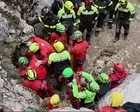
How did the rockslide trap Luca Olmetto in the Gorroppeddu cave?
The entrapment occurred on Sunday afternoon while Luca Olmetto was exploring the Gorroppeddu cave in the rugged Urzulei mountain range of central-eastern Sardinia. Olmetto was accompanied by his girlfriend, who was positioned several metres behind him at the moment of the geological event. A sudden rockslide caused a collapse that completely blocked the cave entrance, effectively sealing the passage.
While the collapse was significant enough to obstruct all exits, his companion narrowly avoided being caught in the debris. She managed to escape the immediate area unharmed and promptly alerted emergency services to the situation. This rapid response was critical, as it allowed rescue teams to mobilize before the window of opportunity for finding a conscious survivor might close.
The depth of the entrapment added significant complexity to the initial search. Olmetto was located roughly 10 metres below the ground level, trapped within a section of the cave that became inaccessible due to the accumulation of earth and stone. The geological instability of the Urzulei mountain range suggests that such collapses can occur with little warning, particularly in largely unexplored natural cavities like Gorroppeddu.
What were the details of the rescue operation?
Rescuers successfully reached Olmetto by late Monday afternoon after a grueling period of manual labor to clear the blocked passage. The operation required a coordinated effort from multiple specialized agencies to navigate the narrow and unstable environment of the cave. According to reports from Rai News, Olmetto was brought to the surface just after 6:00 PM CET on Monday.
The scale of the response was substantial, involving a diverse group of professionals trained in high-risk subterranean environments. The workforce included:
- Approximately 48 experts from Sardinia’s Alpine and Speleological Rescue Corps (CNSAS).
- 30 firefighters dedicated to the extraction process.
- Various civil protection staff members.
- Helicopter support for delivering essential materials and securing the site.
The extraction process was described as a delicate operation. Once rescuers established contact with Olmetto, who remained conscious and responsive throughout the 26-hour ordeal, they had to carefully remove large quantities of debris covering the cavity. This manual removal of rubble and earth was necessary to ensure the path was stable enough for his extraction without causing further collapses.
Medical response and stabilization
Following his extraction from the cave, immediate medical attention was required to address the physical toll of the entrapment. Once Olmetto reached the surface, medical staff worked to stabilize him before he could be moved. Due to the nature of the accident and the potential for internal injuries or exhaustion, he was subsequently airlifted to a hospital for further evaluation and treatment.
What has been the community reaction in Codrongianos?
The news of the rescue brought a sense of relief to the town of Codrongianos in north-west Sardinia, where Olmetto resides. The local community had spent the previous 24 hours in a state of high tension as news of the accident spread. The town council officially addressed the situation via social media, acknowledging the intense anxiety felt by residents.
In a public statement, the council of Codrongianos expressed their support for the victim and his family, stating that the community was closely monitoring the situation in hopes of receiving positive medical updates. The council also used the platform to extend gratitude to the rescue teams, praising their tireless work in bringing Olmetto to safety. The sentiment reflected a community united by the gravity of the accident, emphasizing the emotional impact of such high-stakes rescue missions on local populations.
How does this compare to previous cave accidents in Italy?
The Gorroppeddu incident highlights the inherent dangers of speleology, a risk underscored by previous high-profile entrapments in the Italian peninsula. While the depth and duration of Olmetto's entrapment were significant, they mirror the complexities seen in other recent geological emergencies involving explorers.
A notable comparison can be made to the December 2024 incident involving Ottavia Piana. In that case, a 32-year-old explorer became trapped in the Bueno Fonteno caves near Bergamo in northern Italy. The scale of that rescue was even larger, requiring 160 specialists to navigate the subterranean environment. Unlike the 10-metre depth experienced by Olmetto, Piana was trapped at a depth of approximately 600 metres and remained underground for 75 hours.
The consequences of such accidents can be severe. While Olmetto's condition was not detailed in terms of specific fractures immediately following the rescue, Piana suffered extensive injuries, including fractured vertebrae, ribs, and facial bones. These comparisons illustrate the spectrum of risk in cave exploration, from relatively shallow collapses to deep-earth entrapments that require massive, multi-day logistical operations.
Key takeaways
- Luca Olmetto was rescued from the Gorroppeddu cave after being trapped for 26 hours.
- The rockslide occurred in the Urzulei mountain range, trapping him 10 metres underground.
- The rescue involved 48 Alpine and Speleological experts and 30 firefighters.
- Olmetto was stabilized on-site before being airlifted to a hospital for medical care.
- The incident follows similar high-profile cave rescues in Italy, such as the 2024 Bergamo accident.
Frequently asked questions
Who was involved in the rescue of Luca Olmetto?
The rescue was a massive coordinated effort involving 48 experts from Sardinia’s Alpine and Speleological Rescue Corps, 30 firefighters, and various civil protection staff. A helicopter was also utilized to transport equipment and secure the site during the complex operation.
How long was the man trapped in the cave?
Luca Olmetto was trapped for approximately 26 hours. The rockslide occurred on Sunday afternoon, and he was successfully brought to the surface by late Monday afternoon, just after 6:00 PM CET, according to Rai News.
Where exactly did the accident take place?
The accident occurred in the Gorroppeddu cave, located within the rugged Urzulei mountain range in the central-eastern region of Sardinia, Italy. The cave is noted for being a largely unexplored natural cavity.
Was anyone else injured in the rockslide?
Olmetto's girlfriend was present during the cave exploration and was positioned a few metres behind him when the collapse happened. However, she managed to escape the area unharmed and was able to raise the alarm immediately.
How is the victim's condition?
After being extracted from the cave, Olmetto was stabilized by medical personnel on the surface. Following this stabilization, he was airlifted to a hospital to receive further professional medical treatment and monitoring.
Conclusion
The successful extraction of Luca Olmetto from the Gorroppeddu cave serves as a testament to the efficiency of Sardinia's specialized rescue services. While the 26-hour entrapment posed significant risks to the explorer, the rapid mobilization of 78 personnel and the use of aerial support ensured a timely recovery. This incident, while localized to the Urzulei mountain range, underscores the persistent dangers associated with exploring unmapped subterranean systems. As the medical community monitors Olmetto's recovery, the event remains a stark reminder of the logistical complexities and physical perils inherent in cave exploration.