
Why did Russia strike energy facilities despite the energy ceasefire?
Russia targeted six Ukrainian energy sites within hours of President Donald Trump's announcement of an energy ceasefire between the two nations. President Volodymyr Zelensky characterized these strikes as a direct response to the proposed truce, suggesting they were "Putin's answer to President Trump." The attacks specifically focused on gas stations, energy infrastructure, and other critical facilities, undermining the immediate effectiveness of the agreement.
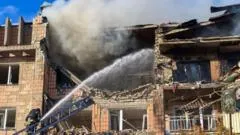
The strikes have had immediate human and structural consequences. Zelensky reported that 33 individuals sustained injuries during the attacks on energy facilities across the country. Furthermore, in Kyiv, Mayor Vitali Klitschko reported that a drone strike hit a 25-story residential building in the Darnytskyi district, resulting in one death and 11 injuries, alongside fires in the building's courtyard.
The discrepancy in ceasefire implementation
A significant gap exists between the diplomatic claims made in Washington and the operational reality in Ukraine. While President Trump asserted that the two countries had agreed to a truce that was "effective immediately," the Ukrainian leadership was caught off guard. Zelensky noted that the ceasefire was "news to him" when it was first announced, highlighting a lack of direct coordination or mutual consent regarding the timing and terms of the agreement.
What is the impact of the strikes on Ukraine's energy grid?
The recent Russian attacks have caused widespread instability across the Ukrainian power network, leading to new blackouts and the necessity for electricity rationing. According to Ukraine's state-owned grid operator, Ukrenergo, power cuts have been reported in Kharkiv, Donetsk, and Zaporizhzhia due to damage to essential energy equipment. The destruction of power grids in the city of Izyum was also confirmed by the state news agency Ukrinform.
To prevent the total collapse of the electrical system, Ukrenergo has introduced electricity rationing in various parts of the country. This measure is intended to protect damaged equipment from being overloaded as the nation faces the challenges of maintaining a functional grid under constant bombardment. The targeting of both energy and railway infrastructure in western Ukraine further complicates the logistical and humanitarian situation.
How does the ceasefire relate to US diesel imports?
The proposed energy ceasefire is closely linked to a plan announced by President Trump to import Russian diesel into the United States. This plan involves a temporary suspension of US sanctions on certain energy imports, a move that Zelensky described as a "gift" to Russian President Vladimir Putin. The strategic intent behind the ceasefire includes allowing Russia to fulfill deals to release diesel to the US and the broader global market.
This economic dimension has created friction between the US administration and the Ukrainian government. Trump has been actively urging Ukraine to cease its strikes on Russian oil infrastructure to facilitate this energy flow. However, Zelensky maintains that Ukrainian strikes deep within Russian territory are necessary to reduce Russia's capacity to fund its ongoing military operations.
The economic drivers of the conflict
The intersection of energy policy and military strategy is becoming increasingly pronounced. As global conflicts continue to drive fuel prices higher, the US administration is looking toward Russian energy as a potential stabilizer ahead of the midterm elections. This approach, however, places Ukraine in a difficult position, as it must balance the need for international support with the necessity of defending its own infrastructure and economic sovereignty.
What is the historical context of energy infrastructure attacks?
The targeting of energy infrastructure has become a central component of the ongoing conflict, with both sides engaging in reciprocal strikes. For months, Ukraine and Russia have exchanged attacks on energy installations, which has disrupted supplies on both sides of the border. Moscow maintains that the facilities it targets are legitimate military objectives that support Ukraine's combat capabilities.
Data from conflict monitors and independent verification shows a marked escalation in these activities. According to analysis by BBC Verify, there has been a significant increase in strikes on Russian-controlled oil and gas facilities in 2026. Specifically, 273 strikes were recorded in 2026, which is more than double the 124 strikes recorded during the same period in 2025. Furthermore, the Armed Conflict Location and Event Data project (Acled) reported that Russian attacks affecting Ukraine's energy network have increased by 2.4 times this year compared to previous periods.
How have international leaders responded to the ceasefire?
International reactions to President Trump's energy ceasefire have been varied, ranging from cautious support to skepticism regarding Russia's commitment. UK Prime Minister Andy Burnham expressed support for the call for a sustained ceasefire, a sentiment echoed by officials in France, Canada, and the European Union. These leaders have signaled a desire for a stable energy environment to prevent further escalation.
However, European officials have expressed significant doubt about the feasibility of the agreement. EU foreign policy chief Kaja Kallas noted during a meeting of EU foreign ministers that while the bloc welcomes an energy ceasefire, they have yet to see evidence that Russia intends to adhere to it. This skepticism is grounded in the immediate reality of the strikes occurring even as the ceasefire was being touted globally.
Frequently asked questions
What happened to the energy ceasefire announced by Trump?
The ceasefire, which Trump claimed was "effective immediately," was met with immediate Russian strikes on Ukrainian energy sites. President Zelensky reported that these attacks targeted gas stations and infrastructure, suggesting that Russia was unwilling to respect the terms of the proposed energy truce.
How many people were injured in the recent strikes?
President Zelensky stated that 33 people were injured in the strikes on energy facilities across Ukraine. Additionally, a drone strike in Kyiv's Darnytskyi district resulted in one death and 11 injuries after hitting a residential building.
What is the impact on the Ukrainian electricity supply?
The strikes caused power cuts in Kharkiv, Donetsk, and Zaporizhzhia, according to Ukrenergo. To protect damaged equipment from overloading, the grid operator has been forced to introduce electricity rationing in several parts of the country.
Why is the US importing Russian diesel?
President Trump announced a plan to import Russian diesel to stabilize markets and address rising fuel prices. This involves a temporary lifting of certain US sanctions, a move intended to facilitate the flow of Russian energy to the US and the global market.
Has the frequency of energy infrastructure attacks increased?
Yes, attacks have increased significantly. BBC Verify recorded 273 strikes on Russian-controlled facilities in 2026, more than double the 124 strikes in the same period in 2025. Acled data shows Russian attacks on Ukraine's energy network have increased 2.4 times this year.
Key takeaways
- Russia struck six Ukrainian energy facilities shortly after the announcement of an energy ceasefire.
- President Zelensky reported 33 injuries resulting from the recent strikes on energy infrastructure.
- Ukrenergo has implemented electricity rationing in Ukraine to protect damaged power equipment.
- The ceasefire is linked to a US plan to import Russian diesel by temporarily lifting sanctions.
- BBC Verify recorded 273 strikes on Russian-controlled energy sites in 2026, doubling 2025 figures.
Conclusion
The attempt to establish an energy ceasefire appears to be facing a critical test of legitimacy. While the US administration views the agreement as a necessary step to settle the conflict and stabilize global energy markets, the immediate escalation of Russian strikes on Ukrainian infrastructure suggests a profound lack of consensus. The divergence between diplomatic announcements and the reality of blackouts and casualties in Ukraine highlights the difficulty of implementing such a truce. As the international community watches, the effectiveness of the ceasefire will depend not on declarations, but on whether Russia adheres to the terms and whether the energy-for-diesel trade can withstand the ongoing military realities.




