
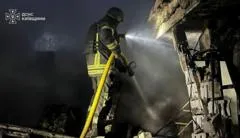
What was the scale of the Russian strike on Ukraine's energy grid?
The overnight offensive represented the most extensive combined attack on Ukraine's energy systems since the conclusion of the previous heating season. Prime Minister Serhiy Koretskyi noted that while daily attacks on energy infrastructure have been a near-constant since the summer, the sheer scale and coordination of this specific mass assault set it apart from recent smaller-scale engagements.
The strikes were not limited to a single location; rather, they were distributed across 11 different regions of the country. According to official reports, the targets included a wide array of civilian and state assets, such as residential buildings, social infrastructure, civilian enterprises, and railway networks. This broad targeting suggests a strategic attempt to degrade the nation's logistical and social stability simultaneously.
Regional impact and casualties
The human cost of the strikes was immediate. In the Kyiv region, Timur Tkachenko reported the death of a child whose body was recovered from the rubble of a destroyed home. In the capital itself, Mayor Vitaly Klischko confirmed three fatalities, one of whom was a utility worker killed at a warehouse. Beyond the capital, the violence extended to the southern Mykolaiv region and the north-eastern Sumy region, where at least two people were killed and a school was struck.
How did the attack impact the Trypilska power station?
The Trypilska thermal power station, located approximately 40km from Kyiv, emerged as a primary target during the Russian offensive. As the largest supplier of electricity to the Ukrainian capital, any damage to this facility has immediate and profound consequences for the stability of the metropolitan power supply. The plant's operator, Centrenergo, has confirmed that the facility sustained damage and is currently conducting assessments to determine the full extent of the technical impact.
The Russian Ministry of Defence justified the targeting of the plant by claiming it serves as a critical supplier for Ukrainian military installations. This narrative highlights the ongoing tension between civilian energy security and military necessity, as infrastructure essential for civilian life is frequently identified by combatants as legitimate military targets. The disruption at Trypilska places additional strain on the national grid, especially as Ukraine prepares for the upcoming winter months.
What is the current state of electricity supplies in Ukraine?
Widespread power outages have affected several major regions, including Kyiv, Dnipropetrovsk, Donetsk, Sumy, and Kharkiv. While some progress has been made in restoring services, the energy sector remains under significant pressure. The private energy firm DTEK reported that it successfully restored power to 8,000 homes following a particularly difficult night in the capital, yet many households remain in the dark.
To manage the diminished capacity of the grid, state-owned operator Ukrenergo has implemented emergency measures to prevent a total system collapse. Residents in affected areas have been advised to limit the use of high-power electrical appliances during specific windows of the day. Specifically, the operator requested that citizens avoid using heavy electrical loads between 10:00 and 16:00 local time, as electricity supplies are currently lower than standard operating levels.
The threat of winter energy insecurity
This latest escalation follows a consistent pattern of energy warfare that has characterized the conflict since the full-scale invasion began in 2022. Ukraine has faced systematic Russian assaults on its energy grid every winter, creating a predictable cycle of infrastructure degradation and emergency rationing. The timing of this September attack suggests a strategic effort to weaken the grid's resilience before the onset of freezing temperatures, which will increase the demand for heating and electricity.
How does the energy conflict intersect with the battlefield?
The strikes on energy infrastructure are occurring alongside intense kinetic activity on the front lines. While Russia continues its campaign against the power grid, Ukraine has maintained its own offensive operations. The Ukrainian military reported striking a drone warehouse in the occupied Donetsk region, a territory that remains part of the approximately 20% of Ukraine currently under Russian control. This highlights the ongoing struggle for control over logistics and supply chains in eastern Ukraine.
On the ground, the conflict shows signs of both localized movement and general stagnation. The Ukrainian Third Army Corps has reported recent successes near the city of Lyman in the Donetsk region, where several settlements were recaptured as part of the ongoing counter-offensive known as Operation Vivaldi. President Volodymyr Zelensky has personally visited troops in these areas to oversee the progress of these operations.
The stalemate of the front lines
Despite the localized gains made during Operation Vivaldi, the broader strategic picture remains largely unchanged. Most analysts and military reports suggest that the front line remains largely stagnant in many sectors. Both the Russian and Ukrainian forces have struggled to achieve decisive breakthroughs, leading to a high-intensity war of attrition where territory changes incrementally while both sides face significant resource exhaustion.
Frequently asked questions
Which regions were most affected by the recent strikes?
The most significant impacts were felt in the Kyiv region and the capital city. However, President Zelensky confirmed that critical infrastructure was also targeted in the Zhytomyr, Mykolaiv, Kirovohrad, and Rivne regions. Eleven regions in total were impacted by the overnight barrage.
What is the status of the Trypilska power station?
The Trypilska thermal power station has sustained confirmed damage following Russian strikes. As the primary electricity provider for Kyiv, its current operational capacity is under assessment by the operator, Centrenergo, to determine how much the damage will affect the capital's supply.
Are there any restrictions on electricity usage in Ukraine?
Yes, Ukrenergo has advised residents to limit the use of powerful electrical appliances between 10:00 and 16:00 local time. This measure is intended to manage the lower-than-usual electricity supplies caused by the damage to the national energy infrastructure.
How many people were killed in the attacks?
At least five people have been confirmed dead across various regions. This includes three fatalities in Kyiv, one person in the Mykolaiv region, and two people in the Sumy region, where a school was also among the targets hit.
What is Operation Vivaldi?
Operation Vivaldi is a Ukrainian counter-offensive currently active in the Donetsk region. Recent reports from the Third Army Corps indicate that the operation has successfully resulted in the recapture of several settlements near the city of Lyman.
Key takeaways
- The recent Russian strike is the largest attack on Ukraine's energy grid since the spring.
- The Trypilska power station, a vital electricity source for Kyiv, sustained damage.
- At least five people were killed, including a child in the Kyiv region.
- Ukenergo has advised restricted electricity usage between 10:00 and 16:00 local time.
- Ukraine's Third Army Corps recently recaptured settlements near Lyman via Operation Vivaldi.
The strategic outlook for Ukraine's energy security
The massive scale of the recent attack underscores the persistent threat to Ukraine's energy security as the winter season approaches. By targeting critical nodes like the Trypilska power station, the offensive aims to diminish the country's ability to maintain essential services for both civilians and military operations. While Ukraine has shown resilience through rapid repairs and localized battlefield successes like Operation Vivaldi, the systematic nature of these strikes suggests a prolonged period of energy instability. The ability of the Ukrainian grid to withstand continued pressure will be a decisive factor in the country's stability in the coming months.