
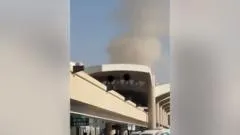
What happened during the latest Riyadh airport attack?
A projectile struck Passenger Hall No 4 at King Khalid International Airport on Sunday, causing a significant fire within the terminal. According to the Saudi civil aviation authority, the strike resulted in the death of a Pakistani resident and left 11 individuals injured. This event follows a much larger and more lethal strike on the same airport just 24 hours earlier, which reportedly caused 13 fatalities and injured 308 people.
Military officials have provided conflicting details regarding the nature of the projectile. Maj Gen Turki al-Maliki, a spokesman for the Saudi-led military coalition, stated that air defences successfully intercepted a missile near the airport. However, authorities were simultaneously managing the aftermath of an "unknown projectile" that breached the terminal and ignited a fire. The rapid succession of these events has created a state of high alert at one of the region's most critical aviation hubs.
How have the Houthis responded to the escalating conflict?
The Houthi movement in Yemen has officially claimed responsibility for the recent series of strikes against Saudi Arabian infrastructure. Brig Gen Yahya Saree, a Houthi military spokesman, confirmed that the group utilized a diverse arsenal, including ballistic missiles, cruise missiles, and drones, to target the Riyadh airport. Beyond the capital, the group also claimed to have targeted oil facilities and Dammam airport in eastern Saudi Arabia within the same 24-hour window.
The Houthi leadership has issued explicit warnings to the international community and the aviation sector. They have advised both airlines and passengers to avoid using Saudi Arabian airports and airspace. Brig Gen Saree vowed to continue "escalating operations deep inside Saudi Arabia," explicitly stating that all Saudi airports remain potential targets, with the sole exceptions being those located in the holy cities of Mecca and Medina. This strategic shift indicates an intent to expand the geographic scope of their military operations.
The Houthi military strategy and objectives
The Houthi strategy appears focused on maximum disruption of Saudi Arabian economic and logistical networks. By targeting international airports and oil facilities, the group aims to exert pressure on the Saudi government and its coalition partners. Their stated motivations for these strikes include:
- Retaliation for Saudi support of government forces during the Yemeni civil war.
- Response to Saudi air strikes on Sanaa International Airport in Yemen.
- Demonstrating the ability to bypass sophisticated air defence systems.
Currently, the Houthis control approximately one-quarter of Yemeni territory but command the loyalty of roughly 80% of the country's population. This demographic weight provides them with significant leverage as they seek total control over Yemen.
What is the international reaction to the strikes?
The international community has responded with a mixture of condemnation and warnings of potential military intervention. US President Donald Trump stated that the United States would "make a decision" and "move very quickly" regarding potential strikes against Houthi positions. Similarly, UK Defence Secretary Wes Streeting suggested that the United Kingdom could "potentially" increase its support for Saudi Arabia in response to the escalating violence.
Diplomatic leaders have expressed profound concern over the human cost of the attacks. US Secretary of State Marco Rubio condemned the strikes and confirmed the death of a US citizen. In the United Kingdom, Foreign Secretary Ed Miliband described himself as "appalled" by the recent developments. The humanitarian impact is reflected in the diverse nationalities of those killed in the recent wave of violence, including citizens from the US, Jordan, Palestine, Syria, Sudan, Egypt, Bangladesh, and India.
| Country | Status of Citizens Impacted |
|---|---|
| United States | Confirmed fatality |
| India | One fatality reported by embassy |
| Pakistan | One fatality reported by aviation authority |
| Bangladesh | Fatalities reported in recent strikes |
| Saudi Arabia | Multiple fatalities reported |
Why has the conflict in Yemen escalated so rapidly?
The recent surge in violence is largely attributed to the collapse of the temporary ceasefire brokered in 2022, which fell apart in July. Since then, the conflict has intensified as the Houthis conducted a rapid offensive to seize strategically important stretches of the Red Sea coast. This move prompted a series of Saudi-led strikes to reclaim those territories, which Yemeni pro-government forces claim to have since secured.
The geopolitical implications of a Houthi victory are a primary concern for regional powers. Saudi Arabia views the potential for a Houthi-controlled Yemen as the establishment of an Iranian satellite state on its southern border. This fear is compounded by the fact that the Houthis are an Iran-backed group. While Iran's Foreign Minister Abbas Araghchi has expressed a willingness to facilitate dialogue between Saudi Arabia and the Houthi administration, the immediate reality remains one of kinetic military engagement.
The impact on Yemeni civilians and infrastructure
The conflict is not limited to Saudi territory; Yemen's own infrastructure is also under heavy fire. Houthi-run Al Masirah TV reported that Saudi-led air strikes hit Sanaa International Airport and a residential home, resulting in the death of a child and several injuries. While Saudi Arabia has not officially confirmed these specific reports, the cross-border nature of the violence continues to place civilian populations at extreme risk.
Frequently asked questions
What weapons are being used in the Riyadh airport attacks?
The Houthis have employed a sophisticated mix of weaponry to conduct these strikes. According to Houthi military spokesman Brig Gen Yahya Saree, the group has used ballistic missiles, cruise missiles, and unmanned aerial vehicles (drones) to target Saudi infrastructure, including airports and oil facilities.
Are Saudi airports still safe for international travel?
Travel safety is currently highly uncertain. The UK Foreign Office is advising against all travel to parts of Saudi Arabia, particularly areas within 10km of the Yemen border. Additionally, Houthi forces have explicitly warned airlines and passengers to avoid Saudi Arabian airspace and airports.
Who are the Houthis and why are they attacking Saudi Arabia?
The Houthis are an Iran-backed armed group that controls about 25% of Yemen. They claim their attacks on Saudi Arabia are a response to Saudi military support for the Yemeni government and retaliatory strikes against Yemeni infrastructure, such as Sanaa International Airport.
What is the geopolitical risk of the Houthi movement's expansion?
The primary risk is the potential establishment of an Iranian satellite state on Saudi Arabia's southern border. If the Houthis achieve total control over Yemen, it could significantly shift the regional balance of power and increase Iranian influence in the Arabian Peninsula.
How has the international community responded to the deaths?
Global leaders, including officials from the US and UK, have condemned the attacks. The US has signaled that it may take rapid military action, while the UK is considering increased support for Saudi Arabia. Various embassies have issued travel warnings to their citizens in the region.
Key takeaways
- The Riyadh airport attack killed one Pakistani resident and injured 11 others.
- Houthis used ballistic missiles, cruise missiles, and drones in recent strikes.
- The 2022 ceasefire between Houthis and Saudi-led forces collapsed in July.
- International leaders in the US and UK have signaled potential military responses.
- The Houthis control 25% of Yemen and 80% of its population.
The shifting landscape of Middle Eastern security
The recent strikes on King Khalid International Airport represent a dangerous escalation in a conflict that has already claimed hundreds of lives. The transition from localized skirmishes to direct attacks on major international aviation hubs marks a significant shift in Houthi military capabilities and intent. As the United States and United Kingdom weigh their responses, the risk of a broader regional conflagration increases. The stability of the Red Sea corridor and the safety of international transit depend heavily on whether diplomatic dialogue, as suggested by Iran, can supersede the current cycle of missile strikes and retaliatory air campaigns.




