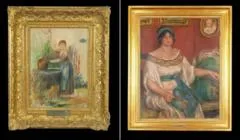
The recovery of the stolen Impressionist works
Authorities have successfully retrieved two significant works by Auguste Renoir that were stolen from a museum in Cagnes-sur-Mer. The recovery marks the end of a month-long search for the missing pieces following a breach of the Renoir Museum on 8 September. According to the local town hall, the heist involved thieves cutting through a perimeter fence and smashing a window to gain entry to the facility.
The two specific artworks identified in the recovery are the 1910 piece Portrait of Madame Colonna Romano and the 1886 painting Jeune fille au puits. During the initial robbery, the perpetrators utilized an electric saw to bypass the frame mountings inside the museum. While the thieves originally made off with four paintings, they reportedly abandoned two of them in the museum's garden while attempting to flee the scene.
The local mayor, Bryan Masson, expressed profound relief regarding the news. He emphasized that the paintings represent more than mere aesthetic value, noting that they are integral to the city's cultural heritage and the lasting legacy Renoir left to Cagnes-sur-Mer. Masson, a member of France's National Rally, highlighted the emotional weight the recovery carries for the local community.
Investigation and suspect arrests
Six individuals have been arrested in connection with the heist at the Renoir Museum, as confirmed by the local town hall. The arrests follow the successful retrieval of the artworks and are part of an ongoing criminal investigation into the theft. While the town hall had initially planned to hold a press conference on Friday to provide more granular details regarding the recovery, the event was ultimately cancelled.
The Renoir Museum serves as a vital repository for the artist's history, housing 12 of his famous works. Beyond the paintings, the museum contains personal artifacts that offer insight into the Impressionist's life, including his easel, wheelchair, personal letters, and various photographs. The security breach at such a site highlights the ongoing vulnerability of cultural institutions to targeted criminal activity.
A rising trend of high-profile art heists in Europe
The theft in Cagnes-sur-Mer is not an isolated incident but rather the latest in a series of sophisticated art robberies across the European continent. Criminal groups have increasingly targeted high-value collections using rapid, high-impact methods. For instance, earlier this year, a raid near the Italian city of Parma resulted in the theft of works by Renoir, Paul Cézanne, and Henri Matisse. That specific heist lasted only three minutes, though those paintings were eventually recovered in August.
France, in particular, has faced significant challenges regarding museum security in recent months. In October of last year, the country experienced one of its most substantial art robberies when the Louvre in Paris was targeted. In that instance, thieves disguised themselves as construction workers to enter the Apollo Gallery during regular opening hours. Using an angle-grinder to breach display cases, they stole approximately €88m (£78m) worth of crown jewels belonging to 19th-century French queens and empresses.
H4: Implications for museum security protocols
The methods used in these recent thefts—ranging from the use of electric saws and angle-grinders to disguising as maintenance staff—suggest a level of premeditation that challenges traditional museum security. The ability of thieves to penetrate fences, smash windows, or even operate during public hours indicates a need for more robust physical and procedural defenses in major cultural institutions.
FAQ
Which Renoir paintings were recovered?
The recovered works include the 1910 painting Portrait of Madame Colonna Romano and the 1886 piece Jeune fille au puits. These two Impressionist masterpieces were stolen during a break-in at the Renoir Museum in Cagnes-sur-Mer on 8 September, following a theft that originally involved four paintings.
How many people were arrested in the investigation?
Six suspects have been arrested in relation to the Renoir Museum heist. The local town hall confirmed these arrests following the recovery of the stolen artworks, as law enforcement continues to investigate the circumstances surrounding the break-in and the theft of the paintings.
What was the method used by the thieves?
The thieves gained entry by cutting through a fence and smashing a window at the museum. Once inside, they reportedly used an electric saw to cut through the frame mountings of the paintings. During their escape, they dropped two of the four stolen paintings in the museum's garden.
Conclusion
The recovery of the Renoir paintings in Cagnes-sur-Mer provides a much-needed victory for cultural preservation and local heritage. While the arrest of six suspects offers a path toward justice, the incident underscores a worrying trend of sophisticated art thefts across Europe. From the rapid raids in Italy to the brazen daylight robbery of the Louvre's crown jewels, the increasing technicality of these heists suggests that museum security must evolve. As authorities continue their investigations, the focus remains on protecting the irreplaceable legacies left by masters like Renoir from increasingly daring criminal operations.