
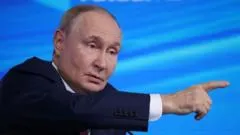
How has the recent Russian election impacted Putin's war strategy?
The recent legislative elections in Russia have provided Vladimir Putin with an unprecedented level of domestic political consolidation to support his military objectives. The process, referred to by some Russian media as "The Special Election Operation," has resulted in a State Duma that is more aligned with the Kremlin than previous iterations. The ruling party, United Russia, has secured a higher number of seats than ever before, allowing the leadership to claim a massive popular mandate for its ongoing policies.
This political dominance serves a specific strategic purpose: it legitimizes the continued conduct of the "special military operation" and minimizes domestic opposition to the mounting costs of the conflict. By framing the war as a mission supported by the Russian people, the Kremlin can more easily justify the economic sacrifices and the high rate of casualties reported from the front lines. This mandate provides the political cover necessary to maintain a high-intensity war footing without immediate fear of legislative or internal institutional pushback.
What role does hybrid warfare play in Moscow's approach to Europe?
Moscow is increasingly utilizing hybrid warfare to pressure European nations and diminish their support for Kyiv. This "grey zone" strategy operates in the space between traditional peace and open military conflict, involving cyber-attacks, acts of sabotage, and airspace violations. A notable recent example includes the discovery of a drone carrying an explosive device near Ukrainian cargo planes at Leipzig airport in Germany.
The Kremlin's objective with these actions is not necessarily to trigger a direct military confrontation with NATO, but rather to create enough instability and fear to erode the political will of European governments. By targeting infrastructure and security, Russia aims to convince Western leaders that supporting Ukraine comes at too high a cost to their own domestic stability. This strategy seeks to sever the financial and military lifeline that currently sustains the Ukrainian defense.
The Kremlin's perspective on European involvement
Russian officials have explicitly reframed the conflict to suggest that Europe is a primary combatant. Foreign Minister Sergei Lavrov has argued that the West is waging a war against Russia by supplying the weaponry used in the conflict. From the Kremlin's viewpoint, the destruction of Western-supplied missiles and drones is not an act of defense against an invader, but a necessary response to a European-led war of aggression. This narrative is used to justify Russian actions as defensive measures against a "Nazi regime" backed by the West.
Why is the Russian leadership maintaining high military pressure in Ukraine?
The Kremlin remains confident in its ability to secure a military victory despite the significant losses sustained over the last four and a half years. Moscow is reportedly encouraged by the perceived shortage of air defense missiles within Ukraine, which allows Russian forces to increase the frequency and intensity of their strikes. This tactical advantage is being leveraged to increase pressure on Ukrainian infrastructure and civilian resilience, particularly as winter approaches.
Reports from the ground suggest that the introduction of new jet-powered drones and ballistic missiles has complicated Kyiv's ability to maintain an effective air defense umbrella. This technological and tactical shift is intended to degrade Ukraine's capacity to function as a sovereign state. The strategic goal appears to have shifted from mere territorial occupation to the total neutralization of Ukraine as a viable political and military entity.
What are the implications of the escalating nuclear rhetoric?
The discourse surrounding the potential use of nuclear weapons has become significantly more prominent among Russia's strategic elite. Sergei Karaganov, the honorary chairman of Russia's Council for Foreign and Defence Policy, has warned that if Europe does not "surrender" its support for Ukraine, Russia may be forced to escalate to nuclear options. Karaganov has suggested that the initial stages of such an escalation would be conventional, but the ultimate consequence of continued Western involvement would be nuclear.
This rhetoric serves several functions. First, it acts as a psychological tool intended to frighten European populations and policymakers into reducing their military aid. Second, it signals a departure from traditional deterrence models, suggesting that Russia is willing to contemplate extreme measures to achieve its geopolitical goals. While such threats are often viewed as coercive diplomacy, the increasing frequency of these statements from high-level strategists indicates a hardening of the Kremlin's long-term strategic outlook.
Comparing Russian and Western use of force
The debate over the legitimacy of "brute force" has become a central pillar of Russian diplomatic messaging. During recent international forums, Russian leadership has accused the West of using force under the guise of soft power, citing US operations in South America and the Middle East. This is a deliberate attempt to highlight perceived Western double standards and to frame Russia's military actions in Ukraine as a legitimate struggle against Western-backed aggression. By characterizing the conflict as a defensive necessity, Moscow attempts to bypass international legal norms that condemn its invasion.
Key takeaways
- The United Russia party has secured a historic mandate in the State Duma, strengthening Putin's domestic control.
- Russia is actively employing hybrid warfare, including sabotage and cyber-attacks, to destabilize European security.
- Moscow is leveraging a shortage of Ukrainian air defenses to increase strikes with ballistic missiles and drones.
- High-level Russian strategists are increasingly using nuclear escalation rhetoric to deter Western military aid.
- The Kremlin's stated goal includes the permanent removal of Ukraine as a viable sovereign state.
FAQ: Putin's war strategy
Is Russia planning a direct invasion of a NATO country?
Current evidence suggests that a direct military conflict with a NATO member is unlikely. Instead, Russia appears focused on using hybrid warfare and "grey zone" tactics to intimidate European nations and reduce their willingness to provide military and financial assistance to Ukraine.
What is the goal of Russia's hybrid warfare in Europe?
The primary objective is to create domestic political pressure within European countries. By utilizing cyber-attacks, sabotage, and airspace violations, Moscow seeks to convince Western governments that the cost of supporting Ukraine is too high for their own national security.
How is Russia justifying its use of force in Ukraine?
The Kremlin uses a narrative that characterizes Ukraine as a neo-Nazi state and views Western military aid as a direct act of war against Russia. This allows Moscow to frame its invasion as a defensive measure against Western-backed aggression.
What does "doing away with Ukraine as a viable state" mean?
This refers to a strategic objective to degrade Ukraine's military, economic, and political infrastructure so thoroughly that it can no longer function as an independent, sovereign nation capable of resisting Russian influence or maintaining its borders.
Why is nuclear rhetoric increasing in Russia?
Nuclear threats are used as a tool of coercive diplomacy. By suggesting that escalation is inevitable if Western support continues, Russian strategists aim to frighten European leaders into abandoning their military commitments to Kyiv.
Conclusion
The trajectory of Putin's war strategy indicates a long-term commitment to a high-intensity conflict that extends beyond the borders of Ukraine. Through the combination of domestic political consolidation, the deployment of hybrid warfare against Europe, and the use of extreme nuclear rhetoric, the Kremlin is attempting to reshape the European security architecture. While the economic and human costs to Russia are substantial, the current leadership appears focused on the strategic goal of neutralizing Ukraine's sovereignty. As Moscow continues to intensify its military and psychological pressure, the stability of the European continent remains under significant threat.