
Why is the US returning to public executions after 90 years?
The decision to livestream a military execution marks the first major move toward public capital punishment in the United States since the mid-20th century. Secretary of Defense Pete Hegseth announced that the execution of Nidal Hasan, who killed 13 soldiers at Fort Hood in 2009, will be broadcast to the public. The Pentagon has specified that the method will be a firing squad, and the event will be live-streamed to ensure the public understands the severity of such crimes.
Hegseth emphasized the deterrent aspect of the decision, stating that people must grasp the serious consequences associated with these types of actions. This shift moves the execution from a private, administrative process back into the public consciousness, albeit through a digital medium rather than a physical crowd. This transition has sparked immediate concern among scholars and human rights advocates who view the move as a regression in judicial standards.
The shift from physical crowds to digital audiences
Unlike the massive physical gatherings of the past, the modern iteration of public execution relies on digital reach. While a physical crowd in the 1930s was limited by geography, a livestream can potentially reach millions of viewers simultaneously. This technological capability transforms the execution from a local event into a global spectacle, raising questions about the role of media in the administration of justice.
What was the history of public executions in the US?
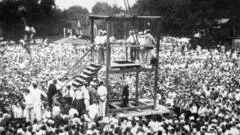
The history of public executions in America was defined by large-scale, often chaotic gatherings that eventually led to a nationwide shift toward private methods. The most notable historical reference point is the execution of Rainey Bethea in Owensboro, Kentucky, on August 14, 1936. An estimated 20,000 people gathered to witness the hanging of Bethea, who had been convicted of the rape and murder of 70-year-old Lischia Edwards.
The Bethea execution was characterized by a "carnival" atmosphere. Spectators traveled from as far as New York and Chicago, with some arriving the night before to secure spots. The event featured vendors selling popcorn and soda, and even drew attention to the "Lady Executioner"—the widow of a former sheriff. However, the sheer scale and perceived lack of dignity in the proceedings embarrassed Kentucky officials. Consequently, the governor outlawed public executions in the state 18 months later. While a smaller execution occurred in Missouri in 1937, the Bethea event remains the definitive end of the era of mass public hangings in the US.
How does the Hasan execution differ from historical precedents?
The upcoming execution of Nidal Hasan represents a fundamental change in how the state communicates justice through death. While historical executions like Bethea's relied on physical presence and local spectacle, the Hasan execution is designed for a digital, mass-audience experience. The use of a firing squad is a traditional military method, but the addition of a livestream introduces a level of visibility previously unseen in the American legal system.
The motivations behind the Hasan execution are tied to the nature of his crime. Having killed 13 unarmed fellow soldiers at the Fort Hood military base in 2009, the administration views the public nature of his death as a necessary component of military discipline. This contrasts with the 1930s, where public executions were often driven by local curiosity and social gatherings; the modern approach is a deliberate policy choice by the Department of Defense to broadcast the consequences of treason and mass violence.
The role of political leadership in the decision
The decision has been supported at the highest levels of the US administration. President Donald Trump has confirmed his approval of the livestreaming, stating that the death penalty is a "very worthy way of going" for Hasan. While he avoided commenting on whether he would personally watch the broadcast, his support underscores the administration's stance on using the execution as a visible tool of justice.
What are the societal and psychological implications?
Sociologists and scholars suggest that the return to public executions may reflect deep-seated political polarization and a changing public perception of violence. Kurt Gray, a social psychology professor at Ohio State University, suggests that while many Americans may not actively seek blood, the current political climate may have desensitized the population. He notes that some citizens might view the livestream not as an event to cheer, but as an inevitability of the current era.
However, many experts argue that this move contradicts long-term trends in American attitudes toward capital punishment. Michael Radelet, a professor emeritus and scholar of the death penalty, noted that public support for the death penalty has declined significantly. According to Radelet, support stood at 80% in 1994 but has since dropped to 52%, largely because many people prefer the alternative of life without parole.
The psychological impact on the American identity is also a point of contention. Critics argue that moving toward televised executions aligns the United States with nations known for human rights concerns. Sonya Lea, a researcher of the Bethea execution, expressed horror at the prospect of using technology to recreate the "carnival of sadism" seen in 1936. Similarly, Garen Wintemute of the University of California, Berkeley, argued that a public execution is fundamentally at odds with the aspirations of the country, noting that survey data suggests a declining appetite for violence among the American public.
FAQ: Public executions in the US
Why is Nidal Hasan being executed by firing squad?
Nidal Hasan is being executed by firing squad as a military punishment for his role in the 2009 Fort Hood killings. The Pentagon has selected this traditional military method and decided to livestream the event to demonstrate the severe consequences of such actions to the public.
How much has support for the death penalty changed?
Support for the death penalty in the United States has seen a significant decline over recent decades. According to scholar Michael Radelet, public support was as high as 80% in 1994, but has since fallen to approximately 52%, as many favor life without parole instead.
What was the last major public execution in the US?
The last high-profile public execution was the hanging of Rainey Bethea in Owensboro, Kentucky, in August 1936. The event drew an estimated 20,000 spectators and was characterized by a festive, almost carnival-like atmosphere, which eventually led to the banning of public executions in Kentucky.
Will the Hasan execution be televised?
Yes, the Department of Defense has confirmed that the execution of Nidal Hasan will be live-streamed. This decision aims to ensure the public witnesses the consequences of the crimes committed at Fort Hood, marking a return to public visibility for capital punishment.
What do human rights advocates say about the livestream?
Human rights advocates and religious leaders have criticized the decision, calling it "barbaric." Critics argue that livestreaming an execution turns judicial punishment into a form of entertainment and moves the United States away from its democratic and human rights aspirations.
Key takeaways
- The US military will execute Nidal Hasan via a live-streamed firing squad.
- Public support for the death penalty has dropped from 80% in 1994 to 52% recently.
- The last major public execution occurred in 1936 with the hanging of Rainey Bethea.
- The decision to livestream aims to demonstrate the consequences of mass violence.
Conclusion
The return to public executions via digital livestreaming represents a significant shift in the American approach to capital punishment. By moving from the private executions of the last century back into the public eye, the US government is attempting to use Nidal Hasan's death as a visible deterrent. However, this decision faces intense scrutiny from scholars, religious leaders, and the public. As the nation grapples with the tension between seeking justice and maintaining human rights standards, the Hasan execution will serve as a critical test of whether the US is embracing a new era of televised retribution or regressing into historical patterns of spectacle.




