
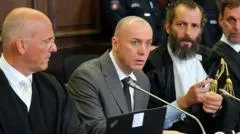
What charges does the prosecution bring against Serhii Kuznetsov?
German federal prosecutors have brought serious charges against Serhii Kuznetsov, accusing him of playing a leading role in a team of saboteurs that destroyed the Nord Stream gas pipelines. The indictment specifically alleges that Kuznetsov, a 50-year-old former officer in the Ukrainian army, ordered a group consisting of professional divers, a boat captain, and an explosives expert to carry out the attack on civilian infrastructure.
The prosecution has framed this operation not merely as property damage, but as a war crime under Germany’s code of crimes against international law, categorizing the event as an "attack by military means against civilian objects." Central to the prosecution's narrative is the allegation that the saboteurs conceived and executed the plot while acting by order of Ukrainian state agencies. To support these claims, investigators point to the discovery of subsea explosive traces in samples taken from the Andromeda, a yacht rented in the northern German port of Rostock which was used by the group. The case rests on the determination that the act was a direct threat to the stability of the region, leading the German federal court of justice to rule in January 2025 that the matter fell within German territorial jurisdiction because it involved "undermining [Germany's] internal security."
How does the defence contest the evidence and procedure?
The defence has mounted a vigorous challenge to both the substance of the evidence and the legality of the proceedings. Italian defence lawyer Nicola Canestrini, representing Kuznetsov, has argued that despite a thorough four-year investigation, the prosecution has failed to produce any direct forensic links to the defendant. "They did not find one single witness, they did not find no forensics, no DNA, no fingerprints - nothing!" Canestrini told the BBC outside the courtroom, emphasizing that the case currently relies entirely on circumstantial evidence.
Beyond the lack of physical evidence, the defence has raised fundamental concerns regarding the right to a fair trial. They argue that because Kuznetsov was a soldier, he is bound by military secrecy. This creates a legal paradox: if the defendant has an alibi involving a secret military operation, he cannot disclose those details to his lawyers to build a defence without violating his professional obligations. This inability to summon witnesses or provide specific details regarding his whereabouts is, according to the defence, a barrier to justice. Furthermore, the defence has challenged the validity of the extradition process itself, noting that the specific war-crime allegations were not mentioned at the time the European arrest warrant was initially processed.
Why was jurisdiction transferred to Germany?
The question of whether Germany had the right to prosecute an event occurring in international waters was a significant legal hurdle. In January 2025, the German federal court of justice issued a decisive ruling, stating that the case fell within German territorial jurisdiction. The court's reasoning was rooted in the impact of the sabotage rather than just the physical location of the pipelines.
Because the destruction of the Nord Stream pipelines was seen as an act that undermined Germany's internal security, prosecutors were deemed to have a legal responsibility to act. This ruling allowed the German judiciary to take the lead in an investigation that had previously involved various international actors, including investigators from Sweden and Denmark, before those nations eventually shut down their own inquiries.
What political tensions surround the Hamburg proceedings?
The trial takes place against a backdrop of intense geopolitical sensitivity. Germany has been one of Ukraine's closest allies since Russia's full-scale invasion in February 2022, and the Nord Stream blasts occurred just seven months after that invasion. The indictment's allegation of Ukrainian state involvement creates a friction point between the judicial process in Berlin and the diplomatic stance in Kyiv.
Ukrainian President Volodymyr Zelensky has consistently maintained that Ukraine had "nothing to do with [the Nord Stream blasts]." This sentiment is echoed by Oleksandr Merezhko, chair of the Foreign Affairs Committee in the Ukrainian parliament, who characterized the German account as merely "one of the versions." Merezhko further argued that the Nord Stream 2 pipeline was essentially a tool used by Russia to prepare for war, suggesting the infrastructure itself was part of the conflict landscape. In contrast, Stefan Meister of the German Council on Foreign Relations noted that German chancellors have made concerted efforts to "depoliticise" the case. By handing the investigation to the judiciary and attempting not to make it a "big story," Berlin has sought to ensure that the legal pursuit of justice does not derail its strategic and political support for Ukraine.
How have other European courts handled related extradition requests?
The legal handling of the Nord Stream suspects has been inconsistent across Europe, highlighting different judicial interpretations of the event's legality. While Kuznetsov was extradited from Italy following his arrest near Rimini in August 2025, other suspects have seen different outcomes.
In a notable contrast, a Polish court ordered the release of another Ukrainian man, Volodymyr Zhuravlov, in October 2025. The Polish judge ruled that the attack on the pipelines was not unlawful, suggesting that if Ukraine had organized an armed mission, it was "justified, rational and just" within the context of the ongoing war. Meanwhile, a second suspect is currently fighting extradition from Croatia. These divergent rulings—where one court sees a criminal act of sabotage and another sees a justified wartime action—underscore the complex legal and moral landscape surrounding the investigation.
Frequently asked questions
When did the Nord Stream explosions occur?
The explosions occurred on 26 September 2022 in the Baltic Sea, near the island of Bornholm, damaging three of the four gas pipelines.
Who is the main suspect on trial in Hamburg?
Serhii Kuznetsov, a 50-year-old former Ukrainian army officer, is the first suspect to go on trial. He was extradited from Italy after being arrested in August 2025.
Has Ukraine accepted responsibility for the attacks?
No. President Zelensky has maintained that Ukraine had no involvement, and Ukrainian officials have described the German allegations as just one version of events.
What evidence has been made public so far?
Prosecutors have cited traces of subsea explosives found on the yacht Andromeda, which was rented by the group in Rostock.
Could the trial affect German support for Ukraine?
While the case is sensitive, German officials have attempted to keep the proceedings within the judiciary to prevent them from becoming a political issue that impacts bilateral relations.
Key takeaways
- Serhii Kuznetsov faces war-crime charges in Hamburg for allegedly leading the 2022 Nord Stream sabotage.
- Prosecutors allege the attack was ordered by Ukrainian state agencies.
- The defence argues there is a total lack of DNA, fingerprint, or witness evidence.
- A Polish court previously ruled that such an attack by Ukraine could be considered "justified."
- Germany asserts jurisdiction because the blasts undermined its internal security.
Conclusion
The Hamburg trial represents a pivotal moment for both the German judiciary and European international law. As the court weighs circumstantial evidence against the high threshold required for war crime convictions, it must navigate a minefield of military secrecy and conflicting international legal rulings. The verdict will not only determine the fate of Serhii Kuznetsov but will also serve as a litmus test for how democratic nations balance the pursuit of criminal justice with the complexities of wartime alliances and national security.




