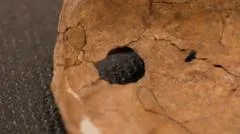
What does the shoulder blade wound indicate about the cause of death?
The circular perforation measures 15 millimetres across and shows clean edges inconsistent with natural breakage or animal attack. Researchers reconstructed the trajectory and concluded a wooden spear entered the chest and exited through the left shoulder blade. This path would have traversed the lung and major blood vessels, producing a fatal injury. The individual, labelled Shanidar A, also yielded a right hand, three ribs and teeth, but the shoulder blade provides the clearest trauma evidence. Experiments with replica wooden spears produced matching round holes in bone, supporting the interpretation of a sharpened wooden projectile.
Could the injury have resulted from hunting rather than conflict?
The study authors leave open the possibility of a hunting accident or friendly fire during a group pursuit. The wound location aligns with a potential heart shot, which might occur in either scenario. However, the precise circular shape and entry-exit alignment make accidental self-injury or animal goring less likely. Prof Chris Stringer of the Natural History Museum considers rival attack the more plausible explanation given the wound position and extent. No stone tool fragments were associated with the injury, pointing specifically to wooden spear technology.
Comparison with earlier Shanidar remains
Excavations in the same cave during the 1950s uncovered at least ten Neanderthal individuals. One set of remains dated around 50,000 years ago displayed a partly healed rib wound attributed to a stone-tipped spear. The new find extends the timeline of possible spear use in the region by roughly 25,000 years and introduces wooden rather than stone weaponry.
How does this discovery fit with evidence from the Pit of Bones?
A 2022 study examined 20 early Neanderthal skulls from northern Spain dated to approximately 430,000 years ago. Researchers identified 57 healed head injuries and nine potentially fatal fractures. Six individuals showed similar puncture wounds at the back-left of the skull, suggesting repeated deliberate blows rather than random accidents. One skull carried two wounds likely inflicted by the same object. These patterns indicate lethal violence occurred among Neanderthal populations hundreds of thousands of years before the Shanidar A individual.
When did organised conflict emerge in human prehistory?
For decades, many archaeologists associated the onset of organised warfare with the advent of farming and permanent settlements. Evidence from hunter-gatherer sites and earlier hominin groups has pushed individual killings much further back. The current debate centres on frequency: whether sporadic lethal encounters were rare or relatively common, and at what point they evolved into sustained group conflict. The accumulating skeletal trauma data, including the Shanidar and Pit of Bones cases, suggest violence formed part of Neanderthal social dynamics well before agriculture.
Frequently asked questions
What species is Shanidar A?
Shanidar A belongs to Neanderthals, a separate human species that lived across Europe and western Asia until extinction around 40,000 years ago.
Where exactly was the remains found?
The bones were recovered from Shanidar Cave in Iraqi Kurdistan during renewed excavations building on 1950s work.
Is wooden spear use confirmed elsewhere in the Middle East at this date?
The wound represents the first proposed evidence for sharpened wooden spears in the prehistoric Middle East according to the lead author.
Did Neanderthals overlap with Homo sapiens?
Yes, the two species coexisted in parts of Europe and Asia for several thousand years before Neanderthal disappearance.
Are there other signs of violence at Shanidar Cave?
Yes, a second individual from around 50,000 years ago shows a partly healed rib injury consistent with a stone-tipped spear.
Key takeaways
A 15 mm circular hole in the left shoulder blade of Shanidar A suggests death from a wooden spear thrust approximately 75,000 years ago.
The wound trajectory indicates the spear passed through the chest, likely damaging lung and major vessels before exiting the shoulder.
Researchers consider both hunting accident and interpersonal violence possible, with rival attack viewed as more probable by independent experts.
Similar trauma patterns appear in 430,000-year-old remains from Spain, showing repeated lethal head injuries among early Neanderthals.
These cases push evidence of individual killings far earlier than the previously assumed link to farming societies.
Conclusion
The Shanidar A shoulder blade injury supplies one more data point in a growing collection of skeletal evidence for lethal violence among Neanderthals. While the precise circumstances remain open to interpretation, the find aligns with patterns observed at much older sites and challenges earlier assumptions that such conflict emerged only with agriculture. Continued excavation and analysis of trauma on prehistoric remains will help clarify how common these events were and how they relate to the later development of organised warfare.