
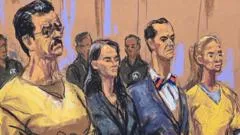
What happened during the New York court appearance?
Nicolás Maduro and Cilia Flores entered pleas of not guilty to recent charges of conspiracy to commit torture during a hearing in New York on Thursday. The former Venezuelan leader addressed the court through a translator, explicitly rejecting the allegations presented by US government prosecutors. Maduro characterized the claims as "false accusations and false testimony," stating his total rejection of the indictment.
The proceedings were marked by direct intervention from the presiding judge, Alvin Hellerstein. When Maduro attempted to address the charges, Judge Hellerstein interrupted the defendant, ultimately declaring that the court would formally enter a plea of not guilty on Maduro's behalf. Cilia Flores also utilized a translator to declare her complete innocence to the court.
Observers noted the physical appearance of the defendants, who were dressed in beige jail uniforms. Both Maduro and Flores appeared to have experienced weight loss since their initial detention in Brooklyn following their capture in January. The couple remains in custody at the Metropolitan Detention Center while awaiting their trial, which is currently scheduled to commence in June 2027.
What are the specific allegations regarding torture and repression?
US prosecutors allege that Maduro and Flores oversaw a systematic and violent regime of repression designed to control the Venezuelan population. The new indictment, released last week, claims the couple "created and maintained a violent system of repression" that led to the harassment, torture, and killing of thousands of Venezuelans. These allegations move the legal focus from financial and drug-related crimes to direct human rights violations.
The indictment provides a harrowing list of specific methods allegedly used under the direction or authorization of the former leaders. According to the prosecution, these methods included:
- Electric shocks and asphyxiation
- Rape and forced nudity
- Prolonged isolation and punishment cells
- Starvation and psychological torture
Furthermore, the US government alleges that Maduro authorized these torture methods against specific individuals. Notably, the prosecution has also included claims that US citizens were targeted and tortured under this established system of repression.
The scope of the prosecution's evidence
The prosecution's case is built on the premise that these acts were not isolated incidents but were part of a structured, state-sanctioned system. By linking the leadership directly to these methods, the US government seeks to prove a conspiracy to commit torture rather than just individual acts of violence. This distinction is critical for the upcoming trial in 2027, as it establishes the level of command responsibility required for conviction under US law.
How do the existing narco-terrorism charges impact the case?
The new torture-related charges are an expansion of a much broader legal framework involving narco-terrorism and weapons-related offenses. Before the recent indictments, the US government had already accused Maduro of engaging in drug trafficking and forming criminal partnerships with cartels designated as terrorist organizations. These existing charges involve a conspiracy to distribute cocaine and facilitate illegal weapons movement.
The legal strategy of the US government appears to be a multi-pronged approach, targeting both the financial mechanisms of the former regime and its methods of domestic control. By combining narco-terrorism charges with human rights violations, prosecutors are building a case that addresses both the destabilization of regional security and the internal suffering of the Venezuelan people. The intersection of organized crime and state-sponsored violence forms the core of the government's argument against the former leaders.
Why are the defendants claiming sovereign immunity?
The legal defense for Maduro and Flores centers on the principle of sovereign immunity, arguing that their status as leaders of a sovereign nation protects them from the jurisdiction of US courts. Their lawyers contend that the US military raid conducted in January to capture them was an illegal act of aggression. They argue that a head of state cannot be subjected to the criminal processes of another nation for actions taken while in office.
Maduro has historically framed these legal actions as politically motivated. He has previously described the US charges as a tool used by foreign powers to further "imperial" agendas, specifically aimed at gaining control over Venezuela's significant oil reserves. This defense seeks to shift the narrative from criminal liability to a violation of international law and national sovereignty.
The challenge of the immunity argument
The application of sovereign immunity in cases involving alleged international crimes is a complex area of law. While traditional immunity often protects heads of state, many legal scholars argue that such protections may not extend to crimes against humanity or systemic torture. The court will have to decide whether the alleged actions of the Maduro administration fall under protected sovereign functions or if they constitute international crimes that bypass traditional immunity protections.
What is the current status of the defendants' detention?
Maduro and Flores are currently held at the Metropolitan Detention Center in Brooklyn. The conditions of their detention have become a point of legal contention, particularly regarding the health of Cilia Flores. Flores has unsuccessfully petitioned the court for release on bond, citing significant medical concerns including heart problems and other health issues exacerbated by her time in custody.
The detention has been described as difficult, with some activists and observers highlighting the harshness of the facility. The legal battle over their physical well-being and the legality of their confinement will likely continue as the June 2027 trial date approaches. For now, the defendants remain in federal custody, facing a combined weight of drug trafficking and human rights charges that represent some of the most serious allegations brought by the US justice system against foreign leaders.
Frequently asked questions
What are the primary charges against Nicolás Maduro?
Maduro faces a wide range of charges including narco-terrorism, drug trafficking, and weapons-related offenses. Most recently, the US government added charges of conspiracy to commit torture, alleging he participated in a system of violent repression that harmed thousands of Venezuelans and potentially included US citizens.
On what grounds are Maduro and Flores defending themselves?
The defendants argue that they are entitled to sovereign immunity as leaders of a sovereign nation. They also contend that the US military operation used to capture them in January was illegal and that the various accusations brought against them are false and politically motivated.
When is the trial for Maduro and Flores scheduled to begin?
The trial for Nicolás Maduro and Cilia Flores is currently scheduled to take place in June 2027. Until that time, both individuals remain incarcerated in the United States, specifically at the Metropolitan Detention Center in Brooklyn, New York.
What specific torture methods are mentioned in the indictment?
The indictment alleges that the repression system utilized several brutal methods. These include electric shocks, asphyxiation, rape, forced nudity, prolonged isolation, starvation, the use of punishment cells, and various forms of psychological torture directed at individuals within Venezuela.
Has Cilia Flores been granted any legal relief regarding her detention?
No, Cilia Flores has not been granted release on bond. Despite her legal team's efforts to secure her release based on her heart problems and other health issues, she remains detained at the Metropolitan Detention Center in Brooklyn awaiting trial.
Key takeaways
- Maduro and Flores pleaded not guilty to new conspiracy to commit torture charges in New York.
- The indictment alleges a violent system of repression involving electric shocks, starvation, and psychological torture.
- The defendants are utilizing sovereign immunity as their primary legal defense against US jurisdiction.
- The trial for these combined narco-terrorism and torture charges is set for June 2027.
Conclusion
The legal proceedings in New York represent a significant escalation in the US government's efforts to hold the former Venezuelan leadership accountable. By introducing charges of conspiracy to commit torture alongside existing narco-terrorism allegations, prosecutors are attempting to address both the criminal and humanitarian dimensions of the Maduro administration's tenure. While the defense relies heavily on the principle of sovereign immunity and claims of political persecution, the scale of the alleged atrocities presents a profound challenge to the court. The outcome of the 2027 trial will likely serve as a landmark decision regarding the intersection of international law, state sovereignty, and human rights accountability.




