
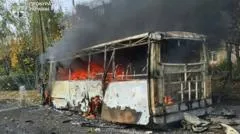
What happened during the Russian strike on buses in Kramatorsk?
A Russian glide bomb attack on two civilian buses in the eastern front-line city of Kramatorsk killed at least 30 people, according to rescue officials. The strike also impacted the nearby village of Bilenke, which is part of the Kramatorsk community, where three additional deaths were reported. Donetsk regional head Vadym Filashkin confirmed that 18 other people sustained injuries during the incident.
Filashkin accused Russian forces of deliberately targeting passenger vehicles to maximize civilian casualties. Local prosecutors released images depicting the aftermath, showing the charred remains of the bus shells and debris scattered across the road alongside victims. The Kramatorsk city council characterized the event as a "horrific crime" committed by the Russian army against a civilian population, noting that the strike hit a location where there were absolutely no military targets.
In response to the extreme danger, authorities ordered a total halt to all public transport in the area. Filashkin appealed to anyone still in the eastern front-line region to move to safer parts of Ukraine, stating that the safety of civilians is paramount and that officials have no right to risk the lives of passengers and drivers given the sharp deterioration in security.
How are glide bombs contributing to the surge in civilian casualties?
Glide bombs have become a primary instrument in the increased frequency of Russian strikes against Ukrainian urban centers like Slovyansk and Kramatorsk. Unlike standard gravity bombs, these munitions are equipped with winglets that allow them to glide toward a designated target after being released, rather than simply falling. This capability allows them to be launched from distances that can keep aircraft safer from immediate air defense while still reaching their targets.
The use of these weapons has led to high-intensity bombardment. For example, in late August, as many as nine glide bombs were fired at Kramatorsk in a single day. This technology has enabled a sustained and deadly presence over cities that were previously considered part of a "fortress belt" that Moscow is currently attempting to seize.
The tactical use of glide bombs in Donbas
The deployment of these weapons is central to the Kremlin's objective to capture the remaining 20% of the Donetsk territory still held by Ukraine. While much of the Luhansk region is already under Russian control, the fight for the Donbas industrial region remains intense. Kramatorsk, which has historically acted as a vital logistics and supply hub for the Ukrainian military, is now under almost daily Russian attack as the military front moves closer to the east of the city.
The "fortress belt" of cities, including Kramatorsk and neighboring Slovyansk, is being targeted as part of President Vladimir Putin's claim to the entire Donbas region. Moscow frequently justifies its invasion by citing the "liberation" and "protection" of the predominantly Russian-speaking Donbas, though Ukraine and its allies reject these claims as baseless. The use of glide bombs ensures that even as the front lines shift, urban centers remain under constant threat.
Why are civilian deaths in Ukraine increasing so rapidly?
The scale of human loss in Ukraine has reached unprecedented levels. According to the UN, Ukraine saw more civilians killed by August this year than were killed in all of 2025. This surge is driven by frequent, heavy strikes on high-density residential areas and critical infrastructure.
A recent example occurred in Pryluky, east of Kyiv, where a single attack destroyed a five-storey block of flats. That strike killed 22 people, including five children, three of whom were only one year old. Such attacks underscore the vulnerability of civilian populations to the current Russian military strategy.
Beyond direct kinetic strikes, the ongoing bombardment of the energy grid is creating secondary humanitarian crises. In Kyiv, strikes on key infrastructure have caused power outages that affect water supplies and public transport. Local water authorities in the capital warned that pressure was dropping across the city's right bank due to these power cuts. Furthermore, the Kyiv metro network briefly halted all train traffic due to a voltage drop from "external power centres," highlighting how the war is disrupting the most basic necessities of life for millions.
What is the international and political response to these attacks?
Ukrainian President Volodymyr Zelensky has called for a harsh international reaction, stating that Russia is trying to destroy all life in the Donbas. He has urged international partners to provide "concrete action" through new defense packages to protect Ukraine. Zelensky emphasized that the current lack of interceptor missiles leaves Ukraine with little chance to stop incoming Russian ballistics, as these missiles are in short supply globally.
In the United Kingdom, Foreign Secretary Ed Miliband visited the site of the Pryluky strike alongside Zelensky and condemned the attacks as evidence of Putin's "evil intent and evil strategy." To counter the Russian military capability, Miliband announced a new wave of sanctions targeting several key sectors, including:
- The Russian "war machine" and the financing of the war.
- The "shadow fleet" used for oil transport.
- International oil companies.
- Cryptocurrency channels used for war funding.
The UK government has reaffirmed its commitment to supporting Ukraine "as long as it takes" for the country to prevail in the conflict.
How is the conflict affecting the stability of the Donbas region?
The Donbas region remains the central focus of the Russian offensive. As the military moves closer to the eastern edges of cities like Kramatorsk, the distinction between military objectives and civilian life continues to vanish. The constant air raids, sirens ringing virtually non-stop in cities like Kyiv, and the destruction of logistics hubs have forced a fundamental shift in how Ukrainians live.
In Kyiv, the threat of attacks is forcing schoolchildren out of classes and into underground shelters, while businesses are being shuttered. In the Donbas, the deterioration of security is so severe that residents are being urged to flee to safer parts of the country. The conflict has evolved into a cycle of long-range strikes, with both sides intensifying attacks on data centres and logistics warehouses. Recently, Russian state-run media reported that several websites in Russia were inaccessible following a Ukrainian drone attack on a Yandex data centre.
Frequently asked questions
What is the current death toll in the Kramatorsk bus strike?
At least 30 people were killed in the Russian glide bomb attack on two civilian buses in Kramatorsk. Additionally, three people died in the village of Bilenke, and 18 others were wounded, according to Donetsk regional head Vadym Filashkin.
Why are glide bombs used in these attacks?
Glide bombs are fitted with winglets that allow them to glide toward targets rather than simply falling. This technology allows for longer-range strikes and increased precision, as seen in the frequent attacks on cities like Slovyansk and Kramatorsk.
How does the UN view the current casualty rates in Ukraine?
The UN has noted a dramatic surge in civilian casualties. According to UN data, the number of civilians killed in Ukraine by August this year has already exceeded the total number of civilian deaths recorded throughout the entirety of 2025.
What impact do Russian strikes have on Kyiv's infrastructure?
Strikes on the energy grid cause power outages that affect water supplies and public transport. In Kyiv, voltage drops have caused the metro network to halt traffic briefly and have led to dropping water pressure on the city's right bank.
What sanctions has the UK announced in response to the strikes?
UK Foreign Secretary Ed Miliband announced new sanctions targeting Russia's war machine, the shadow oil fleet, cryptocurrency-related war financing, and various oil companies to restrict the Kremlin's ability to fund its military operations.
Key takeaways
- A Russian glide bomb strike on civilian buses in Kramatorsk killed at least 30 people.
- UN data shows civilian deaths in Ukraine by August this year have already surpassed the 2025 total.
- Glide bombs use winglets to glide toward targets, increasing strike range and frequency.
- The UK has introduced new sanctions against Russia's shadow fleet and crypto-financing.
- Infrastructure attacks in Kyiv have caused water pressure drops and metro disruptions.
Conclusion
The recent strike on civilian buses in Kramatorsk underscores a broader, lethal pattern of Russian attacks targeting the Ukrainian civilian population and vital infrastructure. As glide bomb technology enables more frequent and devastating strikes in the Donbas, the humanitarian toll continues to rise at an unprecedented rate. With civilian casualties in 2024 already exceeding those of 2025, the pressure on international partners to provide more robust air defense and economic sanctions is intensifying. The conflict's focus on the Donbas "fortress belt" ensures that civilian safety remains precarious as the struggle for territorial control continues.




