
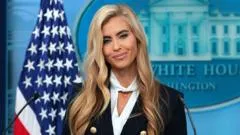
Why are Katie Zacharia's legal credentials under scrutiny?
Scrutiny of Katie Zacharia's professional background intensified after she provided an ambiguous response regarding her legal licensing during a public appearance. While President Donald Trump introduced her as an attorney, Zacharia's responses to inquiries about where she passed the bar exam have raised questions about her actual status as a licensed practitioner.
The controversy gained momentum when, standing alongside the president, Zacharia responded "When I moved to China" to a reporter's question about which state she had passed the bar exam in. This statement has been difficult to reconcile with public records, which indicate she is not registered to the bar in any US state where she has resided. In response to the mounting pressure, White House communications director Steven Cheung defended her, stating that Zacharia is "uniquely qualified and whip smart to help inform the American people".
Zacharia has attempted to clarify her position through official statements and media interviews. In a statement released this week, she asserted that she "practised international transaction law, with all the appropriate credentials." She also told the New York Times that her response regarding China was a misunderstanding caused by the noise from Marine One, claiming she thought the reporter had asked where she was located after law school rather than where she had passed her exams.
What is the nature of the legal complaint against Zacharia?
A formal complaint has been filed by the watchdog group Campaign for Accountability with the California State Bar Association. The group is seeking an investigation into whether Zacharia's public claims constitute a violation of state law regarding the unauthorized practice of law.
The complaint specifically focuses on whether Zacharia has repeatedly presented herself to the public as being entitled to practice law without the necessary license. According to the group, such conduct is treated as a crime under California law. This legal challenge follows a pattern of Zacharia identifying herself using legal terminology in various professional and media settings, including her tenure as general counsel for the conservative non-profit Fix California.
The distinction between law degrees and bar licensure
A central point in the debate is the distinction between academic achievement and professional licensure. Zacharia graduated from law school at Pepperdine University in California in 2011, a fact confirmed by the institution. However, holding a Juris Doctor or a similar law degree does not grant an individual the right to practice law in the United States. To legally represent clients or call oneself an attorney in most jurisdictions, one must pass a state bar exam and be admitted to the bar.
How did Zacharia's career in China impact her legal standing?
Zacharia's professional history in Beijing has become a focal point for those questioning her claims of practicing international transaction law. Her LinkedIn profile indicates she served as an associate at the Zhong Lun Law Firm in Beijing between 2011 and 2013.
The legal landscape in China presents specific challenges to her claims of being a practicing lawyer. In China, the eligibility to obtain a license to practice law is restricted exclusively to Chinese citizens. Foreign employees working at Chinese law firms are typically limited to other professional roles rather than active legal practice. Despite these restrictions, Zacharia claimed on the conservative radio programme The Clay Travis and Buck Sexton Show in February last year that she had worked as outside counsel for the International Finance Corporation (IFC) and the World Bank during her time in Beijing.
The complexity of these claims is heightened by the operational structures of international organizations. While the World Bank Group frequently retains outside legal counsel, these decisions are typically made by the firms themselves, which then assign specific lawyers to tasks. The BBC has reached out to the World Bank, the IFC, and Zhong Lun Law Firm for comment to clarify the nature of her involvement in these transactions.
What is the background of her legal education and exam history?
Zacharia's academic and examination history provides the context for the current discrepancy between her titles and her actual licensure status. While she holds a degree from a recognized institution, her attempts to enter the legal profession in the US appear to have been unsuccessful.
According to the Wall Street Journal, Zacharia took the California bar exam following her graduation from Pepperdine University but did not pass. The California bar exam is noted for being one of the most difficult professional examinations in the United States. Sources with direct knowledge of the matter suggested that her attempt to take the exam coincided with significant personal transitions, including her wedding preparations and her planned relocation to China.
Zacharia has addressed the naming conventions used during her media appearances. She informed the New York Times that when she first began appearing on cable news, she sought guidance from Pepperdine University regarding her professional identification. She stated that the university president advised her that she could use the term "lawyer," but cautioned her against using the term "attorney." This distinction remains at the heart of the tension between her public persona and her professional credentials.
Frequently asked questions
Is a law degree the same as being a licensed attorney?
No, a law degree is an academic qualification that signifies the completion of legal studies at a university. In the United States, a person must also pass a state bar examination and meet specific character and fitness requirements to be licensed as an attorney and legally practice law.
Why is the California State Bar investigating Zacharia?
The California State Bar is reviewing a complaint from the Campaign for Accountability. The investigation seeks to determine if Zacharia's public claims of being an attorney or lawyer constitute the unauthorized practice of law, which is a criminal offense under California statutes.
Can a foreign national practice law in China?
No, under current Chinese regulations, only Chinese citizens are eligible to obtain a license to practice law within the country. While foreign nationals may work at law firms in Beijing or other cities, they generally do so in supporting or non-legal capacities.
What was Zacharia's explanation for the "China" comment?
Zacharia stated that her response was a misunderstanding caused by environmental noise. She claimed that amidst the sound of Marine One, she believed the reporter was asking where she had been located following her time in law school, rather than asking which state she passed her bar exam.
What role did Pepperdine University play in her professional identity?
Pepperdine University confirmed her 2011 graduation. Zacharia claims that the university's president advised her that she could identify herself as a "lawyer" based on her degree, but specifically advised against using the title "attorney" without proper licensure.
Key takeaways
- The Campaign for Accountability has filed a formal complaint with the California State Bar regarding Zacharia's credentials.
- Zacharia graduated from Pepperdine University law school in 2011 but did not pass the California bar exam.
- In China, legal practice licenses are restricted to Chinese citizens, complicating her claims of practicing law there.
- The White House has officially defended Zacharia, describing her as uniquely qualified for her role.
Conclusion
The controversy surrounding Katie Zacharia highlights the critical distinction between legal education and professional licensure. While her academic credentials from Pepperdine University are confirmed, the discrepancy between her public titles and her actual bar status has triggered a formal investigation by a watchdog group. As the California State Bar examines whether her conduct violates state laws against the unauthorized practice of law, the White House maintains its support for the new press secretary. The outcome of this investigation will likely clarify the legal boundaries of professional self-identification in high-profile political roles.




