
Why is the Italian government proposing new security measures?
The Italian government is preparing emergency legislation to address a surge in urban violence and property damage that has targeted major cities. Following an emergency security meeting chaired by Prime Minister Giorgia Meloni on Monday, the administration is poised to implement a decree law designed to curb what officials describe as chaotic rioting. According to reports from the Milanese newspaper Corriere della Sera, these measures aim to provide law enforcement with more robust tools to manage large-scale unrest and youth-led disorder.
The primary drivers for this legislative shift include the scale of recent violence and the specific demographic profile of those involved in the clashes. During the weekend unrest in Milan, police reported that of the 271 individuals taken into custody on Sunday, 32 were formally arrested, including 23 minors. This high proportion of young participants has prompted the government to consider measures specifically targeting youth gangs and the use of preventative detention for minors.
Legislative focus on youth and gatherings
The proposed decree law is expected to be approved as early as Tuesday. Key components of the plan include extending the ability to use preventative detention for minors and placing stricter limits on the ability of groups to gather in public spaces. These moves are intended to preempt the type of violence seen when social media is used to mobilize large numbers of young people to urban squares.
What happened during the Milan protests?
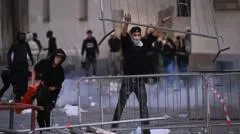
Violent clashes broke out in Milan over the weekend as protesters, many of whom wore masks, engaged in confrontations with police forces. The unrest, which originated during demonstrations regarding rising costs, escalated into significant property damage and looting. According to local reports, protesters utilized paving stones, bins, and chairs as projectiles against law enforcement officers, prompting police to deploy water cannons and tear gas to regain control of the streets.
The impact on the city's commercial infrastructure was substantial. High-end shops in Milan's central districts were forced to close early on Monday, with many business owners boarding up windows to protect against further looting or arson. Milanese Mayor Giuseppe Sala described the scene as witnessing smashed shop windows, looted stores, and frightened citizens, noting that the scale of the disruption was significant.
Beyond the immediate physical damage, the protests highlighted a breakdown in public order that extended into other northern Italian cities. For instance, disorder in Turin led to the detention of individuals allegedly carrying window-breaking hammers and cobblestones, while a train station in Bologna was closed as a precautionary measure due to similar security concerns. The cumulative effect of these events has created a sense of instability across the region's urban centers.
How widespread is the unrest in Europe?
The violence in Italy is not an isolated incident but appears to be part of a broader pattern of civil unrest affecting several European nations. Similar rioting and looting have been observed on the sidelines of youth-led protests in France, Spain, and Albania in recent weeks. This trend suggests that the domestic issues driving the protests in Italy are being amplified by a wider international context.
Milan Mayor Giuseppe Sala suggested that the current situation represents a "new phenomenon" that is fueled by an international scenario. He noted that the patterns of violence seen in Milan are increasingly mirroring the disorder observed in many other global cities. This interconnectedness is further evidenced by the social media mobilization used to organize the recent gatherings in Italy, which mirrors tactics seen in other European protest movements.
In France, for example, hundreds of thousands of people have taken to the streets in recent protests, leading to scenes of burnt-out cars and shattered glass in Paris. The similarity in the nature of the unrest—moving from peaceful demonstration to violent rioting—indicates a shared challenge for European urban security and social stability.
What is the political reaction to the violence?
Prime Minister Giorgia Meloni has taken a firm stance against the rioters, distinguishing between the right to demonstrate and the act of destroying public property. During a post on the social media platform X, Meloni characterized those involved in the violence as "hooligans" who have exploited legitimate protests to sow chaos. She has called for a unanimous condemnation of the rioting from all political opponents, stating that any hesitation in condemning the violence could be perceived as justification for it.
The political tension is heightened by the fact that Meloni is facing an upcoming election next year. Her administration's handling of security and public order will likely be a central theme in the campaign. By pushing for tougher security measures, the government is signaling a commitment to law and order, a move that is often a key priority for voters during periods of social instability.
However, opposition leaders have cautioned against using the violence as a pretext to suppress democratic expression. Elly Schlein, leader of the Democratic Party, stated that while her party condemns all violence, the rioting should not be used as a reason to stifle the voices of peaceful protesters. Schlein emphasized that many citizens are struggling with the cost of living and that their legitimate grievances must still be heard despite the actions of a violent minority.
Frequently asked questions
What specific security measures is the Italian government considering?
The government is looking to approve a decree law that includes extending preventative detention to minors and placing stricter restrictions on group gatherings. These measures are intended to combat youth gang activity and prevent the rapid escalation of protests into violent riots in urban centers.
Who was involved in the Milan protests?
The protests involved a large number of participants, with more than 5,000 people gathering in Milan over the weekend. Police data indicates that a significant portion of those detained were young people, with minors making up a large percentage of the 271 individuals taken into custody.
How did the violence affect the city of Milan?
The violence resulted in widespread property damage, including looted stores and buildings set on fire. Many high-end shops in the city center were forced to close early and board up their windows to prevent further damage from protesters using paving stones and other objects.
Is the unrest limited to Italy?
No, the unrest is part of a wider trend across Europe. Similar patterns of rioting and looting have been reported in France, Spain, and Albania, where youth-led protests have occasionally turned violent, reflecting a broader international phenomenon of social and economic discontent.
What has Prime Minister Meloni said about the situation?
Prime Minister Meloni has stated that while demonstrating is a right, destroying cities is not. She has labeled the violent participants as hooligans and has urged political opponents to provide a unanimous condemnation of the rioting to avoid giving the perpetrators any sense of justification.
Key takeaways
- Italy plans to extend preventative detention to minors as part of new emergency security measures.
- Over 270 people were detained in Milan following violent clashes involving paving stones and arson.
- Mayor Giuseppe Sala described the unrest as a "new phenomenon" linked to an international scenario.
- The government intends to approve a new decree law to crack down on youth gangs.
- Opposition leaders warn that violence should not be used to silence peaceful protesters.
Conclusion
The recent violence in Milan has prompted a decisive legislative response from the Italian government, as Prime Minister Giorgia Meloni seeks to restore public order through stricter security measures. By targeting the specific demographics and tactics used during the unrest—such as the involvement of minors and social media mobilization—the administration aims to prevent further escalation. However, the tension between maintaining security and protecting the right to peaceful protest remains a central political challenge. As Italy prepares for upcoming elections, the government's ability to manage this "new phenomenon" of internationalized urban unrest will be closely watched.




