
What happened during the raid on Jalud village?
More than 100 Israeli settlers descended on the Palestinian village of Jalud, south of Nablus, to prevent the al-Tubasi family from returning to their property. The confrontation occurred on a Monday night as the family attempted to reclaim two houses that had been seized by settlers weeks earlier. The presence of the settlers was reportedly coordinated via WhatsApp groups, where alerts were posted to intercept the family's return.
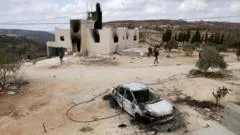
The raid resulted in significant property damage and physical confrontation. As the al-Tubasi family, accompanied by Israeli security forces, attempted to inspect their homes, settlers began throwing stones. While the Israeli military used tear gas to manage the crowd, the sheer number of participants—estimated at over 150—rendered the security forces unable to maintain control. The violence escalated as settlers slashed the tires of a military van used by the family, forcing them to transfer to an armored vehicle. During the chaos, the family's car and both of their houses were set on fire, leaving the structures in ruins.
The condition of the al-Tubasi properties
Video footage obtained by the BBC documented the extensive destruction inside the homes prior to the fire. The properties had been stripped of electrical fittings, tiles had been ripped up, and windows were smashed. The interior was described as being littered with rubbish, and the sanitary facilities had been destroyed and filled with human waste. Mahmoud al-Tubasi, 60, described the experience as terrifying, noting that he genuinely feared for his life during the encounter.
Why did the High Court ruling fail to protect the family?
The failure to implement the High Court's decision underscores a disconnect between Israel's judicial branch and the enforcement of law on the ground. Earlier this month, the Israeli High Court ruled that the al-Tubasi family must be allowed to return to their homes, criticizing the current state of settler violence as an unacceptable phenomenon that contradicts the principles of a democratic state. The court had set a deadline of September 20 for the family's safe return.
Despite this legal mandate, the mission was aborted due to the intensity of the settler violence. While the Israel Defense Forces (IDF) stated they acted to protect the family by forming a barrier and using pepper spray to push settlers back, they did not take direct action against the rioters themselves. This lack of intervention is a recurring theme cited by human rights organizations. The IDF characterized the incident as a "nationalist crime" and noted that the violence prevented the completion of the mission to return the family to their residence.
How does settler violence impact Palestinian communities?
Settler violence has become a primary driver of Palestinian displacement and instability across the West Bank. According to the United Nations, more than 6,500 Palestinians have been forced from their homes due to settler attacks and associated access restrictions since 2023. The escalation is not limited to individual families but often involves broader community clashes.
The local council in Jalud reported that the recent raid led to clashes that spread to neighboring villages. In one instance, a Palestinian woman was assaulted and her home was set ablaze during the unrest. This pattern of violence is often linked to the establishment of illegal outposts near Palestinian villages, which serve as focal points for settler activity and harassment. The humanitarian impact is compounded by the fact that these attacks often occur in areas where Palestinian movement is already restricted.
Statistical overview of West Bank violence
The scale of the conflict is reflected in recent data provided by the UN Humanitarian Office (OCHA). In the same period since 2023, OCHA has logged 6,199 attacks by Israeli settlers that resulted in either casualties or property damage. The human cost is significant: at least 23 Palestinians have been killed in the context of settler attacks, and at least 82 Palestinians have been killed by a combination of Israeli forces and settlers this year. While four Israelis—including members of the security forces—have also been killed, the frequency and displacement effects of settler-led incidents remain a central concern for international observers.
What is the legal and political landscape regarding settlements?
The expansion of Israeli settlements and outposts remains a deeply contentious issue, as these structures are considered illegal under international law. The current Israeli government has overseen a rapid growth of these settlements, with several ministers advocating for policies that would effectively end the possibility of an independent Palestinian state. This political environment provides the backdrop for the increasing frequency of settler-Palestinian confrontations.
Human rights groups argue that the lack of legal consequences for settlers encourages continued aggression. Ziv Stahl, executive director of the Israeli human rights group Yesh Din, stated that the violence is part of a systematic government policy intended to expand Israeli control over West Bank land. This is supported by historical data: according to Yesh Din, fewer than 3% of police investigations into settler violence over the last two decades have resulted in a criminal conviction.
In response to the Jalud incident, Prime Minister Benjamin Netanyahu condemned the attacks on security forces and called for the prosecution of rioters. However, his stance on the broader issue remains defensive. During the UN General Assembly, Netanyahu dismissed international concerns, characterizing the perpetrators as a small group of "juvenile delinquents" rather than a systemic threat. While Israeli police have arrested three suspects in connection with the Jalud raid, critics argue that such arrests do not address the structural nature of the violence.
Frequently asked questions
What caused the violence in Jalud?
The violence was triggered by the al-Tubasi family's attempt to return to their homes following a High Court ruling. Aggrieved settlers, coordinated through WhatsApp, gathered in large numbers to block the family and prevent them from reclaiming their property, leading to clashes and arson.
What did the Israeli High Court say about settler violence?
The High Court described settler actions as an "unacceptable phenomenon" that contradicts the basic moral principles of Israel as a democratic state. The court specifically ordered that the al-Tubasi family be allowed to return to their homes safely, a mandate that was ultimately not met.
How many Palestinians have been displaced by settlers?
According to United Nations data, more than 6,500 Palestinians have been displaced due to settler attacks and access restrictions in the occupied West Bank since the year 2023.
Is settler violence being prosecuted in Israel?
While the Israeli government calls for the prosecution of rioters, human rights groups report extremely low conviction rates. According to Yesh Din, fewer than 3% of police investigations into settler-related violence over the past 20 years have led to a conviction.
What is the international legal status of West Bank settlements?
Settlements and outposts in the West Bank are considered illegal under international law. The expansion of these areas is a central point of contention in the conflict over land and Palestinian sovereignty.
Key takeaways
- The al-Tubasi family was prevented from returning to their Jalud homes despite a High Court ruling.
- More than 100 settlers participated in the raid, resulting in the arson of two houses.
- UN data shows 6,500 Palestinians displaced by settler activity since 2023.
- Yesh Din reports that fewer than 3% of settler violence investigations result in convictions.
Conclusion
The events in Jalud serve as a stark illustration of the widening gap between Israeli judicial rulings and the reality of security enforcement in the West Bank. While the High Court has explicitly condemned settler violence as contrary to democratic values, the inability to protect families like the al-Tubasis suggests a systemic failure in implementation. As settlement expansion continues and displacement figures rise according to UN reports, the cycle of violence and the erosion of legal protections for Palestinian residents remain central challenges to regional stability and the possibility of future diplomatic resolutions.