
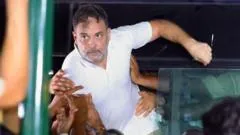
Why did the protest in Delhi turn violent?
Police intervention and the use of force against opposition leaders triggered dramatic scenes in Delhi on Tuesday night. Law enforcement officers, some equipped with batons and body cameras, moved to break up a march led by Rahul Gandhi and other MPs who were attempting to reach the Election Commission's headquarters. According to news agency ANI, police stated the removal of protesters was necessary to "maintain law and order and prevent the situation from escalating." Videos circulating on social media showed police forcing Gandhi onto a bus and physically preventing him from exiting through a bus window. The confrontation occurred as the opposition attempted to march toward the commission's office, a route that had been heavily barricaded by security forces. The tension was compounded by the detention of several lawmakers who tried to bypass police cordons using alternative routes.
Law enforcement actions and detentions
The police response involved significant numbers of officers and the use of transport buses to move protesters. Official Manjeet Sheoran told the BBC that several MPs were picked up in buses and transported to various police stations. While the Gandhi siblings—Rahul Gandhi and Priyanka Gandhi Vadra—were briefly detained and taken away in a police vehicle, they were released shortly after. However, the scale of the detentions remains unclear, as police have not provided an official count of the lawmakers held. A formal police complaint has also been filed against the Gandhis for allegedly entering Akashvani Bhavan (Broadcasting House) without authorization, according to the PTI news agency.
What is the controversy surrounding the voter roll revision?
The central point of contention is the Special Intensive Revision (SIR), an electoral roll update that began in Bihar in June 2025 before expanding across India. The Election Commission defends the SIR as a vital administrative measure to purge duplicate entries and ineligible voters from the system. However, the scale of the deletions has raised significant alarms among political actors and activists. According to reports, more than 130 million names have been removed from draft voter lists across the country during this exercise. The opposition parties allege that this process is being conducted improperly and that many legitimate, eligible voters are being systematically excluded. These groups claim the revisions are designed to provide a strategic advantage to the ruling Bharatiya Janata Party (BJP), though both the BJP and the Election Commission have officially rejected these allegations.
Why is Chief Election Commissioner Gyanesh Kumar facing calls to resign?
Calls for the resignation of Chief Election Commissioner Gyanesh Kumar intensified following investigative reports regarding the internal decision-making processes of the commission. An investigation by the Indian Express newspaper revealed that two other election commissioners, Sukhbir Singh Sandhu and Vivek Joshi, had formally raised objections at least 14 times over a 10-month period. These objections concerned decisions they claimed were issued in the commission's name without their knowledge or consent. The specific issues raised by the commissioners included:
- The processes for adding and deleting names from voter rolls.
- The level of access granted to the national voter database.
- The overall security protocols surrounding electoral data.
How has the Election Commission responded to the opposition's demands?
The Election Commission has maintained a firm stance regarding its operational procedures and its refusal to meet the opposition's specific terms for engagement. While the commission expressed a willingness to meet with opposition representatives, it explicitly rejected the proposal for a 240-member delegation to meet at the Parliament. Instead, the commission stated that any formal meeting must be requested by a party representative and must take place at the commission's own offices. Rahul Gandhi has publicly questioned this stance, noting that the opposition's goal was simply to engage in a dialogue regarding the voter roll revisions. "We are all opposition MPs... and we just want to speak with them," Gandhi told reporters during the protests. "I do not know why the Election Commission does not want to talk to us." On the political front, the ruling BJP has condemned the protests as a threat to democratic stability. BJP MP Sambit Patra characterized the demonstrations as a "sponsored attempt" to induce anarchy and undermine constitutional institutions. This political divide has now moved into the judicial sphere, with the Supreme Court of India intervening to demand responses from both the federal government and the Election Commission regarding a petition alleging that Kumar made unilateral decisions without the required approval of his fellow commissioners.
FAQ: India's Election Commission Controversy
What is the Special Intensive Revision (SIR)?
The Special Intensive Revision is an ongoing exercise by the Election Commission to update India's electoral rolls. The commission states the goal is to remove duplicate and ineligible voters, but opposition leaders argue it is being used to improperly exclude eligible citizens from the voting process.
Who is leading the opposition against the Election Commission?
The protests are led by prominent opposition figures, most notably Rahul Gandhi and Priyanka Gandhi Vadra. They are supported by a coalition of opposition parties and have been joined by the Cockroach Janta Party (CJP), a Gen Z-backed movement demanding the resignation of the CEC.
Why did the police intervene during the protest?
Police intervened to maintain law and order and to prevent the situation from escalating. This included barricading routes to the commission's office and detaining protesters who attempted to bypass security cordons or enter restricted areas like Akashvani Bhavan.
What are the Congress party's specific demands?
The Congress party has set three non-negotiable conditions for their satisfaction: the resignation of Chief Election Commissioner Gyanesh Kumar, the total cancellation of the Special Intensive Revision (SIR) exercise, and a transition back to paper ballot voting.
Is there any legal action regarding the commission's decisions?
Yes, the Supreme Court of India has taken notice of the controversy. The court has requested formal responses from the federal government and the Election Commission following a petition alleging that the CEC bypassed his fellow commissioners in making key decisions.
Key takeaways
- More than 130 million names have been removed from India's draft voter lists during the SIR exercise.
- Opposition leaders, including Rahul Gandhi, demand the resignation of Chief Election Commissioner Gyanesh Kumar.
- Police used force to break up a march of approximately 237 MPs in Delhi.
- The Supreme Court is investigating allegations of unilateral decision-making within the Election Commission.
The evolving landscape of Indian electoral integrity
The confrontation between the opposition and the Election Commission represents a significant moment of tension for India's democratic institutions. The dispute over the Special Intensive Revision is not merely a procedural disagreement but a fundamental challenge to the perceived neutrality of the electoral process. As the Supreme Court deliberates on the legality of the commission's internal governance, the outcome will likely set a precedent for how voter data is managed and how much autonomy the Chief Election Commissioner holds relative to the full commission. The upcoming protests scheduled for 10 October suggest that this standoff is far from over.
