
What is the current scale of Houthi attacks on Saudi airports?
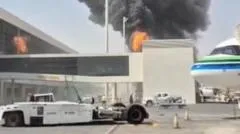
The frequency and lethality of Houthi missile and drone strikes against Saudi Arabian aviation hubs have increased sharply over the past week. King Khalid International Airport in Riyadh has been targeted four times in a seven-day period, resulting in significant casualties and infrastructure damage. The attacks have moved beyond mere harassment to direct strikes on passenger terminals and aircraft on the ground.
Casualty reports and infrastructure damage
The human cost of the recent strikes has been substantial. On Saturday, a missile strike on Terminal 3 resulted in the deaths of several individuals, including three Saudi nationals, one of whom was a pilot for the national carrier, Saudia. The victims of that specific strike included a diverse group of international residents: two Bangladeshis, one American, one Egyptian, one Jordanian, one Syrian, one Palestinian, one Sudanese, and one Indian. Following this, on Sunday, a projectile hit Terminal 4, killing a Pakistani resident, according to the General Authority of Civil Aviation (GACA).
The damage is not limited to a single facility. King Fahd International Airport in Dammam also faced an attack on Sunday evening, though no casualties were reported from that specific incident. The disruption at King Khalid International Airport has been so severe that the facility is expected to remain closed until at least Saturday, severely impacting domestic and international travel connectivity.
How has Saudi Arabia responded to these security threats?
Saudi Arabia's energy minister, Prince Abdul Aziz bin Salman, has pledged a robust reaction to the targeting of the kingdom's vital infrastructure. Speaking at the WPC Energy Congress in Riyadh, the Prince emphasized that the recent escalations are grave and require an equally serious response. He noted that while the country remains a safe destination for industry leaders, the recent developments have tested the nation's resilience and institutional strength.
Military interception and defensive measures
The Saudi-led military coalition has been actively engaged in intercepting incoming threats. On Monday night, explosions were heard in Riyadh after the coalition reported the interception and destruction of a ballistic missile. On Tuesday, the coalition confirmed it had successfully destroyed two additional ballistic missiles launched by Houthi forces targeting the city of Khamis Mushait. Furthermore, defensive systems have been deployed in the Eastern Province to intercept drones.
The Prince’s address at the WPC Energy Congress served as both a reassurance to global energy executives and a warning to the Houthi movement. He acknowledged that "energy security cannot be taken for granted" and affirmed that the Saudi people are "fearless, combatant and determined." This rhetoric suggests a shift toward more decisive military action to protect the kingdom's oil and gas assets, which have also been identified as targets in recent Houthi statements.
What is the impact on regional aviation and energy markets?
The escalation of Houthi attacks on Saudi airports has caused immediate disruptions to commercial aviation and has contributed to volatility in global energy markets. Major regional carriers have been forced to alter their flight paths and cancel services to mitigate the risk to passengers and crew. This disruption coincides with heightened tensions in the Red Sea, a critical maritime artery for global trade.
Aviation disruptions and flight cancellations
The instability has led to several high-profile airline responses:
- Qatar Airways: The carrier has announced a temporary suspension of all flights to Riyadh and the north-eastern city of Dammam.
- Etihad Airways: The airline has cancelled multiple routes, including flights between Abu Dhabi and Riyadh, as well as connections between Jeddah and Dammam, citing "regional disruption."
Beyond aviation, the security situation in the Red Sea is exerting pressure on oil prices. The Houthis recently seized territory overlooking the Bab al-Mandab Strait, a move that has impacted global markets. Because Saudi Arabia has increasingly relied on the Red Sea for oil exports—particularly as the Strait of Hormuz became less viable due to tensions between the US, Israel, and Iran—the threat to these shipping lanes has a direct correlation with global energy costs.
Why are the Houthis targeting Saudi infrastructure?
The Houthi movement claims its recent surge in missile and drone attacks is a direct retaliation for Saudi military actions in Yemen. Houthi spokesperson Yahya Saree has framed the escalation as a "blockade for a blockade," suggesting that their operations are intended to counter the Saudi-led coalition's air strikes and the perceived siege of Yemeni territories. The group has explicitly warned airlines and passengers to avoid Saudi airports and airspace, with the exception of travel to the holy cities of Mecca and Medina.
The context of the Yemeni civil war
The current escalation is a continuation of a conflict that began in 2014 when the Houthis ousted the Yemeni government from Sanaa. While an informal ceasefire had provided some stability, it began to unravel in July when the Houthis declared a "maritime embargo" against Saudi Arabia. The Houthis assert that their strikes are a response to 124 Saudi air strikes conducted in Yemen over a single 24-hour period, which they claim targeted civilian areas, including a home in Sanaa that resulted in the death of a child.
The Saudi-led coalition, conversely, maintains that its interventions are necessary to support pro-government forces and to prevent the proliferation of Iranian influence in the region. The conflict has become increasingly complex, with the Houthis gaining ground along the Red Sea coast, thereby gaining leverage over international shipping lanes and the ability to strike deep into Saudi territory.
Frequently asked questions
What is the status of King Khalid International Airport?
King Khalid International Airport in Riyadh is currently facing significant operational disruptions following multiple missile strikes. Due to the damage sustained and the ongoing security threat, the airport is expected to remain closed to commercial traffic until at least Saturday.
Which airlines have been affected by the attacks?
Both Qatar Airways and Etihad Airways have taken defensive measures. Qatar Airways has suspended flights to Riyadh and Dammam, while Etihad Airways has cancelled several routes, including those connecting Abu Dhabi to Riyadh and Jeddah to Dammam, due to regional instability.
What are the Houthis' stated reasons for the attacks?
The Houthis claim the attacks are retaliatory measures against Saudi-led coalition airstrikes in Yemen. They have described their strategy as an "escalation for an escalation," intended to break what they characterize as a Saudi blockade of Yemeni ports and territories.
Has the conflict impacted global oil prices?
Yes, the security situation has contributed to oil price surges. The Houthi seizure of areas overlooking the Bab al-Mandab Strait has increased risks to maritime oil exports, particularly as the Red Sea has become a vital route for Saudi energy shipments.
What is the international community's stance on these attacks?
The international response has been one of condemnation. UN Secretary General António Guterres described the attacks on civilian infrastructure as a violation of international law. Additionally, the US is reportedly providing intelligence and targeting support to the Saudi-led coalition.
Key takeaways
- Houthi missile strikes on King Khalid International Airport have caused multiple deaths and significant terminal damage.
- Saudi Energy Minister Prince Abdul Aziz bin Salman has vowed a "serious" response to protect national infrastructure.
- Major airlines, including Qatar Airways and Etihad, have suspended or cancelled flights to Saudi cities.
- The escalation in the Red Sea and Bab al-Mandab Strait has contributed to rising global oil prices.
Conclusion
The recent surge in Houthi attacks on Saudi Arabian airports and energy facilities represents a dangerous escalation in the long-standing Yemeni conflict. The strikes have not only resulted in tragic loss of life and disrupted regional aviation but have also introduced new complexities into global energy security and maritime stability. As Saudi Arabia prepares a serious response and the international community monitors the potential for broader regional involvement, the stability of the Red Sea corridor remains under significant threat. The ability of both parties to de-escalate will be critical for regional peace and the continuity of global trade.




