
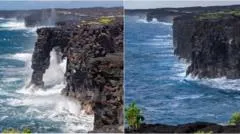
Timeline of the Hōlei Sea Arch collapse
The Hōlei Sea Arch was still visible projecting from the coast of Volcanoes National Park on 23 September, but was completely gone by 27 September, according to the National Park Service (NPS). This rapid disappearance occurred while the park was temporarily closed due to the impact of Tropical Storm Nolo. While the specific hour of the collapse has not been recorded, the window of destruction is narrow.
The formation was a major destination for travelers, situated at the terminus of Chain of Craters Road on the island of Hawaii. For decades, it served as a primary subject for photographers and tourists seeking to capture the rugged beauty of the volcanic coastline. The sudden absence of the arch has left a void in the local landscape, though officials had long anticipated such an event.
Geological instability and contributing factors
Long-term structural weakness played a decisive role in the Hōlei Sea Arch collapse, as the coastline has shown signs of instability for several years. The National Park Service had previously issued warnings in 2021 that the arch would eventually succumb to the elements and crumble into the sea. This was not a sudden anomaly but the culmination of a predictable geological process.
Several specific events contributed to the weakening of the 27.4-meter-tall structure. According to the NPS, earthquakes associated with the 2018 Kīlauea volcano eruption and the subsequent summit collapse caused significant damage to the cliffs surrounding the arch. Furthermore, in 2020, waves from a tropical storm successfully broke off a substantial section of rock from the base of the formation. These combined forces of seismic activity and wave erosion undermined the integrity of the lava rock over time.
Historical management of the site
Because of these ongoing risks, the park service has had to manage visitor safety for years. In January 2020, the emergence of new cracks and visible instability forced the NPS to close the original viewing area. A new, safer viewing location was established a few months later to allow visitors to observe the formation without risking their safety.
The natural cycle of coastal transformation
The destruction of the arch represents the latest transformation in the remote and rugged coastline of the park. While the loss of such an iconic landmark is significant to the human experience, geologists view it as a standard part of the island's evolution. The National Park Service noted in 2021 that while the formation is beautiful, it is inherently temporary and possesses a limited lifespan.
The collapse does not signify the end of interesting geological features in the area, but rather a shift in their location. As the cliffs slowly migrate inland due to continuous erosion, new formations are expected to emerge. The cycle of creation and destruction remains a fundamental characteristic of the volcanic landscape in Hawaii, where the land is constantly being reshaped by both internal volcanic forces and external oceanic pressures.
Public reaction to the landmark's loss
The news of the collapse triggered an outpouring of emotion on social media, where thousands of people engaged with the National Park Service's announcements. Many users shared personal memories of visiting the site and posted historical photographs of the arch in its prime. The digital response highlighted the deep cultural and emotional connection people form with natural monuments.
Comments from the public reflected a philosophical acceptance of the event. One Facebook user remarked that nothing and no one is here forever, suggesting that the ephemeral nature of the arch serves as a reminder to appreciate beauty in the present moment. This sentiment underscores the tension between the human desire for permanence and the reality of a dynamic, changing planet.
Frequently Asked Questions
When did the Hōlei Sea Arch collapse?
The collapse occurred between 23 September and 27 September. The National Park Service confirmed that the structure was still visible on the 23rd, but was gone by the 27th. The exact timing remains unknown, though it likely happened during the recent closure caused by Tropical Storm Nolo.
Why did the lava rock structure fall?
The collapse was caused by years of geological instability, including damage from the 2018 Kīlauea volcano eruption and subsequent earthquakes. Additionally, wave erosion from tropical storms in 2020 had previously weakened the base of the arch, making the eventual crumble inevitable.
Is the coastline of Hawaii changing?
Yes, the coastline is undergoing constant transformation. The National Park Service explains that as the sea erodes existing cliffs and arches, the coastline slowly migrates inland. This process means that while one formation like the Hōlei Sea Arch disappears, new structures will eventually form.
Conclusion
The Hōlei Sea Arch collapse serves as a powerful reminder of the transient nature of Earth's geological wonders. While the loss of this 550-year-old landmark is a blow to tourism and cultural memory, it is a natural progression of the island's lifecycle. The combination of seismic activity from Kīlauea and relentless oceanic erosion has fulfilled a predictable cycle of destruction. As the coastline continues to migrate inland, the rugged landscape of Volcanoes National Park will undoubtedly present new, equally spectacular formations for future generations to witness.