
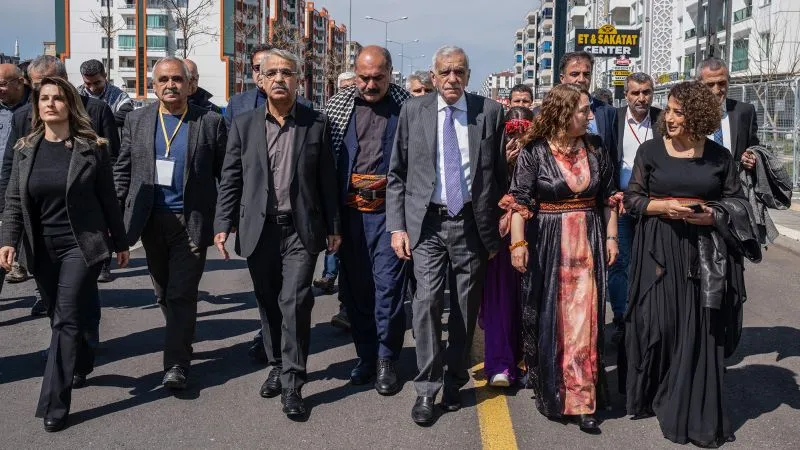
Why is the HDP considered a kingmaker in the 2023 elections?
The HDP's influence stems from its ability to mobilize a massive, concentrated voting bloc that can tilt the results in a highly competitive race. Because the party has decided not to run its own presidential candidate, its supporters are expected to gravitate toward the opposition, potentially providing the necessary margin to defeat the incumbent.
According to Murat Somer, a political science professor at Koc University, the HDP acts as a kingmaker because it commands approximately half of the Kurdish vote in Turkey. While more conservative Kurdish voters have traditionally supported Erdogan's AK Party, the HDP represents a significant portion of the minority population that seeks alternative political representation. This split in the Kurdish vote is a critical variable for both the ruling party and the opposition alliance. The HDP's strategic move is a response to what they describe as a "turning point that will shape the future of Turkey and (its) society," as stated by the party on March 23.
The historical impact of HDP voting patterns
The political weight of the HDP was clearly demonstrated during the June 2015 general elections. In that cycle, the party secured 13% of the seats, a result that successfully denied the AK Party a parliamentary majority for the first time since 2002. This moment proved that the HDP could fundamentally disrupt the ruling party's dominance and alter the legislative landscape.
However, the political environment proved volatile. Erdogan subsequently called for snap elections five months later, which saw the HDP's support dip to 10.7%, as well as the restoration of the AK Party's overall majority. Despite this setback, the precedent of the HDP's ability to act as a spoiler or a stabilizer remains a central factor in current electoral calculations. The party's ability to swing percentages of the vote makes it a force that neither the AK Party nor the opposition can afford to ignore.
How does the HDP's decision affect Kemal Kilicdaroglu?
The decision by the HDP to withhold a presidential candidate is seen as a strategic move that benefits Kemal Kilicdaroglu, the leader of the Republican People’s Party (CHP) and the head of the six-party Nation Alliance. While the HDP has not yet officially announced whether it will put its full weight behind him, analysts suggest that its tactical absence from the presidential race creates a vacuum that the opposition candidate is best positioned to fill.
Kilicdaroglu has actively sought to bridge the gap with Kurdish political leaders to strengthen his position as the strongest contender against Erdogan in years. During a recent visit to the HDP co-chairs, he stated that the solution to Turkey's most pressing issues, including the "Kurdish problem," lies in parliament. This discourse aims to present the opposition as a unifying force capable of addressing minority rights through democratic institutions rather than conflict.
However, the relationship remains delicate. The HDP is attempting to navigate a "carefully crafted political discourse," according to HDP deputy co-chair Hisyar Ozsoy. The party is wary of entering a "contaminated political climate" where the election becomes a polarized battle of ultra-nationalist rhetoric against Kilicdaroglu and others. This caution is necessary to avoid being drawn into a discourse that could alienate moderate voters or trigger a state crackdown.
What legal and political risks does the HDP face?
The HDP operates under a cloud of legal uncertainty that threatens its very existence. The party is currently facing a case in Turkey’s Constitutional Court regarding allegations of suspected ties to the Kurdistan Workers’ Party (PKK), a group designated as a terrorist organization by Turkey, the United States, and the European Union. This legal pressure is a significant part of the crackdown that has characterized the last decade of Turkish politics.
To mitigate the risk of being banned during the electoral process, HDP candidates have been running under the banner of the Green Left Party in parliament. This legal maneuvering is a survival tactic intended to ensure that Kurdish representation remains intact even if the HDP is officially dissolved by the courts. The party's former leader, Selahattin Demirtas, has been in prison for nearly seven years, highlighting the personal and political stakes involved in this struggle.
The challenge of political association
A major risk for the opposition is the potential for the AK Party to use the HDP's perceived links to the PKK to discredit the entire Nation Alliance. Murat Somer notes that if the opposition is seen as being in league with the HDP, Erdogan's administration may leverage its significant influence over national media to frame the opposition as being pro-PKK. This tactic would aim to trigger nationalist sentiment among the broader Turkish electorate, potentially neutralizing the gains made by the HDP's strategic pivot.
The government has consistently attempted to link the HDP to the PKK, though Asli Aydintasbas, a visiting fellow at the Brookings Institution, notes that the government has so far failed to prove "a real connection." This distinction between political association and actual collusion remains a central point of contention in the Turkish legal and political arena.
How has the relationship between Erdogan and the Kurds evolved?
The relationship between President Erdogan and the Kurdish population has undergone a dramatic transformation over the last two decades, moving from cooperation to intense confrontation. This evolution has directly impacted the political standing of the HDP and the broader Kurdish movement.
In earlier years, Erdogan actively courted Kurdish voters by implementing reforms that granted more rights and eased restrictions on the use of the Kurdish language. During this period, relations with the HDP were relatively cordial, as the government engaged in a brief peace process with the PKK. However, these ties deteriorated as the government shifted toward a more hardline stance, leading to a sweeping crackdown on pro-Kurdish political entities.
Asli Aydintasbas suggests that the current political climate is a matter of survival for the HDP. She notes that many Kurdish voters have recently moved away from Erdogan's camp, suggesting that a change in leadership could provide much-needed breathing space for Kurdish-dominated parties and minority rights in Turkey. For the HDP, this is described not just as an ideological choice, but as a fundamental matter of survival.
Frequently asked questions
What is the role of the HDP in the 2023 Turkish elections?
The HDP acts as a kingmaker because its decision not to field a presidential candidate allows its significant voter base to potentially support the main opposition candidate, Kemal Kilicdaroglu, rather than splitting the vote and ensuring an Erdogan victory.
How many Kurds live in Turkey?
According to Minority Rights Group International, Kurds constitute the largest minority in Turkey, making up between 15% and 20% of the country's total population, which gives their voting patterns immense political significance.
Why is the HDP facing legal trouble?
The HDP is facing a case in Turkey’s Constitutional Court due to allegations of suspected collusion with the PKK, which is classified as a terrorist organization by Turkey, the US, and the EU, threatening the party with potential closure.
Has the HDP ever denied the AK Party a majority?
Yes, in the June 2015 general elections, the HDP won 13% of the seats, which prevented the ruling AK Party from securing a parliamentary majority for the first time since the party took power in 2002.
What is the opposition's stance on the Kurdish issue?
Kemal Kilicdaroglu, leading the Nation Alliance, has stated that the solution to Turkey's challenges, including the Kurdish question, should be sought through parliamentary processes and democratic engagement rather than through conflict.
Key takeaways
- The HDP is a decisive kingmaker in the 2023 elections due to its large Kurdish voter base.
- By not fielding a presidential candidate, the HDP enables opposition support for Kemal Kilicdaroglu.
- Kurds represent 15% to 20% of Turkey's population, according to Minority Rights Group International.
- The HDP faces potential dissolution by the Constitutional Court over alleged PKK ties.
- The 2015 elections proved the HDP can successfully deny the AK Party a majority.
Conclusion
The 2023 Turkish elections represent a critical juncture for the country's democratic future and its ethnic social fabric. The HDP's strategic decision to step back from the presidential race highlights the party's awareness of its role as a political pivot point. While the legal threats against the party remain a significant barrier to stability, the potential shift in Kurdish voting patterns could fundamentally alter the balance of power. Whether the opposition can successfully navigate the nationalist rhetoric surrounding the HDP will likely determine if Erdogan's long-standing rule continues or if Turkey enters a new political era.




