
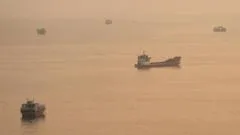
What happened to the GFS Pride in the Strait of Hormuz?
Singapore’s Maritime and Port Authority has confirmed that the GFS Pride, a Singapore-flagged container ship, was struck by an unknown projectile while transiting the Strait of Hormuz on Tuesday. The impact caused significant damage to the vessel and ignited a fire. Following the strike, the ship eventually sank.
Despite the severity of the incident, the Maritime and Port Authority of Singapore reported that all 21 crew members were successfully evacuated from the vessel, and no injuries were reported. The exact location of the sinking has been identified by the Hydrographer of Pakistan, who issued a warning to mariners stating that the GFS Pride sank 4 nautical miles (7.4km) north-west of Ras al-Sheikh Masud, located on Oman’s Musandam Peninsula.
While the cause of the strike remains officially unconfirmed by Singaporean authorities, Iran's Revolutionary Guards provided a different account. The Guards stated that a ship hit naval mines while passing through what they described as an "unauthorised" route within the Strait. To support their claim, the Guards released photographs that appeared to show a container vessel down by its stern with a plume of black smoke rising from it. Other images released by the Guards showed dozens of containers and their contents floating in the water.
Which other vessels were affected on the same route?
The attack on the GFS Pride was not an isolated incident during this period of heightened tension. Another Singapore-flagged container vessel, the GFS Giselle, was also targeted. On Wednesday, the GFS Giselle sustained hull damage after being hit by a projectile, but the vessel was able to reach a safe anchorage with all 22 of its crew members on board.
In a separate report, the United Kingdom Maritime Trade Operations (UKMTO) agency noted that two unnamed container ships had reported being struck by unknown projectiles while transiting the Strait of Hormuz. These incidents occurred on Tuesday between 16:40 and 17:00 GMT. According to the UKMTO, both of these vessels sustained minor damage but were capable of continuing their passages.
The frequency of these strikes highlights the volatility of the region. Merchant vessels have faced repeated attacks in the Strait of Hormuz—a vital corridor connecting the Gulf to the Gulf of Oman and the Arabian Sea—as well as elsewhere in the Middle East. These attacks have intensified since the conflict between the US, Israel, and Iran began in February.
Additional incident involving Cape Dao
The maritime risk management group Vanguard reported further distress in the region on Wednesday. According to news from Reuters, the Antigua and Barbuda-flagged bulk carrier Cape Dao was reported to be sinking following an unsuccessful rescue attempt.
The Cape Dao incident occurred on 23 September, when the vessel was transiting the Strait of Hormuz, north-east of Khasab, Oman. During the transit, an unknown projectile struck the vessel, specifically hitting the bridge and the accommodation area. This strike resulted in the death of one seafarer. The sinking of the Cape Dao adds to the growing list of maritime casualties linked to projectile strikes in these waters.
How does the current conflict affect shipping through the Strait?
The Strait of Hormuz is a critical global artery, through which a fifth of all global oil and gas shipments typically pass. Since the start of the Iran war in February, the strait has been effectively closed due to a combination of Iranian missile and drone attacks on commercial vessels and a US naval blockade of Iranian ports.
Diplomatic efforts to stabilize the waterway have seen limited success. A preliminary agreement was reached between the US and Iran in June to end the war and reopen the strait, but the agreement collapsed within weeks. This collapse followed the resumption of Iranian attacks on shipping and the subsequent reinstatement of the US blockade. Iran has maintained that it will not relinquish control over the waterway, leading to a shift in tactics. Iran has begun targeting vessels that utilize a southern route through Omani waters, a route chosen by some to avoid Iranian-controlled waters.
To mitigate these risks and ensure the continued flow of exports from Gulf Arab states, the US military has stepped in to provide protection for tankers shuttling oil through the Strait of Hormuz. Despite the increased threat of attack, shipping data from Kpler indicates that crude exports through the waterway have shown resilience. Last month, exports rose to approximately 80% of the pre-war average of 16 million barrels per day (bpd).
What casualty and incident figures have been recorded?
The scale of the maritime instability is reflected in the data provided by the United Nations' International Maritime Organization (IMO). Since the conflict began in February, the IMO has confirmed 106 incidents involving merchant vessels, resulting in the deaths of at least 24 seafarers.
The GFS Pride is one of the few vessels to have sunk during this period. Prior to this, the only other vessel reported to have sunk was the Malta-flagged container ship Safeen Prestige, which was attacked near Oman on 4 March. The recent sinking of the GFS Pride, alongside the reported sinking of the Cape Dao, underscores the increasing lethality of the projectile strikes in the region.
Frequently asked questions
Which flag state confirmed the sinking of GFS Pride?
Singapore’s Maritime and Port Authority confirmed the sinking of the GFS Pride and the successful evacuation of all 21 crew members.
Did Iran claim responsibility for the attack?
Iran’s Revolutionary Guards did not claim a direct strike on the GFS Pride, but they stated that a ship sank after hitting naval mines while using an "unauthorised" route.
How many seafarers have died since February?
According to the UN's International Maritime Organization, at least 24 seafarers have been killed in 106 confirmed incidents since February.
Has the Strait of Hormuz reopened to commercial traffic?
While the strait was effectively closed following the start of the war, crude exports have recently reached about 80% of pre-war levels, despite ongoing attacks and the US naval presence.
Which other vessel sank earlier in the conflict?
The Malta-flagged container ship Safeen Prestige is the only other vessel reported to have sunk since the conflict began, following an attack near Oman on 4 March.
Key takeaways
Singapore confirmed that the GFS Pride sank after being struck by a projectile, though all 21 crew members were evacuated safely.
Multiple vessels, including the GFS Giselle and two unnamed container ships, have reported projectile damage in the Strait of Hormuz recently.
Iran's Revolutionary Guards attributed a sinking in the area to naval mines hit on an unauthorised route.
The UN International Maritime Organization has recorded 106 confirmed incidents and at least 24 seafarer deaths since February.
Despite the violence, crude exports through the Strait of Hormuz have recovered to roughly 80% of the pre-war average of 16 million barrels per day.
Outlook for maritime traffic in the region
The recent sinking of the GFS Pride and the reported sinking of the Cape Dao highlight the persistent dangers facing merchant shipping in the Strait of Hormuz. As Iran continues to target vessels using southern routes through Omani waters, and the US maintains a naval presence to protect tankers, the security environment remains highly volatile. The collapse of the June peace agreement suggests that the cycle of attacks and blockades is likely to continue, keeping maritime insurance and routing decisions in a state of constant flux for global shipping companies.




