
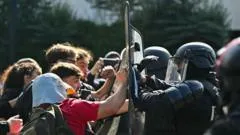
Why are the French student protests spreading so rapidly?
The movement has transitioned from localized unrest in the low-income Seine-Saint-Denis area to a nationwide phenomenon affecting major cities. What began nearly two weeks ago has reached a critical mass, forcing authorities to take drastic measures to ensure the safety of students and educators.
On Thursday, the intensity of the demonstrations peaked as hundreds of lycées—secondary schools for 15-to-18-year-olds—faced blockades. By Friday, the scale of the disruption necessitated the closure of approximately 400 lycées to prevent further confrontation. Beyond the school gates, the unrest has spilled into the streets, with reports of fires being lit in various locations across the country.
The scale of school disruptions
The impact on the education system is both physical and operational. In Nantes, the main hall of a lycée was destroyed by fire, and numerous smaller fires have been reported at school entrances nationwide. The financial cost of this destruction is estimated to be in the millions of euros. While the mood among some participants is described as excitement rather than pure anger, the logistical burden on the state is immense.
What is the impact of the violence on staff and security forces?
Violence has resulted in significant injuries to both educational professionals and emergency responders. According to Education Minister Édouard Geffray, 65 teaching staff members, including 40 school heads, have sustained injuries during the unrest. Notably, Geffray observed that many of the injured staff members reported that the individuals they were facing were not actually their own pupils, suggesting the presence of outside agitators.
The security response has also taken a heavy toll. The government reports that approximately 300 police officers and firefighters have required medical treatment for injuries sustained during the protests. Law enforcement has also been active in managing the crowds, with around 2,000 people—the majority of whom are minors—taken into custody. Conversely, student groups have highlighted the heavy-handedness of the police, reporting serious injuries among their ranks, including two teenagers with severe eye injuries and one individual who has lost multiple teeth.
What are the underlying causes of the education crisis?
The protests are driven by long-standing grievances regarding the state of the French education system, specifically concerning chronic underfunding. While the students' specific demands can sometimes appear vague, they center on fundamental needs: more teachers, smaller class sizes, and improved school infrastructure.
The timing of the protests coincides with a period of intense fiscal austerity. Prime Minister Sébastien Lecornu recently published a draft budget for the upcoming year that focuses heavily on spending reductions. The administration is aiming to remove €54bn (£46bn) from state spending, a move that signals the end of the era of public spending used to defuse social tension. This fiscal tightening directly clashes with student requests for basic necessities, such as additional school nurses or better insulation in school buildings.
How are the protests linked to the upcoming presidential elections?
The unrest is occurring in a highly charged political atmosphere, with presidential elections scheduled for only months away. This timing has led to intense scrutiny regarding whether the student movements are being utilized as a tool for political mobilization by the radical left.
For supporters of the right and center, the protests are not spontaneous outbursts but are being guided by the France Unbowed (LFI) party and its presidential candidate, Jean-Luc Mélenchon. Critics point to the presence of LFI leaders alongside protesters and the involvement of local politicians, such as the mayor of Saint-Denis, Bally Bagayoko, who faced criticism for suggesting that "violence can sometimes be legitimate."
Allegations of political manipulation
A leaked internal report prepared for the Paris police department suggests that the movement in Seine-Saint-Denis was actively encouraged by far-left elements, including student unions and political groups like LFI. The report characterizes the tensions as a "flame-kindling strategy" designed to advance radical political agendas before the national elections. Analysts cited several indicators of this influence, including:
- The presence of protesters who are not actual students (lycéens).
- The use of specific political symbols, such as Palestinian and Algerian flags.
- Tactics that mirror the radical-left playbook, such as calling for protests at police stations.
While LFI denies these allegations—with Mélenchon himself calling for students to avoid violence—the political implications remain significant. Mélenchon enjoys approximately 40% support among the 18-24 age demographic, a group that is traditionally prone to high rates of electoral abstention. Mobilizing this group through social unrest could be a decisive strategy for his campaign.
What is the projected political outcome for France?
The potential outcome of the upcoming elections presents a scenario of extreme polarization for the French Republic. If the current trends continue, the country faces a high probability of a runoff between Jean-Luc Mélenchon and the hard-right candidate Marine Le Pen.
Polls suggest that while Mélenchon has strong support among the youth and in high-immigration urban suburbs, he faces a massive deficit if forced into a second-round confrontation with Le Pen. Such a result would place France in a period of profound instability. The current student protests, therefore, may serve as a harbinger of the deep social and political divisions that will define the next presidential term.
Frequently asked questions
How many schools have been closed due to the protests?
Around 400 lycées (secondary schools) have been closed to protect students and staff from the ongoing unrest. This follows a peak in activity where hundreds of schools faced blockades, particularly during the height of the demonstrations on Thursday.
What are the primary demands of the students?
The students are protesting against the lack of funding in the education system. Their core demands include the recruitment of more teachers, the reduction of class sizes, and significant improvements to school buildings and facilities.
Who are the main political figures involved in the controversy?
President Emmanuel Macron is facing the unrest, while Prime Minister Sébastien Lecornu is managing the controversial budget cuts. On the opposition side, Jean-Luc Mélenchon of the France Unbowed (LFI) party is accused of leveraging the movement for political gain.
How has the violence affected school staff?
Education Minister Édouard Geffray confirmed that 65 teaching staff members, including 40 school heads, have been injured. Many of these professionals reported that the aggressors were not their own students, but rather outside individuals.
Why is the timing of the protests significant?
The protests are occurring just months before the presidential elections. This timing increases the risk of political manipulation and heightens the potential for social instability during a critical period of national democratic transition.
Key takeaways
- Approximately 400 lycées have been closed across France due to ongoing student protests and blockades.
- The protests have caused millions of euros in damage to school infrastructure and public property.
- Sixty-five teaching staff members and 300 emergency responders have been injured during the unrest.
- The government is pursuing a budget that aims to cut €54bn from state spending.
- Jean-Luc Mélenchon holds roughly 40% support among French voters aged 18 to 24.
Conclusion
The current wave of French student protests represents more than a simple dispute over educational funding; it is a symptom of deep-seated social and fiscal tensions. As the Macron administration pursues aggressive austerity measures to manage the national budget, the resulting friction with a disillusioned youth population has created a volatile environment. With allegations of political orchestration by the far left and the looming shadow of a presidential election, the unrest threatens to deepen the polarization of French society. Whether these protests remain localized or evolve into a broader movement of civil disobedience will likely determine the political stability of France in the coming year.