
What are the primary causes of the French school protests?
Students are protesting a systemic lack of resources within the French education system, specifically targeting insufficient funding, staff shortages, and deteriorating infrastructure. The demonstrations, organized by a union representing lycée students, seek to address the daily challenges faced by pupils in overcrowded classrooms and run-down buildings.
The grievances are not limited to secondary education; university students have also joined the movement, citing similar institutional failures. For many participants, the frustration stems from a perceived total absence of budgetary support for essential school functions. In an interview with news agency AFP, a seventeen-year-old student named Raphael in Strasbourg highlighted the physical decay of school facilities, noting issues such as leaking rooms, inadequate toilet facilities, and undersized cafeterias. He characterized the situation as having "zero budget" and "zero resources," leaving schools without enough supervisors to maintain order or safety.
How widespread is the current unrest across France?
The scale of the movement is significant, with over 1,000 secondary schools affected and dozens of higher education institutions facing blockades. According to the interior ministry, 1,027 lycées have been impacted by the demonstrations, 222 of which are currently under blockade. The disruption has moved beyond the school gates to affect urban infrastructure and public services.
The geographic reach of the protests spans from the north to the south of the country. In the northern city of Rouen, video footage showed a fire engulfing a school entrance, while in the south, Marseille faced significant disruptions. The impact on public life was particularly visible in Marseille and Strasbourg, where transport services were halted due to vandalism and threats of violence intended to prevent the movement of protesters. At least 30 universities, including major campuses in Paris and Rennes, have also reported blockades, indicating a coordinated effort across different levels of the French academic system.
The scale of disruption by the numbers
To understand the magnitude of the current crisis, the following data from the interior ministry illustrates the scope of the impact:
- 1,027: Total number of lycées affected by demonstrations.
- 222: Number of lycées currently under active blockade.
- 30: Minimum number of universities reported as blockaded.
- 1,949: Total number of arrests made on Thursday.
- 305: Number of police officers injured during the unrest.
What specific incidents of violence have been reported?
The demonstrations have frequently descended into "urban violence," involving arson, physical assaults, and the use of projectiles against staff and law enforcement. The government has expressed grave concern over the escalation from peaceful protest to targeted attacks on school property and individuals.
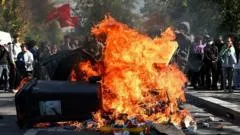
In Nantes, two separate fires broke out at high schools after bins were set alight. At the Nelson Mandela high school in the city centre, the blaze spread to the building's front, causing damage to the entrance hall. Similar scenes were reported in Rouen, where a school entrance was engulfed in flames. The violence has also targeted educators; in Marseille, staff at Victor Hugo high school were reportedly splashed with petrol by protesters carrying containers. In the village of Auchel, a headteacher at Degrugillier high school sustained an injury to the ear caused by a wayward firework.
Impact on public safety and infrastructure
The unrest has moved beyond symbolic blockades to direct confrontations. In Strasbourg, protesters used barriers to obstruct tram tracks, complicating the movement of commuters. The disruption of public transport in Marseille and Strasbourg was a direct result of vandalism and tactical maneuvers by protesters to hinder movement, creating a volatile environment for both citizens and security forces.
How is the French government responding to the crisis?
Prime Minister Sébastien Lecornu convened a crisis meeting on Thursday to address the rapid escalation of the demonstrations and the resulting violence. The government's official stance is that the student-led protests have transitioned into a state of "urban violence," necessitating a firm response to restore order.
While the government focuses on the security implications, the political landscape is becoming increasingly fractured. The administration is facing pressure to balance the legitimate concerns of the youth with the need to protect public property and safety. Local leaders have offered varying perspectives; for instance, the left-wing mayor of Marseille, Benoît Payan, condemned the "unacceptable violence" while acknowledging that young people are "legitimately concerned" about their future and the state of public services.
How has the unrest become politicized in France?
The protests have become a central flashpoint in French politics, with various parties using the unrest to attack their ideological opponents. This politicization is occurring even as France prepares for its next general election, turning a student movement into a proxy battle between the left and the right.
The hard-right National Rally, led by Marine Le Pen, has characterized the events not as student protests but as riots organized by professionals and overseen by members of the radical left, La France Insoumise (LFI). Le Pen has called for the passage of new anti-rioting legislation. Conversely, the government and hard-right politicians have pointed toward the hard left as the instigators of the violence.
Political reactions and ideological divides
The debate over the legitimacy of the protests has created several distinct political positions:
- The Radical Left (LFI): Bally Bagayoko, a Parisian mayor and LFI member, defended remarks suggesting violence could be legitimate in specific contexts, such as when protesters are targeted by gunfire. However, LFI leader Jean-Luc Mélenchon has maintained that he supports non-violent protest and argues that blaming the left is a distraction from the core issues.
- The Hard Right (National Rally): Marine Le Pen has labeled the unrest as organized rioting and is pushing for stricter legal measures to combat such disruptions.
- The Center-Right (Republicans): Eric Ciotti, the mayor of Nice, has proposed that the financial burden of repairing damaged school property should be shifted to the parents of the students involved.
- Local Governance: Mayors like Benoît Payan have attempted to bridge the gap by validating the students' concerns while strictly condemning the violent methods used.
Frequently asked questions
What are the students demanding in the French protests?
Students are demanding significant improvements to the education system, specifically focusing on increased funding, better staffing levels to address teacher shortages, and the renovation of aging school buildings that suffer from poor maintenance and inadequate facilities.
How many people have been arrested during the protests?
According to the interior ministry, 1,949 people were arrested on Thursday as the protests and blockades spread across the country, reflecting the intensity of the clashes between protesters and law enforcement.
Which cities have seen the most significant violence?
Nantes, Rouen, Marseille, and Strasbourg have all reported significant incidents of violence, including arson at high schools, petrol being used against staff, and the obstruction of public transport through vandalism and barriers.
Is the protest limited to high school students?
No, while the movement began with lycée students (ages 15-18), it has expanded to include university students. At least 30 universities, including those in Paris and Rennes, have reported being affected by blockades.
What is the political stance of the National Rally on this issue?
The National Rally, led by Marine Le Pen, views the protests as organized riots led by professional agitators from the radical left rather than genuine student movements, and they are calling for new anti-rioting laws.
Key takeaways
- Over 1,000 French lycées and 30 universities are affected by student blockades.
- The interior ministry reported 1,949 arrests and 305 injured police officers on Thursday.
- Protesters are citing lack of staff, overcrowded classrooms, and crumbling infrastructure.
- Political tensions are rising, with the hard right blaming the radical left for the violence.
Conclusion
The French school protests have evolved from localized grievances over educational resources into a nationwide crisis characterized by significant civil unrest and political polarization. While the underlying demands regarding school funding and infrastructure are rooted in the lived experiences of students, the escalation into arson and violence has shifted the national conversation toward security and law and order. As the government attempts to manage the immediate volatility and the political opposition uses the unrest to advance ideological agendas, the fundamental issues facing the French education system remain unresolved and deeply contested.