
Why are students protesting in French high schools?
The core of the France student protests lies in deep-seated grievances regarding the stability and quality of the national education system. Students have targeted high schools—known as lycées—to highlight what they describe as a fundamentally broken infrastructure. Primary drivers of this movement include chronic teacher shortages and increasingly overcrowded classrooms.
One 16-year-old female student, speaking to the AFP news agency, emphasized that the current classroom conditions are unsustainable. She noted that classes containing as many as 34 students make effective learning unfeasible while placing an immense burden on overworked educators. She explicitly stated that the students are not there to smash things up for no reason, but to signal that the education system is completely broken. These logistical failures have moved beyond mere dissatisfaction, manifesting as physical blockades of school premises to force government attention on the crisis.
Systemic pressures in the French education sector
The movement is not an isolated outburst but a reaction to long-term structural deficiencies. Beyond classroom density, the lack of available teaching staff has left many institutions struggling to maintain standard curricula. This vacuum of resources has created a sense of urgency among the youth, who feel that their academic future is being compromised by administrative and budgetary shortcomings.
The protests began in the Île-de-France region around Paris last week and have since expanded. The students' grievances center on the fact that the current working conditions for both students and staff are simply not feasible. By blockading schools, the protesters aim to make the invisible crisis of overcrowded and understaffed classrooms visible to the state.
What is the scale of the recent unrest and detentions?
The scale of the recent unrest is substantial, with at least 400 schools reportedly affected across France, according to the education ministry. On Tuesday, the situation reached a critical point of confrontation, leading to a massive police response and numerous arrests.
Interior Minister Laurent Nuñez confirmed that over 400 people were detained, noting that approximately two-thirds of those arrested were taken into police custody. The demographic of those detained is particularly notable, as the majority of the individuals apprehended are minors. This has added a layer of complexity to the legal and social response to the demonstrations.
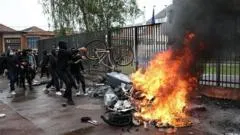
The physical impact of the protests has also been documented through reports of property damage. Pictures and videos appeared to show bins being set alight and bus stops being damaged by protesters. Additionally, French media reported that protesters hurled projectiles at police, contributing to the widespread disruption across the country.
How many people have been injured in the demonstrations?
The violence associated with the protests has resulted in significant injuries to multiple groups of people. Official reports indicate that at least 10 teachers and several students were injured during the demonstrations on Tuesday. Furthermore, the impact on security forces has been heavy, with 48 law enforcement officials sustaining injuries during the course of their duties.
The clashes often involve a cycle of escalation: French media reported that protesters hurled projectiles at police units, who subsequently responded using batons and tear gas to disperse the crowds. This pattern of confrontation has turned school zones into volatile environments, complicating the safety of both the students and the public employees tasked with maintaining order.
What has been the government's response to the violence?
The French government has adopted a dual-track response: acknowledging the right to protest while strictly condemning the accompanying violence and disorder. Education Minister Édouard Geffray stated that while students possess a fundamental right to demonstrate, the use of such freedoms to justify destructive actions is "indefensible." He further warned that calling for extended blockades is irresponsible, as it endangers both students and public workers.
Prime Minister Sébastien Lecornu also addressed the volatility of the situation. Following the arrest of 164 people on Monday, the Prime Minister warned that any further escalation would be considered irresponsible. He specifically cited the use of fireworks, fires, and general violence near high schools as actions that cannot be justified under any circumstances, noting that nothing justifies endangering students, staff, or police officers.
The debate over police conduct and repression
While the government maintains that its response is necessary to preserve public order, the methods used by law enforcement have come under intense scrutiny. Ryad Rani, president of the Union Syndicale Lycéenne, which represents students, has accused the French government of engaging in "repression" and criticized the police for using excessive force against the student body.
In response to these criticisms, which have been echoed by several French politicians, Interior Minister Laurent Nuñez defended the actions of the police. He asserted that the law enforcement response to the protests has been "carried out in an extremely proportionate manner," despite the widespread use of tear gas and batons reported in the field.
How do these protests intersect with wider labor unrest?
The student demonstrations do not exist in a vacuum; they coincided with broader national instability. On Tuesday, the school blockades occurred alongside nationwide walkouts by various labor unions. These strikes involved teachers, hospital staff, and civil servants, all of whom were protesting common themes of low wages and deteriorating working conditions.
This convergence of student activism and professional labor strikes suggests a period of significant social friction in France. The intersection of these movements highlights a widespread dissatisfaction with public sector management and economic stability, as different sectors of society simultaneously demand systemic reforms and better treatment of workers and students alike.
Frequently asked questions
Who is involved in the France student protests?
The protests primarily involve high school students (lycéens) protesting against overcrowded classrooms and teacher shortages. The unrest also involves teachers, civil servants, and hospital staff through coordinated nationwide walkouts, as well as law enforcement officials managing the demonstrations.
Why are students blockading schools?
Students are using school blockades as a tactic to draw attention to the perceived collapse of the French education system. They cite unfeasible classroom sizes, such as 34 students per class, and a lack of adequate teaching staff as the primary reasons for their actions.
What is the status of the detainees?
More than 400 people have been detained, with a significant majority being minors. According to Interior Minister Laurent Nuñez, approximately two-thirds of those detained were placed into formal police custody following the demonstrations.
How has the government reacted to the protests?
The government has condemned the violence and property damage, labeling it "indefensible" and "irresponsible." While ministers acknowledge the right to protest, they have warned that blockades and violence endanger students and staff, and they have defended police actions as proportionate.
What are the reported injuries from the protests?
The protests have caused injuries to several groups: at least 10 teachers, multiple students, and 48 law enforcement officials were reported injured during the clashes on Tuesday.
Key takeaways
- Over 400 people, mostly minors, were detained during recent French student protests.
- At least 400 schools have been affected by student-led blockades across France.
- Protest causes include overcrowded classrooms and significant teacher shortages.
- Injuries include 10 teachers, several students, and 48 police officers.
- Demonstrations coincided with nationwide strikes by teachers and hospital staff.
Conclusion
The escalating France student protests represent a profound challenge to the country's social and educational stability. With hundreds of schools affected and significant injuries reported among students, teachers, and police, the movement has moved beyond academic grievance into a broader crisis of public order. The government's firm stance against violence, contrasted with student accusations of police repression, suggests a widening gap between the youth and state authorities. As these demonstrations intersect with wider labor unrest regarding wages and working conditions, the resolution of these tensions will likely require addressing the underlying structural failures within the French public sector.