
What are the primary grievances driving the students?
Students are protesting a combination of deteriorating infrastructure, staffing crises, and systemic academic pressures within the French lycée system. Many students report that teacher absences often go unaddressed for weeks, leaving classrooms without instruction. Madalena, a student in Paris, highlighted this issue to the BBC, noting that teachers are sometimes absent for several weeks without being replaced. This lack of continuity directly impacts the quality of education and student stability.
Beyond staffing, the physical environment of schools has become a major point of contention. Recent heat waves have left buildings described by students as "boiling hot," lacking adequate climate control to handle extreme temperatures. These dilapidated facilities contribute to an environment that many students find increasingly untenable for learning.
The daily schedule and digital transition in education have also fueled deep resentment. Long school days, which frequently extend until 18:00, leave students with minimal time for rest or homework. One lycéen told France 2 that getting home at 19:00 leaves no time for sleep or studies. Furthermore, the Parcoursup platform—the digital system used to allocate university placements—has become a symbol of intense anxiety. Because approximately 80% of each cohort now passes the baccalauréat, the competition for desirable higher education courses is fierce. This creates a scramble for places, and many students regard the Parcoursup allocation process as opaque and unpredictable.
The impact of the school day and digital allocation
The extended school day is a structural feature of the French system, largely due to lengthy lunch breaks and complex scheduling rather than a reduction in holiday time. While holidays are not especially long compared to other EU countries, the daily grind remains a significant burden. For students, this results in arriving home as late as 19:00, creating a cycle of exhaustion that hampers their ability to engage with academic work outside of school hours.
This fatigue is compounded by the high-stakes nature of the Parcoursup system. As the gateway to higher education, the platform dictates the future academic paths of nearly every graduating student. The pressure to secure a preferred course in a competitive environment adds a layer of psychological stress to an already demanding school schedule. The combination of physical exhaustion and academic uncertainty creates a perfect storm of discontent among the youth.
How does French education funding compare internationally?
While the protests highlight significant local issues, international data suggests that the French government's spending levels are relatively high compared to European neighbors. According to a recent report by the OECD, a club of developed nations, France spends more per lycée student than the EU average for upper-secondary schools. This suggests that the unrest may be driven more by how funds are managed or distributed—addressing specific needs like facility maintenance and staffing—rather than a simple lack of total investment.
The issue of teacher shortages also presents a nuanced picture when viewed through a global lens. While shortages are indeed acute in France, OECD measures indicate that the number of unfilled posts is actually milder than in many other developed nations. However, the discontent is exacerbated by the fact that French teachers receive relatively low pay, which impacts recruitment and morale. Therefore, while the volume of funding is high, the specific application of that funding to teacher compensation and classroom stability remains a central grievance.
Why has the movement become so violent and widespread?
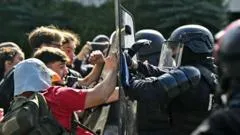
The scale of the current unrest is described by Interior Minister Laurent Nuñez as "unprecedented" in terms of the number of participating schools, the number of pupils involved, and the degree of violence. The protests have frequently turned violent, involving clashes between students, police, and so-called "casseurs" (vandals). The movement has resulted in hundreds of students, teachers, and police officers being injured, and thousands of people—including an unknown number of outside troublemakers—have been arrested.
While students engage in illegal blockades of school gates through threats or force, police operations to manage these crowds have often been criticized as heavy-handed. Prime Minister Sébastien Lecornu has maintained that security forces are not under orders to "confront high-school students," but are instead acting to enforce the law. Despite these tensions, the movement enjoys significant public sympathy. A poll conducted by BFMTV indicates that 72% of the French population views the students' demands as legitimate, and 55% express overall support for the movement.
What is the historical context of student activism in France?
The current protests are deeply rooted in a French political tradition where power is often exercised in the streets as much as through formal democratic institutions. Students are well aware that mass mobilization has historically forced significant government concessions. They are heirs to a culture in which demonstrators compete with elected officials to be seen as the legitimate voice of the people.
History provides several powerful precedents where student pressure successfully altered national policy and secured funding:
- October 1990: A rape at a school in Seine-Saint-Denis triggered mass rallies against underfunding and staff shortages, resulting in the government releasing the equivalent of €1.2bn (in today's money) for lycées.
- October 1998: 500,000 pupils marched across France over similar demands, leading to almost €1bn for school renovations and 14,000 extra staff.
- 1986: Protests helped defeat a major university overhaul.
- 1994: Demonstrations prevented a reduction in the youth minimum wage.
- 2006: Massive blockades led to the withdrawal of a law designed to loosen hire-and-fire rules for those under 26.
This culture of direct action is not limited to students; the "gilets jaunes" (yellow vests) uprising of 2018-2019 demonstrated how widespread civil unrest—including the ransacking of shops and attacks on government buildings—can force the government to drop fuel tax rises and approve €10bn in spending. While the street does not always win—as seen in 1968, when a student uprising was ended by an election—the precedent for success remains a driving force.
How does the political climate affect the government's response?
The French government currently faces a period of extreme political fragility, which may influence how it handles the escalating school protests. President Emmanuel Macron is in a "lame duck" period, as he is barred from standing in the presidential election due in six months. His administration is further weakened by a hopelessly gridlocked assembly following his decision to call a snap election in June 2024.
Prime Minister Sébastien Lecornu has acknowledged the difficulty of his position, describing himself as the "weakest prime minister" in living memory. The government's ability to negotiate is severely limited by a precarious financial situation. France is currently managing a deficit of 5.4% of GDP and public debt at its highest level since the 1940s. These economic constraints make it difficult for the administration to meet the students' financial demands without further straining an already volatile national budget. However, this very weakness could prove to be an asset or a liability in the ongoing showdown with the students.
FAQ: France's school protests
What are the main reasons for the protests?
Students are protesting against underfunding in the education sector, specifically citing teacher shortages, dilapidated school buildings that lack climate control, and the stress caused by the Parcoursup university placement system. They also demand changes to long school days that leave little time for rest.
Is the French government underfunding its schools?
While students claim underfunding, OECD data shows that France spends more per upper-secondary student than the EU average. However, the discontent is fueled by the fact that teacher pay remains relatively low and the distribution of existing funds has not resolved acute staffing and facility issues.
How violent have the protests been?
The movement has seen significant violence, with hundreds of students, teachers, and police officers injured. Clashes often involve students blockading schools, police crowd-control operations, and the presence of "casseurs" or vandals who participate in the unrest.
Does the French public support the students?
Yes, there is significant public backing for the movement. According to a BFMTV poll, 72% of French citizens consider the students' demands to be legitimate, and 55% of the population supports the movement overall.
Can student protests change French law?
Historically, student protests in France have been highly effective at forcing government retreats. Previous movements in 1986, 1994, and 2006 successfully blocked or overturned various government reforms regarding universities and labor laws.
Key takeaways
- Protests are driven by staffing shortages, poor school facilities, and Parcoursup anxiety.
- OECD data shows France spends more per student than the EU average.
- The movement enjoys high public legitimacy, with 72% support according to BFMTV.
- The government faces severe financial constraints, including a 5.4% GDP deficit.
Conclusion
The current wave of student unrest in France represents more than a simple dispute over educational resources; it is a manifestation of a long-standing political culture that prioritizes street mobilization. While the economic data suggests that French education spending is not uniquely low, the lived experience of students—characterized by staffing gaps, intense academic pressure, and aging infrastructure—has created a volatile environment. With a politically weakened government facing significant debt and a gridlocked assembly, the administration finds itself in a difficult position, caught between the necessity of fiscal discipline and the historical power of the French protest movement.




