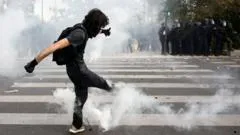
How large is the scale of the current school protests in France?
The scale of the unrest has reached a critical mass, with hundreds of thousands of participants participating in coordinated demonstrations across the country. According to government figures released on Tuesday, more than 250,000 demonstrators took to the streets. However, student unions provided a significantly higher estimate, claiming that 450,000 people were involved in the day's actions.
The disruption to the national education system is profound. The government reported that 891 high schools experienced disruptions on Tuesday, representing nearly one-quarter of all French lycées. Student unions, however, claim a much higher level of mobilization, stating that 1,800 schools have been blockaded as part of the movement, which protesters have dubbed "Act Three." This widespread participation marks a transition from localized student anger to a broader social movement that now includes university students, parents, and labor unions.
The impact on educational institutions
The blockades have moved beyond mere marches into the physical occupation of school grounds. While the government focuses on the number of disrupted schools, the unions emphasize the depth of the blockade, suggesting a systemic refusal to continue normal operations until demands are met. This "Act Three" phase of the movement indicates a sustained strategy of civil disobedience designed to pressure the state.
The scale of the disruption is being felt in classrooms and administrative offices alike. With nearly a quarter of lycées reporting disruption, the ability of the state to maintain a standard educational schedule has been severely compromised. The movement's expansion into universities and the involvement of France's biggest union, the CGT, suggest that the educational sector is facing a prolonged period of instability.
What are the primary grievances driving the student movement?
The protests are driven by systemic failures within the French education system, specifically regarding infrastructure and staffing. What began in mid-September as localized anger in the Seine-Saint-Denis suburb of Paris has evolved into a national demand for better resources. Students have cited overcrowded classrooms, a lack of teaching staff, and dilapidated buildings as primary reasons for their mobilization.
In cities like Marseille, students have described conditions that make learning nearly impossible. For instance, students reported leaking ceilings and general decay in school facilities. Alissa, a student in Marseille, noted that the movement is a response to schools being effectively closed or falling into disrepair. Sacha, another student in Marseille, emphasized that the poor conditions prevent students from working effectively, leading to the vow to continue protesting until concrete measures are implemented. These grievances are not limited to the youth; older generations are also joining the cause. In central Paris, a couple in their 70s, Alain and Michèle, marched to show support, noting that as former teachers, they understand the deep-seated problems facing the French education system.
How has the government responded to the unrest?
The French government has taken a dual approach of condemning violence while attempting to offer limited concessions. Prime Minister Sébastien Lecornu condemned the violence associated with the protests, noting that since the movement began, 215 students, 85 staff members, and 715 police officers have been injured. The administration has also accused radical elements of infiltrating the movement to cause instability.
Education Minister Édouard Geffray has called for dialogue instead of blockades, expressing concern over "ultra-violent elements" within the student groups. To address grievances, the government has introduced measures such as a dedicated website for student feedback and a scheduled afternoon for internal school discussions. However, these efforts have so far failed to gain traction with the protesters, who view them as insufficient to address the structural issues they face. The government's response remains under pressure as the scale of the demonstrations continues to grow.
Political tensions and the upcoming election
The protests are unfolding against a sensitive political backdrop, with presidential elections scheduled in seven months. Prime Minister Lecornu has accused the radical-left France Unbowed (LFI) party of attempting to "sow chaos" to influence the electoral outcome. As President Emmanuel Macron approaches the end of his second term, the political landscape is highly volatile.
The timing of the unrest is critical. LFI leader Jean-Luc Mélenchon is currently the runner-up in opinion polls, trailing only the hard-right National Rally's Marine Le Pen. With the presidency nearing the end of Macron's tenure, the government is attempting to manage both a massive social movement and a highly competitive electoral environment. Macron was due to chair a meeting with ministers at the Élysée Palace on Tuesday evening to assess the unfolding situation.
What is the impact of police intervention on the protests?
Police intervention has resulted in significant injuries and is currently under intense legal and public scrutiny. Clashes have occurred in several major cities, including Paris, Marseille, Lyon, and Rennes, involving the use of tear gas and water cannons. The French interior ministry reported that 6,547 individuals have been stopped or arrested since September 28.
The use of force has led to severe injuries and subsequent legal action. In Saint-Ouen-l'Aumône, north-west of Paris, a police officer has been charged with violence resulting in mutilation or permanent disability after a 14-year-old student, Eden, was hit in the face by a tear-gas grenade. The student reportedly suffered a fractured jaw and significant dental damage, including broken upper teeth and the loss of four lower teeth. Furthermore, a highly controversial incident in Lens involving a 15-year-old losing a hand after being exposed to a "sting ball" grenade has sparked widespread allegations of disproportionate force. While authorities suggest the student picked up the grenade, students allege he was hit directly after an officer fired.
Investigations into police conduct
The French police inspectorate, the IGPN, is currently investigating multiple cases of alleged excessive force. While authorities in Lens suggested the injury occurred when a student picked up a grenade, students maintain the device was fired directly at them. The local prefect noted the incident occurred when police were confronted by a group of 200-250 students throwing stones and fireworks.
These incidents have fueled a broader sense of injustice among demonstrators, who argue that police tactics are being used to repress legitimate dissent rather than maintain order. The criminal charges brought against the officer in the Saint-Ouen-l'Aumône case underscore the seriousness with which some of these allegations are being treated by prosecutors.
FAQ: School protests in France
How many people are participating in the protests?
Participation figures vary by source. The French government reported that over 250,000 people took to the streets on Tuesday, while student unions estimated the number to be much higher, at approximately 450,000 demonstrators across the country.
What are the students demanding?
Students are primarily demanding increased resources for schools, better infrastructure to fix dilapidated buildings, more teaching staff, and an end to overcrowded classrooms. They are also calling for less police repression during their demonstrations.
Has the government offered any solutions?
Yes, the government has offered a website for students to voice grievances and an afternoon dedicated to internal discussions within schools. However, these measures have so far been rejected by the movement as inadequate.
What is the political context of these protests?
The protests are occurring seven months before the presidential election. Prime Minister Lecornu has suggested that radical-left parties may be using the unrest to create chaos, while the administration faces pressure during President Macron's final term.
Are there legal consequences for police actions?
Yes, prosecutors have already charged a police officer with violence resulting in permanent disability following an incident where a student was injured by a tear-gas grenade. The IGPN is also investigating other allegations of disproportionate force.
Key takeaways
- Over 250,000 people participated in nationwide protests on Tuesday, with unions claiming 450,000.
- The movement involves blockades in up to 1,800 high schools according to unions.
- Primary grievances include dilapidated school buildings, leaking ceilings, and a lack of teaching staff.
- Police interventions have led to serious injuries, including a student losing a hand and another suffering a fractured jaw.
- The unrest occurs seven months before the French presidential elections, amidst high political volatility.
Conclusion
The school protests in France have evolved from localized complaints about classroom conditions into a massive national movement that challenges both the educational system and the political stability of the state. With hundreds of thousands of citizens participating and significant injuries reported due to police clashes, the unrest is unlikely to subside quickly. As the government attempts to implement minor concessions, the movement remains focused on fundamental structural changes. The intersection of student grievances and the upcoming presidential election creates a volatile environment that will test the resilience of the Macron administration in the months ahead.