
What triggered the protests in France on 17 October 2026?
The demonstrations were initially driven by hundreds of thousands of students protesting against staff shortages and dilapidated facilities in the country's lycées—secondary schools attended by 15 to 18-year-olds. These student-led actions expanded significantly on Saturday when their numbers were bolstered by trade union members and various other protest groups.
Among the participants were members of the so-called gilets jaunes, or 'yellow vest' movement. This group has been demonstrating against cost-of-living hikes for over a year, dating back to 2018, making it one of the longest-lived protest movements in French history. The combined turnout for the latest wave of demonstrations reached an estimated 550,000 people across the country. While the core grievances centered on hardship in schools and the rising cost of living, the interior ministry noted that the day was also marked by "targeted acts of violence" carried out by "hooded individuals" in several locations, including parts of the capital, Marseille, Rennes, Toulouse, and Angers.
How did violence unfold in Paris and other cities?
In Paris, the main march appeared to be largely peaceful during the afternoon. A group of young people interviewed by the BBC described themselves as "pacifists" who were "just trying to make things change, but nothing is moving." However, as the day progressed, the atmosphere shifted. Groups began lighting fires in the streets and torching vehicles in iconic locations, such as the Place de la République. Shops were ransacked, at least one restaurant was gutted by fire, and fighting broke out among various groups. Riot police were observed charging at crowds in central Paris and using batons on several individuals.
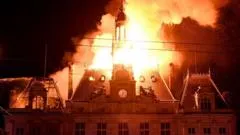
The unrest was not confined to the capital. In Lyon, Mayor Grégory Doucet described the burning of the city's tourist office as "a tragedy," noting that the historic building was iconic and well-known. Local police reported that "hostile individuals" actively prevented firefighters from safely tackling the blaze. In Limoges, a large fire at the town hall caused the roof to partly collapse, according to the local prefecture. Looting also targeted commercial interests, such as an Apple store in Lille which was broken into and emptied, while clothes and food shops were raided in Paris. Damage to buildings was also reported in Grenoble, Avignon, Pau, Montpellier, and Valence.
Reported injuries and specific incidents
The human cost of the unrest was significant. Prime Minister Sébastien Lecornu stated that 150 police officers were injured during the clashes. In the south-eastern city of Saint-Étienne, Mayor Régis Juanico shared the tragedy of a young man who "had his hand blown off by a grenade," stating on social media that such an incident should never have happened.
Visual evidence further illustrated the volatility of the day. Footage authenticated by BBC Verify showed a tourist train in Grenoble being driven by masked men along a narrow street in the city centre, directed towards at least three riot police officers. These incidents of targeted aggression contributed to what the government described as an "escalation in violence" throughout the country.
Which political figures responded to the unrest?
The political response has been sharply divided. President Emmanuel Macron took a firm stance against the destruction, stating, "Those who have broken, attacked the prefectures as well as businesses, looted even our town halls, will be prosecuted and punished." Prime Minister Sébastien Lecornu echoed this severity, noting that police had faced "violence of extreme intensity." He suggested that some groups might be using the protests as a "warm-up" for the upcoming presidential elections, adding that "no-one will impose their political agenda through violence."
The opposition has offered conflicting interpretations. Jean-Luc Mélenchon, who took part in the demonstrations, accused police officers of "unleashing" on protesters, while simultaneously condemning the acts of looting and arson. Prime Minister Lecornu dismissed Mélenchon's comments as "dangerous and cynical." Meanwhile, Marine Le Pen argued that the "legitimate demands" of the protesters had been "held hostage by the far left," accusing Mélenchon of fueling the violence. In an attempt to address the underlying grievances, Education Minister Édouard Geffray had previously promised 3,000 extra supply teachers during a television interview on 8 October.
What is the broader context surrounding these demonstrations?
These outbreaks of disorder occur as France enters a period of profound political uncertainty. President Emmanuel Macron is set to leave office next year, and the upcoming April presidential election is shaping the national discourse. Current polling suggests the election could become a direct contest between the leader of the National Rally, Marine Le Pen, and Jean-Luc Mélenchon of the hard-left La France Insoumise party.
The intersection of long-standing economic grievances—exemplified by the enduring gilets jaunes movement—and the looming leadership transition has created a volatile environment. As the country prepares for a change in presidency, the tension between those demanding systemic change and the government's efforts to maintain order continues to escalate.
Frequently asked questions
How many people were arrested during the protests?
At least 1,200 people were arrested during the demonstrations, which the French government described as an escalation in violence.
Which cities experienced the most significant damage?
Significant damage and fires were reported in Paris, Limoges (where a town hall roof collapsed), Lyon (where a tourist office burned), Lille (where an Apple store was looted), and Grenoble. Damage was also noted in Marseille, Rennes, Toulouse, Angers, Avignon, Pau, Montpellier, and Valence.
Did the main marches remain peaceful?
In Paris, the main afternoon march was largely peaceful, according to reports, but violence increased in the evening as groups began torching vehicles and looting shops.
What concessions has the government offered?
Education Minister Édouard Geffray promised 3,000 extra supply teachers during a television interview on 8 October to address school-related concerns.
Who participated beyond the student groups?
The protests included trade union members and participants from the gilets jaunes movement, who have been protesting cost-of-living hikes since 2018.
Key takeaways
- Over 1,200 arrests were made during nationwide demonstrations.
- 150 police officers sustained injuries during the unrest.
- Significant damage occurred to public buildings, including town halls in Limoges and Lyon.
- Protests involved students, trade unions, and the gilets jaunes movement.
- The unrest occurs amid political uncertainty ahead of next year's presidential election.




