
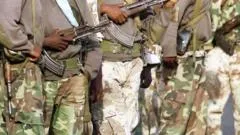
How are Eritrean troops moving through Tigray?
Eritrean military convoys are reportedly advancing from the border town of Zalambessa toward the central Tigray region, according to eyewitness accounts. Residents in the town of Adigrat have described seeing large-scale movements of vehicles, including trucks with Eritrean registration plates, passing through the city heading south.
Specific reports from local inhabitants provide varying estimates of the scale of this mobilization, suggesting a significant influx of personnel and equipment:
- A resident of Adigrat reported witnessing approximately 40 trucks carrying soldiers moving south.
- A second resident noted seeing between 20 and 30 large trucks during the morning hours, moving toward Edaga Hamus.
- Sources in Mekelle relayed accounts from relatives in Adigrat who estimated seeing as many as 60 trucks carrying personnel.
These convoys are reportedly transporting not only personnel but also heavy weaponry. Witnesses have noted the presence of anti-aircraft guns among the vehicles. Some troops are also reported to be advancing on foot. Social media imagery has also circulated, appearing to show heavily loaded military trucks carrying uniformed personnel toward key locations such as Adigrat, Edaga Hamus, and potentially Wukro. While these images have not been independently verified, they align with the testimonies provided by local residents regarding the southward movement of troops.
What is the current state of the conflict in Tigray?
Fighting in the Tigray region escalated two weeks ago following months of mounting tension between the Ethiopian government and the Tigray People's Liberation Front (TPLF). The recent military shifts follow the withdrawal of TPLF forces from Mekelle, the regional capital, which is now under the control of the Ethiopian national army. This shift in control has been accompanied by a partial restoration of mobile phone connections and internet access in most areas since the military took over the city.
The current instability is linked to several overlapping developments that have destabilized the region's fragile peace.
The role of new armed alliances
In September, a new alliance of armed groups was launched within Ethiopia, an organization that includes the TPLF. This shift in political and military alignments has contributed to the breakdown of local stability and has intensified the friction between regional factions and the central government. The formation of this alliance appears to have been a significant catalyst in the recent escalation of hostilities.
The collapse of the 2022 peace agreement
Both the Ethiopian government and the TPLF have accused one another of violating the 2022 agreement that originally brought an end to the two-year civil war. This breakdown in the peace process has reopened the front lines, leading to heavy weapons exchanges in areas such as Wukro. In Wukro, national army soldiers and allied fighters reportedly entered the town on Wednesday following an exchange of heavy weapons approximately 15km south of the town. The failure of the 2022 deal has left the region in a state of renewed combat, with both sides blaming the other for the breach of terms.
Why have relations between Ethiopia and Eritrea deteriorated?
The involvement of Eritrean forces marks a significant escalation in a bilateral relationship that has rapidly declined since the end of the 2020-2022 war. While Eritrea was a critical ally to Ethiopia during the previous conflict against the TPLF—a war that drove the Tigray region to the precipice of famine—the two neighbors have since severed diplomatic ties.
The deterioration is driven by several geopolitical factors:
- Maritime Ambitions: Tensions have been fueled by the Ethiopian Prime Minister's stated ambitions regarding access to one of Eritrea's Red Sea ports.
- Diplomatic Severance: Last week, both nations officially severed diplomatic relations, a move that coincided with the renewed fighting in Tigray.
- Accusations of Interference: Ethiopia has accused Eritrea of providing direct support to the TPLF, an allegation that Asmara has consistently denied.
The recent escalation has led Ethiopian officials to claim that Eritrean involvement is no longer just indirect. Abraham Belay, a senior Ethiopian government official, stated in an interview with Fana Television that the Eritrean army has participated using its full capacity and logistics. He further claimed that many Eritrean soldiers have been killed and captured during these operations, warning that retaliation will follow. He characterized the Eritrean involvement as fighting alongside "bandits."
What is the humanitarian and psychological impact on residents?
The reported return of Eritrean military forces has caused significant distress among the Tigrayan population, many of whom lived through the atrocities associated with the 2020-2022 conflict. The psychological weight of the renewed presence is heavy, as residents recall the violence of the previous war.
The impact on the ground is characterized by:
- Emotional Trauma: Residents in Adigrat have expressed deep sadness and emotional distress at seeing Eritrean soldiers return to the region, with one resident noting that the memories are still fresh.
- Active Combat Risks: In Edaga Hamus, residents reported that Eritrean troops have passed through the town and that drone strikes have occurred nearby, targeting soldiers.
- Information Constraints: While mobile and internet services have been partially restored since the military takeover of Mekelle, the BBC remains unable to independently verify many of the reported movements or the extent of the violence.
The memory of the previous war, which brought the Tigray region to the brink of famine, continues to shadow any new military developments, making the prospect of renewed large-scale combat a matter of extreme concern for the local population.
Frequently asked questions
What is causing the current fighting in Tigray?
The fighting stems from a breakdown in the 2022 peace deal between the Ethiopian government and the TPLF. Tensions have been rising for months, exacerbated by the formation of a new alliance of armed groups in September that includes the TPLF, leading to recent clashes between national and regional forces.
Is Eritrea directly involved in the Tigray conflict?
While Eritrea has denied involvement, the Ethiopian government has accused them of direct participation. Senior official Abraham Belay stated that the Eritrean army is involved with its full capacity and logistics, claiming that Eritrean soldiers have been killed and captured in the fighting.
What happened to Mekelle?
Mekelle, the main city of Tigray, is currently under the control of the Ethiopian national army. This follows a recent withdrawal of TPLF forces from the city, which has shifted the military balance in the region and allowed for the partial restoration of internet and mobile services.
How are Eritrean troops moving through the region?
Eyewitnesses report that Eritrean military convoys are moving from the border town of Zalambessa toward central Tigray. These convoys, consisting of dozens of trucks carrying soldiers and heavy weapons like anti-aircraft guns, have been seen passing through Adigrat toward Edaga Hamus.
Why are Ethiopia and Eritrea no longer on good terms?
Relations have deteriorated due to Ethiopia's ambitions regarding Red Sea port access and the recent accusations regarding Eritrea's support for the TPLF. These tensions culminated last week in both countries officially severing their diplomatic relations.
Key takeaways
- Eritrean military convoys are reportedly advancing from Zalambessa toward central Tigray.
- The 2022 peace agreement between the Ethiopian government and the TPLF has collapsed.
- Ethiopia and Eritrea have officially severed diplomatic relations following renewed fighting.
- TPLF forces have withdrawn from Mekelle, which is now under Ethiopian army control.
- Residents report seeing large convoys of trucks carrying soldiers and heavy weaponry.
Conclusion
The reported movement of Eritrean troops into central Tigray signals a dangerous escalation in a region already destabilized by the collapse of the 2022 peace agreement. The convergence of Ethiopia's maritime ambitions, the breakdown of bilateral diplomacy, and the emergence of new armed alliances suggests that the current clashes could expand into a much broader regional conflict. As the Ethiopian national army maintains control over Mekelle and Eritrean forces push southward, the humanitarian and psychological toll on the Tigrayan population remains a critical concern, shadowed by the memories of previous devastating violence.




