
What are the primary causes of the education protests in France?
The core drivers of the current unrest are systemic issues within the French schooling system, specifically regarding infrastructure, staffing, and funding. Students have voiced significant grievances concerning overcrowded classrooms, excessively long school hours, and inadequate temperature control in buildings. Furthermore, a shortage of teaching staff has become a focal point of student frustration.
Beyond these day-to-day operational issues, a major catalyst for the escalation is the French government's proposed budget cuts. These planned reductions in education funding have infuriated the youth population, who view the cuts as a direct threat to their future academic environments. This financial tension has transformed localized school grievances into a nationwide movement of resistance.
The impact of budget cuts on student sentiment
The timing of the proposed budget cuts has coincided with existing frustrations over school conditions, creating a volatile environment. Protesters argue that reducing funds while classrooms are already overcrowded and buildings are in disrepair is untenable. This perceived neglect by the state has fueled the intensity of the demonstrations, moving the movement from simple complaints about school hours to a broader political confrontation regarding the state's priorities for the next generation.
How widespread is the disruption across French schools?
The disruption has reached a massive scale, with Justice Minister Gérald Darmanin stating that 735 of France's approximately 3,700 schools have been affected in some capacity. What began as demonstrations in the capital, Paris, has rapidly spread to major urban centers including Montpellier, Nantes, and Marseille. The scale of the movement is evidenced by the fact that more than 700 schools have faced some form of disruption or closure.
The physical impact on educational facilities has been severe. The education ministry has reported "significant damage" to school properties, including attacks on perimeter fences, entrances, and gates. In Nantes, the Nelson Mandela high school suffered more than €2m in damages after a fire destroyed its glass entrance and several interior sections. This level of destruction highlights the intensity of the confrontations occurring on school grounds.
What is the scale of the violence and police response?
Law enforcement has engaged in significant clashes with protesters to maintain public order. According to Interior Minister Laurent Nuñez, 1,747 people were arrested on Friday alone as authorities attempted to curb what he described as a slide into "riot and urban violence." In several cities, the response has involved heavy-handed tactics, such as the use of tear gas in Strasbourg to prevent hostile conditions from developing.
The violence has not been limited to property damage; it has also resulted in physical injuries to both students and officials. The education ministry confirmed that at least 65 staff members have been injured during the unrest. In Belfort, a 17-year-old was arrested on suspicion of attempted homicide after video footage, authenticated by BBC Verify, showed a police officer being chased, punched, and kicked in the head by a group of young men.
Police seizures and urban disruption
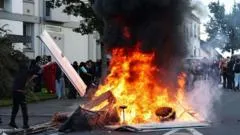
Authorities have seized various dangerous items from demonstrators, including petrol bombs, axes, and mortar-style fireworks. In the Paris suburb of Pantin, police were forced to charge at crowds following the throwing of projectiles at officers. In other areas like Rennes and Paris, the unrest has manifested in the setting of rubbish bins on fire, further complicating the efforts of local municipalities to maintain order and safety.
How have government officials interpreted the movement?
Government officials have expressed deep concern, with many suggesting that the original intent of the student movement has been compromised. Justice Minister Gérald Darmanin remarked that the situation had transitioned from high-school demonstrations into a broader "public order disturbance." Similarly, Education Minister Édouard Geffray suggested that the movement had been hijacked by individuals who are not actually students. He noted that teachers have reported seeing people in front of them who were not part of their student bodies.
In response to the damage, the government is looking toward legal accountability for families. Darmanin indicated that prosecutors have been asked to explore holding parents liable for the damage caused by their children, including the cost of repairs. This move reflects a hardline stance intended to deter further vandalism and hold the community responsible for the destruction of public infrastructure.
What are the political implications for President Macron?
The protests arrive at a highly sensitive period for the French presidency, occurring just six months before the next presidential election. The ability of President Emmanuel Macron to manage the unrest and address the underlying educational grievances will likely become a central theme in the upcoming electoral campaign. The movement represents a significant challenge to the administration's authority and its ability to implement fiscal reforms.
The unrest has also created a rift between the state and various social sectors. While the government seeks to maintain order through arrests and legal threats, trade unions such as SNEP-FSU, SNUEP-FSU, and Solidarités have expressed support for the students. The Solidarités Trade Union Federation has issued statements urging that the state should not "fire on our children," highlighting the growing tension between the executive branch and organized labor regarding the treatment of protesters.
Frequently asked questions
How many people have been arrested in the protests?
According to Interior Minister Laurent Nuñez, 1,747 people were arrested on Friday during the widespread demonstrations. The arrests were part of an effort by the police to curb what the minister described as a slide into urban violence and rioting across various French cities.
What specific damage has been reported to schools?
The education ministry reported significant damage to school facilities, including attacks on gates, fences, and entrances. Notably, Nelson Mandela high school in Nantes incurred over €2m in damages after a fire destroyed its glass entrance and several interior areas of the building.
Why are the students protesting?
Students are protesting due to declining education standards, including overcrowded classrooms, long school hours, and inadequate building maintenance. Additionally, planned government budget cuts to education funding have served as a major catalyst for the escalation of the demonstrations across the country.
How many schools have been affected by the unrest?
Justice Minister Gérald Darmanin stated that 735 of France's 3,700 schools have been affected in some way by the protests. The disruption has spread from Paris to various other cities, including Marseille, Nantes, and Montpellier, impacting hundreds of educational institutions.
Has there been violence against police officers?
Yes, there have been reports of violence against law enforcement. In Belfort, a 17-year-old was arrested on suspicion of attempted homicide after video footage showed a police officer being beaten. Additionally, in Pantin, police were targeted with projectiles, necessitating charges against the protesters.
Key takeaways
- Over 1,700 people were arrested on a single Friday during the widespread education protests.
- Approximately 735 French schools have been impacted by the ongoing student unrest.
- One school in Nantes reported more than €2m in damages caused by fires.
- Protests are driven by classroom overcrowding and planned education budget cuts.
- The unrest occurs six months before the upcoming French presidential election.
Conclusion
The education protests in France have evolved from localized student grievances into a national crisis of public order. With over 700 schools affected and thousands of arrests made, the unrest highlights a profound dissatisfaction with the state of the French educational system and proposed fiscal austerity. As the government moves to hold parents liable for damages and police continue to clash with demonstrators, the political pressure on the Macron administration intensifies. The resolution of this conflict will likely serve as a critical indicator of social stability heading into the next presidential election.