
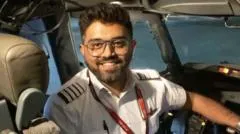
Who is Capt Smit Machchhar?
Capt Smit Machchhar is an experienced Indian commercial pilot who became a central figure in an aviation emergency after being attacked by a colleague mid-flight. The incident occurred on Flydubai flight FZ1073, which was en route from Dubai International Airport to Ben Gurion Airport in Israel. Machchhar, who was the pilot-in-command during the attack, has been widely described by international leaders as a hero for his actions in the cockpit.
Born in Mumbai, India, Machchhar underwent rigorous training to become a highly skilled aviator. His career path took him from India to New Zealand and eventually to the United Arab Emirates. According to his professional profile, he possesses over 9,750 hours of flying experience, with more than 6,400 of those hours served as pilot-in-command. This level of experience was critical during the crisis, as he managed to maintain control of the aircraft despite sustaining serious injuries.
Professional Background and Training
Machchhar's journey into aviation was not an immediate childhood ambition. He initially studied management with the intention of joining his family's business, but a seminar on aviation changed his career trajectory. He attended Mainland Air, an aviation college located in Dunedin, New Zealand, in 2008. Following his studies, he joined the Indian airline SpiceJet in 2011. He later transitioned to Flydubai in 2022, bringing years of international commercial flying experience to the Dubai-based carrier.
What happened during the Flydubai flight incident?
The Flydubai flight FZ1073 experienced a life-threatening emergency on Wednesday morning following a violent altercation between two pilots. The flight departed Dubai at 03:05 GMT, carrying at least 150 passengers, most of whom were Israeli nationals. Data from Flightradar24 indicates that the aircraft entered a period of extreme instability approximately two and a half hours after takeoff. At 05:21, the plane underwent a rapid descent, dropping more than 17,000 feet (5,000 meters) in less than two minutes.
During this descent, the aircraft's transponder signals changed significantly. The plane initially issued a squawk 7700 code, signifying a general emergency, before switching to a squawk 7500 code, which is the international signal for a hijacking. Israeli Prime Minister Benjamin Netanyahu later clarified that the situation involved a pilot stabbing another colleague and subsequently attempting to crash the plane. The aircraft entered a spin, causing a terrifying experience for those onboard.
The Cockpit Struggle and Emergency Landing
The situation was brought under control through the intervention of passengers and crew. According to Netanyahu, an Israeli passenger and a crew member managed to break into the cockpit, where they overpowered the attacker. This intervention prevented the aircraft from completing its descent into a catastrophic crash. The plane, which had briefly entered Jordanian airspace, looped back into Saudi Arabian airspace to begin a manual descent. It eventually touched down at Tabuk Airport in north-western Saudi Arabia at 06:58.
How is Capt Smit Machchhar's health and recovery progressing?
Capt Smit Machchhar is currently recovering in a hospital in Tabuk, Saudi Arabia, where medical professionals have stabilized him. The Indian embassy in the United Arab Emirates has provided updates regarding his condition, stating that he is in "good health and recovering well." This reassurance comes after the initial reports of the severity of his injuries during the stabbing.
Ambassador Deepak Mittal expressed immense pride in Machchhar's bravery and noted that he felt "very reassured" after meeting with the pilot. The physical and psychological toll of the event is significant, but the immediate focus remains on his medical stabilization. While the motive behind the attack remains unknown, the primary concern for his family and the aviation community is his continued recovery.
What has the international community said about the incident?
The incident has drawn praise from high-ranking government officials across the globe, highlighting the gravity of Machchhar's actions. Prime Minister Narendra Modi of India lauded the pilot's "unwavering resolve" and courage, noting that his actions averted a massive tragedy. Similarly, Indian Foreign Minister S Jaishankar commended Machchhar's remarkable presence of mind during the crisis.
International leaders also weighed in on the heroic nature of the pilot's response. US President Donald Trump commented from the White House, noting that despite being in "very bad shape," Machchhar had the presence of mind to ensure the cockpit door could be accessed. This allowed the intervention that ultimately saved the lives of the passengers. The sentiment was echoed by SpiceJet, Machchhar's former employer, which released a statement calling him a hero who saved countless lives.
Global Reactions and Social Media Impact
Beyond official government statements, the incident has sparked massive engagement on social media. In India, the public has rallied around Machchhar, with many users sharing clips from a previous podcast appearance where he discussed his philosophy on aviation and life. These viral snippets have helped humanize the pilot, showing a man who valued discipline and work-life balance alongside his professional rigor.
FAQ: Capt Smit Machchhar and the Flydubai Incident
Who is the pilot involved in the Flydubai stabbing?
The pilot is Capt Smit Machchhar, an Indian national with extensive commercial flying experience. He was the pilot-in-command on Flydubai flight FZ1073 when he was attacked by another pilot during the flight. He is currently recovering in a hospital in Tabuk, Saudi Arabia.
How many people were on the flight?
The flight was carrying at least 150 people. According to Israeli Prime Minister Benjamin Netanyahu, "almost all" of the passengers on the Israel-bound aircraft were Israeli nationals. The intervention in the cockpit is credited with saving approximately 174 lives.
What was the aircraft's flight path during the emergency?
The aircraft was en route from Dubai to Ben Gurion Airport in Israel. During the emergency, the plane made a rapid descent over Saudi Arabia, briefly entered Jordanian airspace, and then looped back into Saudi Arabia. It eventually made an emergency landing at Tabuk Airport.
What emergency codes were used by the plane?
The aircraft initially used the squawk 7700 code, which indicates a general emergency. It then switched to the squawk 7500 code, which is the specific transponder setting used to signal a hijacking. The plane returned to the 7700 code later during its descent.
What is the current status of Capt Machchhar?
According to the Indian embassy in the UAE, Machchhar is in good health and is recovering well. He was taken to a hospital in Tabuk, Saudi Arabia, following the incident and has been stabilized by medical staff.
Key takeaways
Capt Smit Machchhar is an Indian pilot credited with saving approximately 174 lives during a mid-air attack.
The Flydubai flight FZ1073 diverted to Tabuk, Saudi Arabia, after a pilot attempted to crash the plane.
Machchhar has over 9,750 total flying hours, including 6,400 hours as pilot-in-command.
International leaders, including the Indian Prime Minister and US President, have hailed Machchhar as a hero.
Conclusion
The stabbing incident on Flydubai flight FZ1073 represents a rare and extreme aviation emergency. Through the combined efforts of Capt Smit Machchhar, the flight crew, and courageous passengers, a potential catastrophe was averted. Machchhar's extensive experience and ability to maintain professional standards under extreme duress have earned him international acclaim. As he continues his recovery in Saudi Arabia, the aviation industry and the global community remain focused on his wellbeing and the ongoing investigation into the motive behind this unprecedented mid-air assault.