
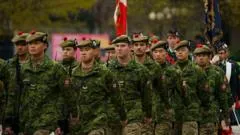
Why is Canada preparing for a US invasion?
Canada is conducting military war games to address a low-probability but high-impact risk involving the United States. Prime Minister Mark Carney acknowledged this strategy in a recent interview with the New York Times, framing the preparation as essential risk management. This shift in posture follows a period of heightened tension characterized by Donald Trump's global tariff policies and recurring rhetoric suggesting Canada could become the "51st state."
While the White House has stated that President Trump has done more than anyone to protect Canadians, the political climate has fueled domestic anxiety. According to a Leger poll conducted in January, over 30% of Canadians expressed belief that a US invasion was likely, a sentiment exacerbated by recent US military interventions in other nations, such as the capture of Nicolás Maduro in Venezuela.
How do current military ties impact the likelihood of conflict?
Existing defense frameworks and deep military integration make an armed assault between the two nations extremely unlikely. Lt-Gen Christopher Coates, a former officer with the Royal Canadian Air Force, noted that throughout his 34-year career, the possibility of an attack from US territory was never a considered reality. The two nations are bound by several layers of cooperation:
- NATO Membership: Both countries are members of the North Atlantic Treaty Organization, which mandates collective defense against attacks on member nations.
- NORAD: The North American Aerospace Defence Command facilitates joint Arctic defense missions and shared intelligence.
- Joint Training: American and Canadian soldiers routinely train together, fostering a level of mutual respect that complicates the prospect of combat.
Lt-Gen Coates suggests that if hostilities were to arise, they would likely not manifest as a traditional kinetic assault but would instead begin through more discreet channels, such as cyberwarfare.
What is the historical context of Canadian security fears?
The fear of American expansionism is a foundational element of the Canadian political project. Tim Foran, a researcher at the Canadian War Museum, explains that Canada's identity was built upon resisting US territorial ambitions during the 18th and 19th centuries. The historical precedents for conflict are significant:
- Revolutionary War: The US attempted to seize control of British North American colonies, successfully capturing Montreal in 1775 and nearly taking Quebec City.
- War of 1812: American forces repeatedly invaded Upper Canada, Lower Canada, and the maritime colonies, eventually resulting in a stalemate.
- Post-WWI Planning: Following World War I, Canadian army generals engaged in intelligence-gathering missions, posing as tourists to photograph US infrastructure like bridges and highways.
While these historical episodes were often characterized by stalemate or reliance on British naval support and Indigenous allies, they established a long-standing tradition of Canadian military preparedness against its southern neighbor.
The evolution of Canadian defensive intelligence
In the early 20th century, Canadian military planners focused heavily on understanding the enemy through ground-level intelligence. This included secret reconnaissance trips to border cities to assess US logistical capabilities. Although researchers like Andrew Burtch note that war was considered an unlikely scenario even then, the Canadian military maintained a culture of envisaging diverse geopolitical scenarios to ensure national survival.
What would a theoretical US invasion look like?
Military modeling suggests that a conflict would be characterized by rapid movement and an immediate imbalance of power. According to a model used by the Canadian military and reported by the Globe and Mail, a US attack could overwhelm Canada's strategic positions within a single week. This scenario would likely force Canadian forces into a defensive posture involving guerrilla-style warfare to sustain resistance.
The theoretical framework for such a conflict includes several key components:
| Phase | Expected Outcome |
|---|---|
| Initial Strike | Rapid overwhelming of strategic positions (within 7 days). |
| Canadian Response | Transition to guerrilla-type warfare due to being outnumbered. |
| International Support | Potential intervention from allied nations like France and Britain. |
| US Objectives | Acquisition of resources (oil/minerals) and political decapitation. |
Matthew Schmidt, an associate professor of national security at the University of New Haven, suggests that a modern operation might mirror the US military action in Venezuela, focusing on high-value political targets and resource security.
What challenges would the US face in an invasion?
An invasion would present significant legal, moral, and logistical hurdles for the United States. Despite its overwhelming military capacity, the US would struggle to secure domestic and professional support for a conflict against a close ally. Professor Schmidt notes that many American officers would likely view an invasion of Canada as an "illegal and immoral order," potentially leading to mass resignations within the military hierarchy.
Furthermore, while the US holds the advantage in raw power, the "pound for pound" combat capability of Canadian soldiers remains a significant factor. The current Canadian strategy to increase military size—including the potential addition of 300,000 lightly trained citizen soldiers—indicates an effort to bridge the gap in ground invasion readiness that Lt-Gen Coates identifies as a current weakness in Canada's defense posture.
Frequently asked questions
Is a US invasion of Canada actually likely?
No, military experts and political leaders consider an invasion to be highly improbable. The deep integration of the two nations through NATO and NORAD, combined with shared intelligence and regular joint training, creates a massive structural barrier against armed conflict between the two allies.
Why is Prime Minister Mark Carney discussing this now?
Prime Minister Carney views the discussion as necessary risk management. Given the shifting geopolitical landscape and the unpredictable nature of the current US administration's policies, Canada is preparing for all possibilities, regardless of how unlikely they may seem, to ensure national security and stability.
How does Canada plan to defend itself?
Canada is currently working to improve its ground invasion response plans, an area where it has historically lagged behind other NATO allies. This includes efforts to increase military personnel, such as the proposed addition of 300,000 citizen soldiers, and preparing for unconventional warfare scenarios.
What historical events shaped Canada's fear of the US?
Canada's identity is rooted in its resistance to US expansionism. Key events include the US attempts to capture Montreal in 1775 and the repeated invasions during the War of 1812. These historical conflicts established a precedent for the need for defensive readiness against American territorial ambitions.
Could cyberwarfare be used instead of a physical invasion?
Yes, military experts believe that any initial aggression from the US would likely manifest as cyberwarfare rather than a kinetic armed assault. This more discreet method of engagement would target critical infrastructure and communication networks before any physical military movement is attempted.
Key takeaways
- Prime Minister Mark Carney is treating a potential US invasion as a necessary risk management exercise.
- Military experts view an armed conflict as highly unlikely due to NATO and NORAD integration.
- Historical precedents, such as the War of 1812, underpin Canada's long-standing security concerns.
- A theoretical US attack could overwhelm Canadian strategic positions within one week.
- Canada is working to increase its military capacity, including potentially 300,000 citizen soldiers.
Conclusion
The shift in Canadian defense planning represents a significant departure from decades of assumed stability. While the physical likelihood of a US invasion remains minimal, the psychological and political impact of changing American rhetoric has forced Ottawa to re-evaluate its security architecture. By addressing both historical vulnerabilities and modern risks like cyberwarfare, Canada is attempting to navigate an era of unprecedented geopolitical unpredictability. The challenge for both nations lies in maintaining their deeply integrated partnership while managing the legitimate fears that arise when the established global order begins to shift.