
Who are the primary candidates in the 2026 race?
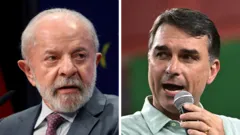
The 2026 presidential contest has narrowed into a two-horse race, with Luíz Inácio Lula da Silva and Flávio Bolsonaro standing apart from a crowded field. While 12 candidates are officially vying for the presidency, the vast majority are struggling to find significant electoral footing. According to BBC Brasil's poll tracker, the remaining 11 candidates are each polling at 4% or less, leaving the two front-runners in a league of their own.
Lula and Flávio Bolsonaro are both currently hovering around the 40% mark in opinion polls, with Lula maintaining a slight lead. This statistical gap suggests that a decisive victory in the first round on 4 October is unlikely. For a candidate to win outright without a second vote, they must secure more than 50% of the valid votes. Given the current polling data, a run-off election on 25 October appears highly probable. However, the race remains volatile; BBC Brasil's poll aggregator indicated that as of late September, 9% of voters were still undecided or intended to spoil their ballots, cast blank votes, or abstain entirely. This significant margin of uncertainty means that while a run-off is the expected path, an outright win cannot be dismissed before the first round concludes.
Voting eligibility and requirements
Brazil's electoral system is characterized by its massive scale and compulsory nature. Approximately 160 million Brazilians are eligible to participate in this election. The rules regarding participation are specific: while all citizens aged 16 and older are entitled to vote, the obligation is legally binding for literate citizens between the ages of 18 and 70. Those within this age bracket who fail to cast a ballot are subject to a fine.
The sheer volume of the electorate poses a challenge for predictive accuracy. Because opinion polls typically survey only a few thousand individuals, the final outcome can differ considerably from early survey indications. This discrepancy highlights the importance of the undecided block and the millions of voters whose preferences remain uncaptured by standard polling methodologies.
How does Jair Bolsonaro influence the election?
Although he is not on the ballot, the influence of Jair Bolsonaro remains a defining element of the political landscape. The 71-year-old former army captain, who governed Brazil from 2019 to 2023, is currently barred from standing for office and is serving a 27-year sentence for his role in plotting a coup following his 2022 loss to Lula. Due to recurring health problems, he is currently under house arrest rather than in a prison cell, and legal restrictions prohibit him from making public statements or posting on social media.
Despite these physical and legal limitations, his presence is felt throughout the campaign. His political shadow is often manifested through digital surrogates; notably, at the official launch of Flávio Bolsonaro's campaign, an AI-generated avatar of the elder Bolsonaro was used to endorse his son's candidacy. While Jair Bolsonaro's lawyers may have denied giving permission for the use of this deepfake when questioned by the Supreme Court, the move clearly signals the continuity of the Bolsonaro political movement. His influence ensures that the ideological battles of his administration remain at the forefront of the current contest.
What is Lula's political platform and record?
Luíz Inácio Lula da Silva, the 80-year-old leader of the Workers' Party, is seeking what many believed would be his final term. His political identity is deeply rooted in his previous two terms from 2003 to 2010, during which he earned widespread praise for his social welfare initiatives. His Bolsa Família cash-transfer programme is credited with lifting millions of Brazilians out of poverty, helping him leave office with approval ratings exceeding 80%.
However, Lula's legacy is complex and subject to intense debate. His career has been marked by significant legal battles, including an 18-month prison sentence between 2018 and 2019 following convictions for corruption and money laundering. While these convictions were annulled in 2021, allowing him to return to politics and win the 2022 election, the controversies continue to shape public perception. Even his environmental record is under scrutiny. While his government has overseen a reduction in Amazon deforestation—with satellite data showing the lowest levels in a decade during the first half of 2026—environmentalists have criticized his support for exploratory oil drilling near the mouth of the Amazon. Lula defends these actions as essential to generating the revenue required to fund Brazil's transition to clean energy.
On the global stage, Lula has asserted a policy of Brazilian autonomy. He has pushed back against the United States' "Donroe doctrine," asserting that "Brazil does not fit into anyone's backyard." This stance on sovereignty, combined with his warnings against "foreign and local enemies of democracy" interfering with the polls, positions him as a leader focused on protecting national interests against both domestic rivals and international pressures.
What are Flávio Bolsonaro's campaign promises?
Flávio Bolsonaro, 45, is attempting to bridge the gap between his father's populist fervor and a more institutional approach to governance. A senator since 2019 and a trained lawyer, he is running under the right-wing Liberal Party (PL). While he is perceived as less confrontational than his father, his platform is a clear continuation of the Bolsonaro legacy, focusing heavily on public security, deregulation, and traditional conservative values.
His campaign priorities are clearly defined across several sectors:
- Public Security and Law: Drawing on his experience in the Senate, he advocates for a tough-on-crime stance, including longer prison sentences and more relaxed gun laws to allow "decent citizens" to defend themselves.
- International Security Alliances: He has actively courted the Trump administration, promising to join the US-led "Shield of the Americas" anti-crime alliance if elected. He also successfully lobbied for the US to designate the Brazilian gangs Comando Vermelho (CV) and Primeiro Comando da Capital (PCC) as Foreign Terrorist Organizations, a move Lula opposed.
- Economic Deregulation: He has positioned himself as a champion of the agricultural industry, promising to cut unnecessary regulations and "get the state off farmers' backs."
- Climate Stance: While he has acknowledged the reality of "extreme climate events," he maintains a skeptical view of systemic climate change, characterizing these events as "cyclical" rather than part of a broader environmental crisis.
How is the Daniel Vorcaro scandal affecting voters?
In the critical weeks leading up to the election, the primary concern for many Brazilian voters has shifted from crime and security to corruption. This shift was triggered by the scandal involving Daniel Vorcaro, a jailed banker accused of orchestrating one of Brazil's largest financial fraud cases. The Vorcaro affair has become a political weapon used by both sides, creating a complex web of allegations that touch the highest levels of power.
The scandal has impacted the two leading candidates in different ways. For Flávio Bolsonaro, the controversy involves allegations of corruption and money laundering. Voice recordings emerged in which he was heard asking Vorcaro for 134 million reais ($25.9m) to bankroll a biopic about his father. This has led to an active police investigation into the senator's conduct.
Conversely, the scandal has also damaged Lula's campaign through alleged links between Vorcaro and Supreme Court Justice Alexandre de Moraes. A police report suggested Vorcaro had communicated with a phone number linked to Moraes, reportedly seeking help to avoid arrest. While Moraes has denied any wrongdoing, the association has allowed Flávio Bolsonaro to frame the election as a fight against a corrupt judiciary. By telling supporters that "voting for Lula means voting for Moraes," Flávio has successfully leveraged the right-wing's intense dislike of the judge to consolidate his base. Lula has attempted to distance himself from the judge by stating that "no one is above the law," but the political damage remains a central theme of the election.
Frequently asked questions
When is the next round of the Brazilian election?
If no candidate achieves more than 50% of the valid votes in the first round on 4 October, a run-off election will be held on 25 October. Current polling suggests a run-off is highly likely.
Is voting mandatory in Brazil?
Yes, voting is compulsory for literate citizens between the ages of 18 and 70. While 16-year-olds are entitled to vote, only those in the 18–70 bracket face fines for non-participation.
Why can't Jair Bolsonaro run for president?
Jair Bolsonaro is barred from holding office and is currently serving a 27-year sentence for his role in plotting a coup. He is currently under house arrest due to health issues.
What is the main issue for Brazilian voters in 2026?
While crime and security were previously the top concerns, the Daniel Vorcaro financial fraud scandal has pushed corruption to the top of the voters' priority list in the weeks preceding the election.
How does Lula view environmental protection?
Lula highlights the reduction in Amazon deforestation as proof of his success, but he faces criticism for supporting offshore oil drilling, which he argues is necessary to fund the transition to clean energy.
Key takeaways
- Lula and Flávio Bolsonaro are the only two candidates polling in double digits, both near 40%.
- A run-off election on 25 October is the most probable outcome if no one exceeds 50% on 4 October.
- Jair Bolsonaro continues to exert influence through his political legacy and digital surrogates despite being barred from office.
- The Daniel Vorcaro scandal has shifted the national conversation toward corruption and judicial integrity.
Synthesis of the political landscape
The 2026 Brazilian election represents a profound moment of political reckoning. The nation finds itself caught between two competing visions: the social-centric, state-driven legacy of the Workers' Party and the security-focused, deregulatory movement of the Bolsonaro family. This contest is not merely about policy, but about the perceived integrity of Brazil's institutions. With the shadow of a former president's legal battles looming and a massive corruption scandal involving both political figures and the judiciary, the electorate is tasked with deciding whether to continue the path of the incumbent or pivot toward the promises of the challenger. The outcome will ultimately hinge on how the significant block of undecided voters weighs the promise of economic stability against the urgent demands for judicial and political accountability.