
How is Australia preparing for potential conflict in the Indo-Pacific?
Australia is significantly increasing its military readiness through large-scale joint exercises and enhanced hardware deployment. Recent drills, such as the Southern Jackaroo program, involve the coordinated efforts of Australian, American, and Japanese armed forces to bolster regional defence cooperation. These exercises simulate high-intensity warfare, involving snipers, missiles, drones, and helicopters, to prepare for what military leaders describe as a potentially more likely era of conflict.
The scale of military preparation is reflected in the growing presence of US forces on Australian soil. In 2012, the annual six-month deployment of US Marines to Australia consisted of approximately 200 personnel; by 2026, this figure has escalated to roughly 2,500. This surge is a direct response to the strategic environment described in the 2026 National Defence Strategy, which identifies the intense competition between the United States and China as an enduring feature of the region. The strategy notes that China continues to undertake the largest military build-up in the world today, notably without the transparency or strategic reassurance the region expects.
The expansion of military infrastructure
Beyond troop numbers, the physical footprint of the alliance is expanding significantly. Key installations, such as the RAAF Tindal air base in the Northern Territory, have undergone upgrades to accommodate long-range American B-52 bombers, extending the reach of allied air power. Furthermore, the AUKUS partnership—a security agreement between Australia, the UK, and the US—aims to equip Australia with nuclear-powered submarines, representing one of the most significant shifts in the nation's long-term defence capabilities.
This infrastructure shift reflects a broader strategic commitment. While some middle powers, such as Canada, have seen leaders like Prime Minister Mark Carney discuss reorganizing priorities in response to an increasingly unreliable US, Australia appears to be moving in the opposite direction, intent on tying itself ever closer to its primary security ally.
Why is the relationship with the United States considered a security mainstay?
The United States remains Australia's primary security ally, providing a framework for military integration that distinguishes Australia from other middle powers. This alliance is reinforced by the sheer scale of cooperation, with US personnel increasingly integrated into Australian training and regional response capabilities. US Marine Kevin Hicks has even characterized the relationship by saying, "We like to call ourselves America's 911 response force."
However, this reliance is met with complex domestic sentiment. According to data from the Lowy Institute, public trust in the US is relatively low, with only 31% of Australians believing the United States acts responsibly on the global stage. This creates a notable disconnect between the Australian government's high level of trust in its ally and the skepticism held by a significant portion of the population. This lack of trust is mirrored in views of China, where only 28% of Australians trust Beijing to act responsibly.
What role does China play in Australia's economic landscape?
China serves as Australia's most critical economic partner, creating a 'frenemy' dynamic where security concerns clash with commercial necessity. Although diplomatic ties date back to 1972, China emerged as Australia's largest trading partner in the early 2010s, driven by a high demand for Australian commodities. This era of cooperation included a free trade agreement signed in 2015 and high-level diplomatic engagements, such as invitations for Chinese leadership to address the Australian parliament.
The relationship has faced severe disruptions since 2020, triggered by Australian calls for investigations into the origins of COVID-19. China responded with retaliatory tariffs and diplomatic pressure. Australia also made strategic shifts, such as the 2021 decision to cancel the state of Victoria's agreement with China's Belt and Road Initiative, only three years after signing it. The human cost of these tensions has also been felt, with Australians including journalist Cheng Lei being detained in China; Lei was released in 2023 after more than three years in detention.
Despite these tensions, economic pragmatism remains high. The Lowy Institute found that 61% of Australians view China more as an economic partner than a security threat, marking an 11-point increase from the previous year. This suggests that while political friction exists, the fundamental economic link remains a priority for the majority of the population.
Trade tensions and investment caution
Even with improved relations under the current Labor government of Anthony Albanese, trade volatility persists. For instance, in June of this year, China imposed 55% tariffs on beef to protect its domestic markets, despite the existence of a free trade agreement. This demonstrates that even established economic frameworks can be bypassed by political maneuvering.
While Australians prioritize the economic importance of China—with 51% stating the relationship is more vital than that with the US—there remains significant wariness regarding Chinese investment. Research suggests that Australians prefer investing with nations like European countries, where there is a higher perceived level of jurisdictional similarity and greater government trust. Charles Lyons-Jones of the Lowy Institute notes that the level of trust between governments plays a crucial role in determining investment patterns, a factor that currently favors European partners over China.
How do superpower rivalries impact Australian national security?
Australia is caught in the middle of a global power struggle that many analysts describe as a manifestation of the 'Thucydides Trap'—the theory that conflict becomes nearly inevitable when a rising power challenges an established one. This theory was recently invoked by Chinese President Xi Jinping during a meeting with Donald Trump. As China continues what is described as the world's largest military build-up, Australia's strategic environment becomes increasingly volatile.
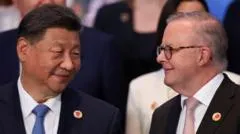
Former Prime Minister Kevin Rudd has highlighted that Australia is navigating 'radical changes' as China rises while the United States undergoes internal debates regarding its role as a global power. This shifting landscape forces Australia into a delicate balancing act. As Dr. Marina Yue Zhang of the University of Technology Sydney notes, the country cannot simply choose one side and abandon the other, as doing so would be contrary to its national interests. The goal is to maintain security through the US alliance while preserving economic stability through China, a task that is becoming increasingly difficult as the two superpowers compete for dominance.
FAQ: Australia navigating superpower rivalry
Is Australia preparing for a specific enemy?
Military leaders, including Brigadier Ben McLennan, remain vague regarding a specific adversary. Instead, they describe the training as preparation for 'total war' scenarios—rehearsing for the worst types of conflict, similar to World War I or World War II.
How has the US military presence in Australia changed?
The US military presence has grown substantially. In 2012, annual deployments included approximately 200 US Marines, whereas by 2026, these deployments have increased to roughly 2,500 personnel, reflecting a much tighter security integration.
Does Australia trust its major partners?
Public trust is low for both superpowers. According to the Lowy Institute, only 31% of Australians trust the US to act responsibly, while only 28% trust China to do the same, despite the government's strategic alignments.
Is the economic relationship with China improving?
While diplomatic tensions like tariffs and the Belt and Road Initiative cancellations have occurred, relations have seen some improvement under the Albanese government. Most Australians (61%) now view China primarily as an economic partner rather than a security threat.
What is the significance of the AUKUS pact?
AUKUS is a critical security partnership between Australia, the UK, and the US. Its most significant component is the plan to provide Australia with nuclear-powered submarines, marking a major shift in regional military capabilities.
Key takeaways
- Australia is increasing military readiness through joint exercises like Southern Jackaroo with the US and Japan.
- US Marine deployments in Australia have risen from 200 in 2012 to approximately 2,500 in 2026.
- China remains Australia's most important economic partner, despite recent trade tensions and tariffs.
- A majority of Australians (51%) believe the relationship with China is more important than the relationship with the US.
- The AUKUS pact is a central pillar of Australia's strategy to acquire nuclear-powered submarines.
Conclusion
Australia's strategic position is defined by a fundamental paradox: the need for US-led security to counter a rising China, alongside a deep economic reliance on that same rising power. As the nation strengthens its military ties through AUKUS and increased US troop presence, it must simultaneously navigate a volatile trade landscape marked by tariffs and geopolitical friction. Ultimately, Australia's survival in this era of superpower competition depends on its ability to maintain a sophisticated balancing act, ensuring national security without compromising the economic stability provided by its most significant trading partner.