
What triggered the recent anti-migrant violence in South Africa?
The immediate catalyst for the violence was a series of demonstrations that turned aggressive following allegations of an assault involving a foreign national in Durban. Protesters gathered outside a government refugee reception centre, demanding that authorities cease accepting asylum applications. This tension quickly transitioned from peaceful protest to civil unrest, characterized by property destruction and clashes between local residents and foreign nationals.
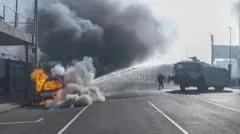
In Durban, located in the KwaZulu-Natal province, the situation necessitated police intervention, including the use of rubber bullets to disperse crowds. Local businesses in the city centre were forced to close their doors to protect themselves from the chaos. Senior local police officer Xolani Fihla informed the state broadcaster SABC that clashes occurred between foreign and South African nationals, though he noted at the time that no injuries had been officially reported.
The escalation in Soweto and Durban
The violence was not confined to a single location, as significant unrest was also documented in Soweto, a large township near Johannesburg. In the Orlando West neighbourhood, the focus of the anger was directed at 'spaza shops'—small convenience stores often operated by foreign nationals. Protesters in this area reportedly forced foreign traders out of their businesses, and in some instances, buildings were set on fire. Police reported that gunshots were heard during the confrontations in Soweto, highlighting the high level of volatility in the region. Acting national police commissioner Lt Gen Puleng Dimpane has since condemned the widespread destruction of property, and authorities have pledged to prosecute those responsible for the arson and looting.
How does the Constitutional Court ruling impact asylum seekers?
The unrest is deeply connected to a July ruling by South Africa's Constitutional Court, which fundamentally altered the legal landscape for asylum seekers. The court struck down previous restrictions that prevented individuals from seeking asylum based on how they entered the country or whether they had missed specific immigration deadlines. Under this new legal framework, asylum seekers must be permitted to submit applications even if they entered South Africa without the necessary documentation.
This judicial decision has caused significant friction between legal rights and public perception. While the court aims to uphold constitutional protections, anti-immigration campaigners view the ruling as a mechanism that will encourage undocumented migration. The resulting long queues at immigration centres have become a visible flashpoint for local frustration. The Department of Home Affairs admitted that its current staff and systems have been "overwhelmed" by the influx, noting that serious threats to public safety and order have emerged as a direct consequence of the current processing environment.
Clarifying the legal status of migrants
To mitigate the growing tension, government officials have attempted to clarify the implications of the court's decision. Government spokesman William Baloyi informed Reuters that there has been a deliberate spread of misinformation regarding the ruling. He emphasized that the judgment does not grant automatic refugee status or a permanent right to remain in South Africa. Instead, all applications remain subject to individual assessments and rigorous immigration checks. The government has stated it intends to change its compliance methods to align with the ruling while managing the practical pressures on the Department of Home Affairs.
What are the historical and socio-economic drivers of xenophobia?
South Africa has a long history of xenophobic violence, with the current unrest following a pattern of periodic outbreaks targeting migrants from neighbouring countries. One of the most significant instances occurred in 2008, when widespread attacks resulted in more than 60 deaths and the displacement of tens of thousands of people. These recurring cycles of violence are often fueled by deep-seated socio-economic grievances within the local population.
The country currently faces significant economic challenges, including widespread poverty and high levels of inequality. Unemployment remains a critical issue, affecting approximately one-third of the South African workforce. In this environment, migrants are frequently scapegoated for various systemic problems. Common accusations include the idea that foreigners take jobs away from citizens, contribute disproportionately to crime, or place unsustainable pressure on public services such as healthcare and housing.
The gap between perception and evidence
While the rhetoric against migrants is intense, researchers have noted a disconnect between public sentiment and factual reality. Although migrants are often blamed for economic instability, sweeping claims regarding their impact on crime and employment are frequently unsupported by empirical evidence. Despite these tensions, South Africa remains a primary destination for migrants across the continent who are seeking safety, employment, and better economic opportunities that are unavailable in their home countries.
How is the government responding to the unrest?
The South African government is attempting a dual approach of law enforcement and policy adjustment. In the immediate aftermath of the Soweto and Durban violence, police reinforcements were deployed to prevent further escalation and protect remaining foreign-owned businesses. The authorities have made public commitments to pursue criminal charges against those involved in the torching of vehicles and the looting of shops.
On a policy level, the Department of Home Affairs is looking for ways to implement the Constitutional Court's mandate without compromising public order. While the specific details of the new compliance strategy have not been fully disclosed, the government's stated goal is to abide by the court's ruling while addressing the capacity issues that have left staff overwhelmed. This delicate balancing act remains a central challenge for the administration as it seeks to manage both legal obligations and domestic stability.
FAQ: Anti-migrant violence in South Africa
What caused the recent violence in Durban and Soweto?
The violence was triggered by protests against the acceptance of asylum applications at refugee centres. This was fueled by anger over a Constitutional Court ruling. The demonstrations turned violent following allegations of an assault on a protester in Durban, leading to the burning of 24 vehicles and looting.
Does the court ruling grant automatic legal status to migrants?
No, the ruling does not grant automatic refugee status or permanent residency. According to government spokesman William Baloyi, the judgment simply ensures that asylum seekers can apply even if they entered without documentation. All applications are still subject to individual assessments and standard immigration checks by the authorities.
How many vehicles were destroyed during the unrest?
A total of 24 vehicles were confirmed to have been set on fire during the protests. Specifically, police reports indicated that 14 vehicles were torched in Durban and 10 vehicles were destroyed in the Soweto area during the confrontations.
What are the main economic factors driving this tension?
The tension is driven by high unemployment, which affects roughly one-third of the workforce, and widespread poverty. These economic pressures lead to the perception that migrants are competing for scarce resources, jobs, and public services, despite a lack of evidence supporting many of these claims.
Has South Africa experienced similar violence before?
Yes, South Africa has faced repeated outbreaks of xenophobic violence for nearly two decades. A major wave of attacks occurred in 2008, which caused tens of thousands of people to be displaced and resulted in more than 60 deaths across the country.
Key takeaways
- At least 24 vehicles were torched during recent anti-migrant protests in Durban and Soweto.
- A Constitutional Court ruling allows undocumented migrants to apply for asylum in South Africa.
- The Department of Home Affairs reported that staff are currently overwhelmed by application volumes.
- Xenophobic violence is often linked to high unemployment and systemic economic inequality.
- Authorities have pledged to prosecute those responsible for the recent property destruction.
Conclusion
The recent outbreaks of violence in Durban and Soweto underscore the volatile intersection of legal rights and socio-economic instability in South Africa. While the Constitutional Court has moved to protect the fundamental right to seek asylum, the practical implementation of this ruling has strained state resources and ignited public anger. As the government seeks to balance judicial compliance with the need to maintain public order, the underlying issues of unemployment and inequality continue to provide fertile ground for xenophobic sentiment. Addressing these systemic challenges remains essential to preventing future cycles of unrest.




