What delayed the Nikumaroro expedition?
Strong El Niño conditions produced rough seas and winds up to 27 knots around Nikumaroro. The team remained on the research vessel Marin Mainiku for three days before conditions cleared on Sunday. Access to the lagoon requires passage through a narrow reef gap created in 1963. High waves risked pushing the transport boat into the reef. The delay forced an extension of the overall expedition schedule.
Which organisations lead the current effort?
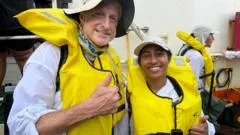
Purdue University and the Archaeological Legacy Institute direct the project. Their focus is the Taraia Object in the atoll lagoon. Sirisha Bandla, a technology specialist on the team, provided video updates from the vessel deck. ALI director Rick Pettigrew stated results will be shared once fieldwork concludes. The team arrived the previous week and completed an initial underwater survey before weather halted further work.
What is the Taraia Object and why does it matter?
Aerial imagery shows an object in shallow water that some interpret as possible aircraft wreckage. Purdue notes the feature appears in photographs dating to 1938. The object sits near the site where Earhart and navigator Fred Noonan aimed to refuel on Howland Island. Researchers plan to measure its depth and dredge surrounding sediment during the second phase. Sceptics suggest it could be a fallen tree rather than metal debris.
How does the Norwich City wreck relate to the theory?
The 1929 grounding of the SS Norwich City left a visible wreck on the island. New Zealand Air Force Museum released 1938 reconnaissance images showing this wreck. Proponents of the castaway theory link a 1937 shortwave radio report of a voice saying “New York City” to a possible mishearing of “Norwich City.” The university notes the wreck demonstrates the navigational hazards of the area.
What happened during Earhart’s 1937 flight?
Earhart had completed the California to South America, Africa and Asia legs in her Lockheed Electra. She reached Lae, Papua New Guinea on 2 July 1937. From there she and Noonan headed toward Howland Island for refuelling before the final Pacific crossing to California. The aircraft vanished without trace near the intended refuelling point. One hypothesis holds that she reached Nikumaroro instead and survived briefly as a castaway.
Have earlier searches produced confirmed evidence?
Previous expeditions found signs of human presence on Nikumaroro consistent with the 1930s period. A 2024 sonar survey near Howland Island identified an object at 4,877 metres that later proved to be a rock formation. A 2019 investigation of possible landing gear near the atoll also yielded no confirmed aircraft parts. The current team has not yet reported any new findings after the weather interruption.
FAQ: Amelia Earhart plane search
When did the weather delay end?
The storm pause ended on Sunday when winds dropped and seas calmed enough for landing. The team immediately prepared to begin the second phase of underwater work.
Where is Nikumaroro located?
Nikumaroro forms part of Kiribati in the central Pacific. It lies near the intended refuelling stop of Howland Island on Earhart’s 1937 route.
Who first spotted the Taraia Object?
Aerial photography reviewed by Purdue University researchers identified the object. Images from 1938 onward show the feature in the lagoon.
Has the team found any wreckage yet?
No confirmed aircraft parts have been reported. The expedition extended its duration to finish all planned survey phases after the weather delay.
Why do some researchers doubt the Taraia Object?
Sceptics point out that the feature could be a tree that fell into the lagoon. Earlier expeditions have repeatedly identified natural formations mistaken for wreckage.
Key takeaways
The search for Amelia Earhart’s plane on Nikumaroro resumed after a three-day weather delay caused by El Niño conditions.
Purdue University and the Archaeological Legacy Institute lead the expedition targeting the Taraia Object in the lagoon.
Earhart disappeared on 2 July 1937 while attempting to reach Howland Island during her round-the-world flight.
The 1929 wreck of the SS Norwich City remains visible and is cited in support of the castaway hypothesis.
Previous searches in 2019 and 2024 identified only natural formations, not confirmed aircraft debris.
The team has extended its schedule and will release findings once all fieldwork is complete.
Conclusion
The resumed Nikumaroro expedition continues a long-running effort to locate physical evidence of Earhart’s 1937 disappearance. Limited time on site after the weather interruption means results remain pending. The project follows established lines of inquiry based on 1930s imagery and radio reports. Any confirmed findings would add concrete detail to a case that has relied largely on circumstantial evidence for nearly nine decades.